Charles Dickens Is Still Everywhere in England, From His Birthplace to His Grave
Few writers are as tied to England as Charles Dickens. Born in Portsmouth in 1812 and buried in Westminster Abbey in 1870, the author spent the years in between walking, writing about, and holidaying in places that can still be visited today. I followed his trail through his surviving London home in Bloomsbury and the Portsmouth house where he was born as well as the Isle of Wight village where he worked on David Copperfield. Here's where you too can walk in the footsteps of Victorian England's greatest novelist.
Portsmouth, Hampshire

My Dickens adventure began at 393 Old Commercial Road, a modest, terraced house in Portsmouth, 70 miles (113 km) southwest of London. It was here on February 7, 1812, that the great writer was born and lived as a toddler. His father worked as a clerk in the Navy Pay Office at the nearby naval dockyard, and the family lived in the city for several years before moving to London.
Now the Charles Dickens' Birthplace Museum, the carefully restored home is furnished in the Regency style his parents would have favored. There are three rooms to explore, including the parlour, the dining room, and the bedroom where he was born. Alongside personal artifacts and a display on Dickens and Portsmouth, you can also see the couch on which he died in Kent in 1870.
The city honors its most famous son in other ways, too. Look for the statue of the author in Guildhall Square. The first full-size Dickens statue in Britain, it was in fact erected despite the author's wish that no monument be raised in his memory.
Ventnor and Bonchurch, Isle of Wight

From Portsmouth it's a pleasant 45-minute ferry ride across the Solent to the Isle of Wight, one of Dickens' preferred holiday spots. He first visited in 1838, spending a week at what is now The Royal Hotel in the resort town of Ventnor on the island's southern coast. He later described the area as "the prettiest place I ever saw in my life, either at home or abroad."
He liked it so much, in fact, that he returned for three months in the summer of 1849. This time around, he made Winterbourne, a house in the neighboring village of Bonchurch, his home-away-from-home while he worked on what was to become David Copperfield.

It was while staying at The Royal myself that I learned of the newly launched Charles Dickens Trail. The trail stretches just over six miles (10 km) from Shanklin over the downs into Ventnor and Bonchurch, with quotes from Dickens' letters accessible along the route via QR codes. A highlight for me was visiting Old St Boniface Church. Now close to 1,000 years old, it's a pretty place that Dickens himself is known to have visited.
The Royal Hotel celebrates its connection with the author through a unique literary experience: an immersive Dickens House Party. These fun weekends feature readings, performances, and anecdotes from the author's life, and are hosted by his descendants, including great-great-grandson Gerald Dickens and Ian Dickens. Planning is underway for 2026's Dickens Christmas House Party themed, of course, around A Christmas Carol. Visit the hotel's website for details.
Charles Dickens Museum, Bloomsbury, London

My interest in all things Dickens, spurred on by my having visited his birthplace and his preferred seaside getaway, I knew I had to visit his home in London. His Georgian terraced house at 48 Doughty Street in Bloomsbury is, in fact, the only surviving London residence where Dickens lived, and even if you can't see anything else connected to the great author, this is a must.
Moving here with his wife Catherine in 1837, it was here he completed such novels as The Pickwick Papers, Oliver Twist, and Nicholas Nickleby. His two eldest daughters were also born in the house, and it was here, too, that his sister-in-law, Mary Hogarth, died aged just 17.

Now the Charles Dickens Museum, the property houses more than 100,000 items including original manuscripts, first editions, personal letters, and the only known surviving item of his clothing, the Court Suit and sword he wore in 1870. The rooms have been restored to their 1830s appearance, including the study where he wrote by candlelight.
Perhaps the museum's most sobering exhibit, however, is the iron grille rescued from the Marshalsea debtors' prison in Southwark. A memento of the darkest chapter of Dickens' childhood, the prison was where his father was locked up in 1824 for owing £40 and 10 shillings (roughly £5,000 today). Just 12-years-old, Charles was pulled out of school and sent to paste labels onto bottles of boot polish for six shillings a week, a humiliation he kept secret from all but his closest confidants.
The George Inn, Southwark, London

A two-minute walk from where the old Marshalsea prison wall still stands in Southwark, The George Inn on Borough High Street is London's last surviving galleried coaching inn. Rebuilt in 1677 after a fire swept through Southwark, its timber-balconied, courtyard style appears throughout Dickens' fiction and is mentioned by name in Little Dorrit.
Now owned by the National Trust and run as a proper pub, it's an atmospheric place to raise a glass to Dickens. Before railways transformed travel in the 1840s and 1850s, inns like this functioned as transport hubs, hotels, and meeting places. Enjoying a pint in the cobbled courtyard certainly gives an idea of the world his characters inhabited.
Westminster Abbey, Westminster, London

Although Dickens asked to be buried quietly at Rochester Cathedral close to his final home in Kent, public demand dictated he instead be laid to rest in Poets' Corner at Westminster Abbey after he died on June 9, 1870. While the funeral itself was private, as he instructed, his grave became one of the most visited spots in the Abbey and remains so today.
You can see his plain stone slab alongside memorials to other giants of British literature, including Chaucer, Shakespeare, Thomas Hardy, and Rudyard Kipling. There's a certain irony in a writer who railed against pomp ending up in one of the country's most celebrated churches, but it's a measure of how deeply he had embedded himself in the national consciousness as "a sympathiser with the poor, the suffering, and the oppressed."
Admission to the Abbey is ticketed, and Poets' Corner is included in the general visit. You'll spot his grave easily as fresh flowers are regularly left there by admirers.
Saffron Hill, Clerkenwell, London

Picturing Saffron Hill as Dickens knew it takes some imagination, but it's worth seeing. A narrow street between Holborn and Clerkenwell and just a short distance from Dickens' home, it's here he placed Fagin's den of thieves in Oliver Twist. Once one of London's worst slums (it was known locally as "Little Hell"), it's down these lanes that the Artful Dodger leads Oliver to Fagin's crumbling lodgings near Field Lane.
The slums were cleared in the 1860s when the Holborn Viaduct was built, but the street survives. So, too, do evocative place names like Herbal Hill and Bleeding Heart Yard, the latter a setting in Little Dorrit.
The One Tun pub on Saffron Hill is a survivor from these times, however. Established in the 18th century, it's thought to be the model for the Three Cripples tavern in Oliver Twist and counted Dickens among its patrons between 1833 and 1838. The nearby Betsey Trotwood pub on Farringdon Road, named after David Copperfield's formidable aunt, adds another literary watering hole to the neighborhood.
St. Paul's Cathedral, City of London

The unmissable dome of St. Paul's Cathedral appears throughout Dickens' fiction, sometimes as a setting, though more often as a presence looming over the city. It features in David Copperfield, Bleak House, Little Dorrit, and Our Mutual Friend, and in Dombey and Son, Dickens describes it as a great black dome watching over London's commerce and all the sorrow in its streets.
St. Paul's Cathedral is the still beating heart of the Square Mile where so much of Dickens' stories played out. The churchyard and surrounding streets turn up in multiple novels, and the cathedral steps are a good place from which to get your bearings. From here, it's a short walk south to the River Thames, east into the old mercantile City of London, or west toward Fleet Street, where Dickens worked as a young journalist.
Admission to the cathedral is ticketed, but the churchyard and gardens are free to explore. For an unforgettable sense of just how sprawling the area is, pay a little extra to climb to the top of its famous dome. While the 528 steps leading to the Golden Gallery at its peak can be tough going, believe me, it's worth it to get a better sense of Dickens' London.
Rochester, Kent

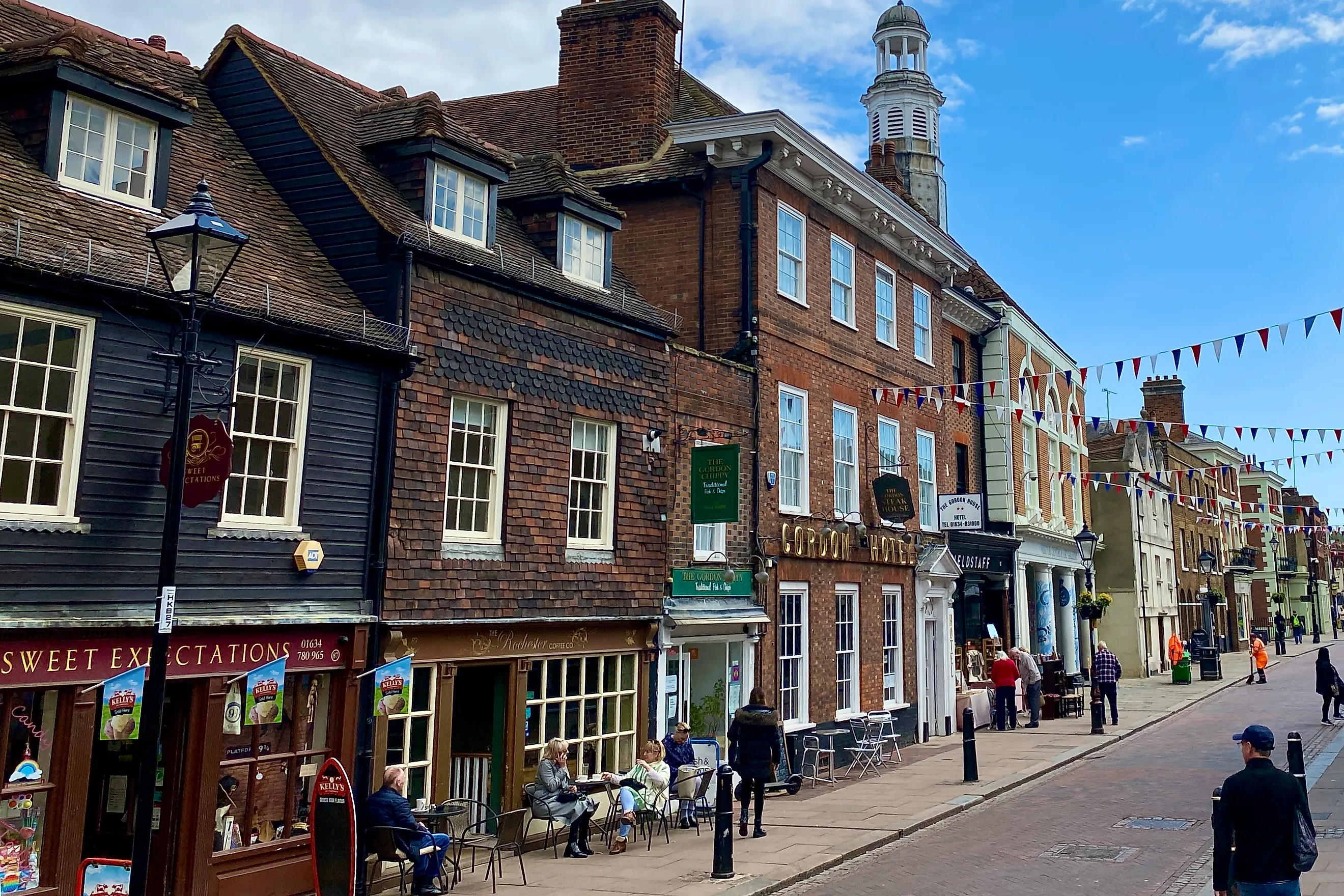
No place outside London is more closely tied to Dickens than Rochester. This cathedral city on the River Medway 30 miles (48 km) southeast of the capital is a city I once knew as well as Dickens, as I went to King's School Rochester. Dickens' presence was known to me, but the man certainly didn't interest or inspire my teenage self the way he does now.
I learned Dickens spent his most impressionable childhood years in the neighboring naval town of Chatham, returning to live at nearby Gad's Hill Place for the last 14 years of his life. Rochester appeared in The Pickwick Papers, Great Expectations, and his unfinished final novel, The Mystery of Edwin Drood, each describing scenes I recognize, as you will, too, if you visit.

Wandering the city's medieval High Street, watched over by Rochester Castle and Rochester Cathedral, you get a sense that not much has changed. Landmarks include the Royal Victoria and Bull Hotel, which appears in The Pickwick Papers and as the Blue Boar in Great Expectations. Restoration House, an Elizabethan mansion on Crow Lane, served as the model for Satis House, the decaying home of Miss Havisham. (Interestingly, there's a real Satis House, too, at my old school.)
Eastgate House on High Street appears as the Nun's House in Edwin Drood, and in its garden stands the Swiss Chalet in which Dickens wrote at Gad's Hill. Relocated here as a memorial, he spent his final day of writing inside it in June 1870. Include the Guildhall Museum in your itinerary as it covers local history and includes Dickens displays, while Six Poor Travellers House, an almshouse dating from 1579, featured in his Christmas story, The Seven Poor Travellers.

Rochester Cathedral, founded in 604 and England's second oldest, deserves a visit, as does Rochester Castle with its tall Norman keep. Rochester's an easy day trip from the capital, with trains from St. Pancras International whisking you there in under 40 minutes. Once there, it's only a few minutes' walk to one of Dickens' most overlooked stomping grounds.
Broadstairs, Kent

Dickens called Broadstairs "our English watering place" in an 1851 essay of the same name, and this seaside town on the Kent coast 80 miles (129 km) from London was his favorite holiday spot for more than two decades. He first visited in 1837, aged 25, lodging at 12 High Street while working on The Pickwick Papers, and he returned often.
He finished Nicholas Nickleby in a house that's now part of the Royal Albion Hotel, and wrote much of David Copperfield at Fort House, the clifftop home overlooking Viking Bay that's now known as Bleak House. Though privately owned and not open as a museum, the home's silhouette above the bay remains the town's most recognizable Dickens landmark.

The Dickens House Museum on Victoria Parade is worth a visit. Set in the old cottage that inspired the home of Betsey Trotwood in David Copperfield, its real-life resident, Mary Pearson Strong, regularly served tea to Dickens and his son.
If you visit in June, grab some tickets for the Broadstairs Dickens Festival. Kicking off in 1937 to celebrate the 100th anniversary of Dickens' first visit, highlights include a costumed grand parade, a Victorian fair, book readings, and a festival play at the Sarah Thorne Theatre.
Following the Trail Today
What struck me most, revisiting these places, was how present Dickens still feels in each of them. The house parties, festivals, and preserved rooms are not relics kept under glass but living connections that the towns themselves keep tending. I came home understanding his novels differently, having finally stood where he wrote them.