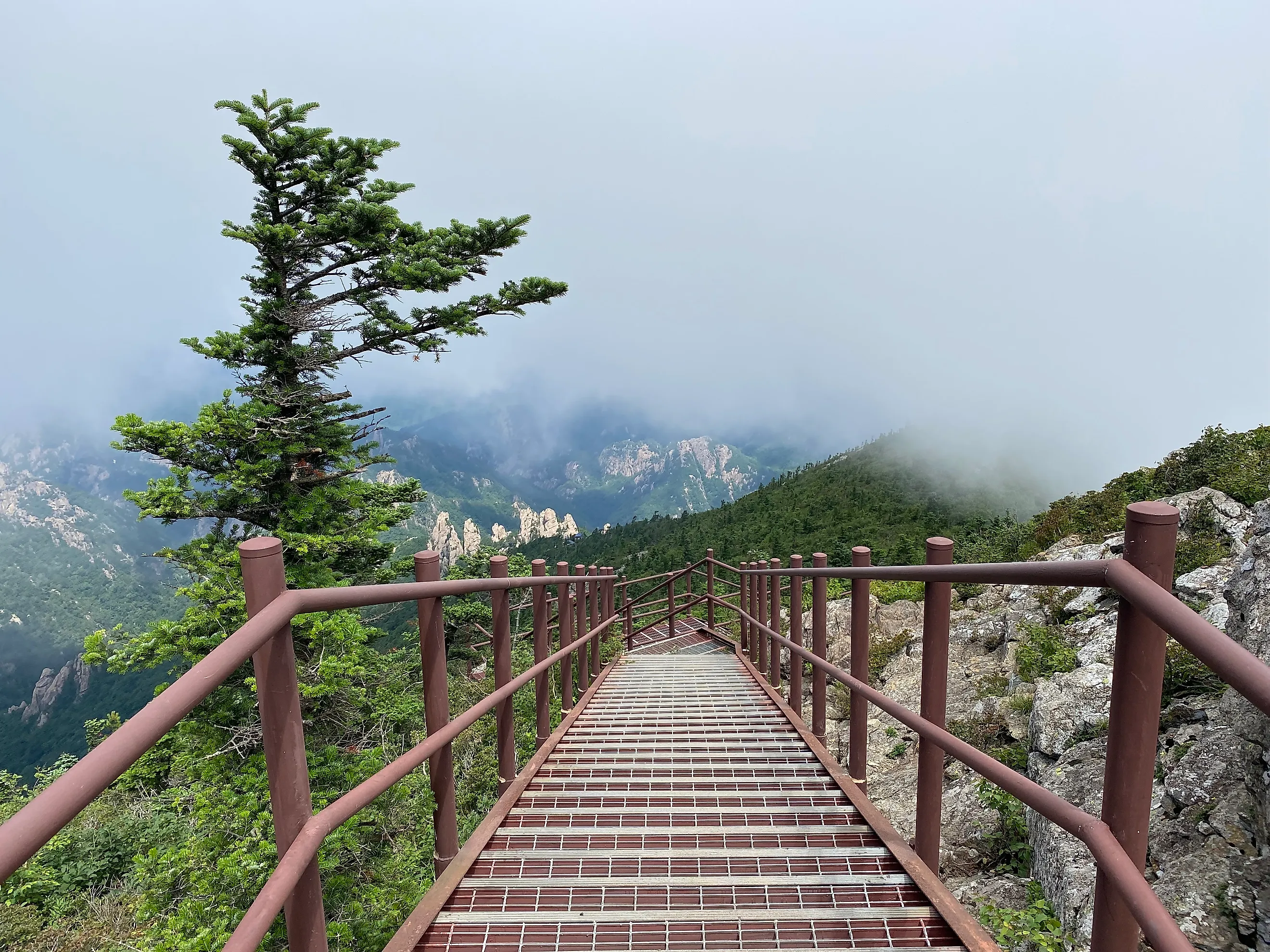
In Seoraksan National Park Staircases Pierce The Clouds
South Korea's Seoraksan National Park utilizes forest trails, rocky steps, and steep steel staircases to climb to the cloud-piercing peaks of the Taebaek Mountains. Lower down, this United Nations Educational, Scientific and Cultural Organization (UNESCO) Biosphere Reserve harbors hikes to granite spire lookouts, Buddhist temples, and ribbon waterfalls.
When I arrived in the northeast corner of South Korea — not much further from the North Korean border than the spritely beach town of Sokcho — I knew I needed multiple days of exploration within Seoraksan.
On day one, I tackled the 5,604-foot Daecheongbong Peak, packing light and bypassing multiple overnight shelters in order to swiftly cover the 14-mile round-trip.
Day two was more of a sweeping affair involving a grunt up a prominent but approachable peak on the opposite side of the valley, paying reverence to Buddhist temples, and a soothing (save for the final staircase) waterfall trail in yet another section of this diverse national park.
Seoraksan National Park filled me with equal parts muscle soreness and whimsy, and for that, now sits on my list of global happy places.
Climbing Into The Clouds

Daecheongbong Peak is the apex of 30 peaks upon Seoraksan Mountain, speaking to the expressive nature of this granite landscape. Counter to the worn, rounded peaks of the Rockies, this East Sea range is sheer and pointy.
I knew I wanted to tackle Korea's third-highest mountain while I was fresh, so I left the touristic beach town of Sokcho, and spent a day casually exploring the promenade, and dining well on what has proven to be one of my favorite ethnic cuisines (Japanese and Greek round out the podium).
The next morning I was up at dawn, ready to catch the bus up to the national park. Thirty stops and about 45 minutes later, I stepped out at the Kensington Hotel Seorak, and walked into the Seorakdong Entrance.
An Asiatic black bear statue and a Daecheongbong Peak trail sign citing 10.9 km (one-way, or about 14 miles, round-trip) welcomed me into this pristine wilderness, but also reminded me of the realities of hiking alone in this part of Korea.
I was confident that my trail running background and experience with bears in the Canadian Rockies would serve me well, but anything can happen in the mountains, and there are additional variables to contend with in foreign countries.
A few strides in, I got distracted by a 48-foot, 108-ton bronze Buddha statue and its surrounding Sinheungsa Temple complex — one of several shrines throughout Seoraksan National Park. As a practicing Buddhist and avid mountain climber, to me, Seoraksan looked like heaven.

Knowing I had to make some miles while the weather was good, I mentally bookmarked temple time for later that afternoon and the following day. The route up Seoraksan Mountain alternates between forest trails, riverside rock hops, natural staircases, bridges & boardwalks, and caged catwalks that are meant to protect against falling rocks, but had me half-glancing around for swooping pterodactyls.
The first reservable mountain shelter popped up about halfway, giving me a bit of social reassurance in between bouts of lone-wolfing.
The second shelter was well up the ridge, prior to the final series of steel staircases that would claim the summit. I could definitely see myself staying at Huiungak Shelter in the future, sprinting back and forth between summits, but this go-round, I merely refilled, refueled, and visited with a particularly assertive chipmunk.

Clouds began rolling in and out as I climbed ever-closer to the summit of Daecheongbong Peak, meaning I was shrouded in that ancient eastern mist one moment, and whooping at infinite panoramas the next.
Exhilarated, I ripped off my shirt to let the cool mountain air engulf my middle-aged body. Gaining energy with each step, I pranced up to the stone summit marker. There, the kindness of South Koreans showed itself all the same as the cities below.
A pair of fellow hikers, who arrived via an alternate route, insisted on sharing their lunch with me. Having only a few protein bars packed in my running belt, I gladly accepted their hard-boiled eggs.
I'm always struck by inner turmoil atop significant summits. On the one hand, I worked for hours to get up there, but on the other, I'm acutely aware of the ever-changing weather conditions and necessary backtrack.
If anything, it's harder to climb down steps and uneven rocks than it is to climb up them, especially on fatigued quads. So with that in mind, I bade Daecheongbong Peak adieu and hustled back down, eagerly anticipating the feast that awaited me in the park's developed entrance area.
Nothing caps off a day in the mountains quite like a Korean lunch spread, Pocari Sweat (i.e. the best freaking electrolyte drink ever created), and a beer.
Spires, Temples, & Waterfalls
My second day in the park saw me once again hailing the first bus out of Sokcho (The House Hostel provided an ideal base camp). Unlike Daecheongbong Peak's singular push, the theme of this day was seeing as many additional highlights of Seoraksan National Park as I could muster.

First up was Ulsanbawi Rock. At 2,864 feet, it is barely half the height of Daecheongbong Peak, and with a round-trip total of about 4.7 miles, the hike is less than a third the distance, yet Ulsanbawi Rock is a view-rivalling leg-zapper.
The hike up was so dynamic, from heart rate-spiking stairs to a calming cave temple—the latter of which I stopped to meditate in on the way down. The blue sky shined brightly as I stared at the stegosaurus-like granite spine starkly contrasted by its surrounding green slopes.
Sinheungsa Temple

Back at base, I stopped into multiple shrines of the Sinheungsa Temple for further observations into South Korea's brand of Buddhism, and to make a donation to a new addition.
I purchased a single roof shingle, which I stacked next to hundreds of other inscribed ones. It was a neat fundraising concept that made me feel directly involved in the construction process. The temple also had fresh robes that could be purchased as a gift for resident monks.
Waterfalls

My third hike of this Seoraksan series made for the perfect palette cleanser after multiple summit pushes. The trail for Biryong Falls is about three miles round trip, and gains only a few hundred feet in elevation. Following a relaxed and relatively easy forest stroll, Yukdampokpo Falls came into view beneath an impressive canyon bridge.
Minutes beyond this postcard, nay screensaver, nay TikTok spot (landscape references are becoming less romantic it seems), Biryong Falls feeds into an alpine pond like a kitchen faucet. Most hikers hang out on the adjacent viewing platform for a while and then head back, while others make for Towangseong Falls Observatory another quarter-mile on. This may not sound like much, but it involves climbing 900 steep metal steps. I must admit that I underestimated the add-on.
Towangseong Falls had unfortunately dried up for the summer, but I still appreciated one last high-angle look at Seoraksan National Park's extreme topography.
At Home In The Mountains

In the northeast corner of South Korea, a full-day's worth of flights from my home, I found familiarity in the clouds. Inclined to running up mountains and meditative moments in nature, Seoraksan National Park allowed me to indulge both ends of my spiritual spectrum.
The all-day grind up Daecheongbong Peak burned off my excess energy, which made reflecting at the park's temples and waterfalls a natural counterbalance the following day. Whether you replicate my itinerary or find your own path throughout this 154-square-mile park, I'm sure that Seoraksan will leave a lasting impression.