National Parks And Monuments You’ve Seen In The Movies
We've likely all experienced that moment while watching a movie when a familiar landscape or building pops onto the screen. It's especially gratifying if you've actually been there. Rather than it detracting from what's going on in the movie, it adds a whole other dimension of appreciation for it, not to mention the bragging rights.
For a surprising number of classic movies, the spots people recognize are situated in America's national parks. Tatooine from Star Wars is Death Valley, the mothership in Close Encounters of the Third Kind landed at Devils Tower, and the road to the Overlook Hotel from The Shining is in Glacier.
The National Park Service (NPS) looks after 63 national parks and more than 370 other monuments, memorials, seashores, and recreation areas, and Hollywood has borrowed several to shoot some of its best-known films.
Here's what you need to know about these on-location shoots, what the film crews got away with, and what's there to see nowadays.
Dances with Wolves (1990), Badlands National Park, South Dakota

Kevin Costner's directing debut was shot in South Dakota between June and November 1989, and the long wagon ride that takes his character, Lieutenant John Dunbar, from Fort Hays to his abandoned frontier post at Fort Sedgwick was filmed in the Sage Creek Wilderness Area of Badlands National Park.
Much of the rest of the production was also shot close by. The buffalo hunt was staged on the Triple U Buffalo Ranch southwest of Fort Pierre, a 46,000-acre spread that had 3,500 head of bison when Ted Turner's company bought it in 2015 and renamed it Standing Butte Ranch.
The Lakota winter camp seen at the end of the film was built in Spearfish Canyon in the Black Hills, a few miles upstream of Spearfish Canyon Lodge.
The Fort Hays set is now located five miles south of Rapid City and is used as a backdrop for the Fort Hays Chuckwagon Supper. You can even see props and costumes from the shoot on display at 1880 Town, the frontier attraction at Exit 170 off Interstate 90.
The easiest way to see the country Costner used is via the Badlands Loop State Scenic Byway, a 39-mile stretch of Highway 240 between Cactus Flat and Wall. Pinnacles Overlook, the westernmost of its 12 signed view spots, is where Sage Creek Rim Road branches off.
Follow the gravel road, and you'll pass Roberts Prairie Dog Town and the Sage Creek Basin Overlook, where bison are often seen grazing.
Star Wars (1977) and Return of the Jedi (1983), Death Valley National Park, California

Luke Skywalker's home planet of Tatooine was filmed in Tunisia and California, but it's Cali's Death Valley National Park footage that gave the first film its best-known desert shots: R2-D2 and C-3PO argue and part ways on the Mesquite Flat Sand Dunes near Stovepipe Wells, R2-D2 rolls alone into Golden Canyon and is captured by the Jawas below Artists Palette, wand the Tusken Raiders rush to their banthas at the mouth of Desolation Canyon.

Remember that famous view of the Mos Eisley spaceport that Obi-Wan Kenobi shows Luke? That's Dantes View, a ridge that's 5,475 feet up in the Black Mountains (the spaceport was painted in afterward).
Oh, and those small, hooded Jawas? They were really school kids from Death Valley.
George Lucas and his film crews returned for Return of the Jedi. The road the two droids take to Jabba the Hutt's palace is Twenty Mule Team Canyon, a one-way dirt road through yellow badlands just east of Zabriskie Point.
Death Valley Park makes a point of saying that most of what was used in the Star Wars films wouldn't be allowed today, with 93 percent of its 3.4 million acres now designated wilderness, where commercial filming is prohibited.
The locations can still be visited, though, and all six are within a 45-minute drive of the Furnace Creek Visitor Center and the adjacent hotels, The Inn at Death Valley and The Ranch at Death Valley.
The free NPS App has a self-guided driving audio tour of the locations, and a printed Star Wars map is available at the visitor center. A word of caution: summer temperatures in the valley regularly pass 120°F, so a visit to Star Wars' Death Valley film locations is best done in the fall, winter, or spring months.
Close Encounters of the Third Kind (1977), Devils Tower National Monument, Wyoming

Steven Spielberg's Close Encounters of the Third Kind made Wyoming's Devils Tower a star of the big screen. Although it was chosen as the spot where humans and aliens would meet at the end of the movie, the National Park Service wouldn't permit the main shoot inside the monument.
Spielberg instead struck a deal with Jesse Thomas Driskill, a local rancher whose irrigated hay meadows were located at the monument entrance.
It was certainly an inspired move. The meadows were graveled over to make a helicopter pad and the base for the landing-site set, and the crew could only film for a few hours each evening to catch the dusk light.
The Driskill family put the $20,000 they were paid into building a campground that opened in 1977 as the Devils Tower KOA. It still shows the film on an outdoor screen every night the campground is open and is planning a 50th anniversary celebration of the film for 2027.
The tower itself was proclaimed the country's first national monument in 1906 by President Theodore Roosevelt, and gets nearly half a million visitors a year. The tower stands 867 feet tall from its base to its summit, and more than 20 Native American tribes consider it sacred.
The Tower Trail, a paved 1.3-mile loop around the base, is the walk most visitors take. The tower is also a popular climbing destination, with between 4,000 and 5,000 climbs recorded each year. The entrance road passes a prairie dog town, and the visitor center is a log building put up by the Civilian Conservation Corps in 1936.
The Shining (1980), Glacier National Park, Montana

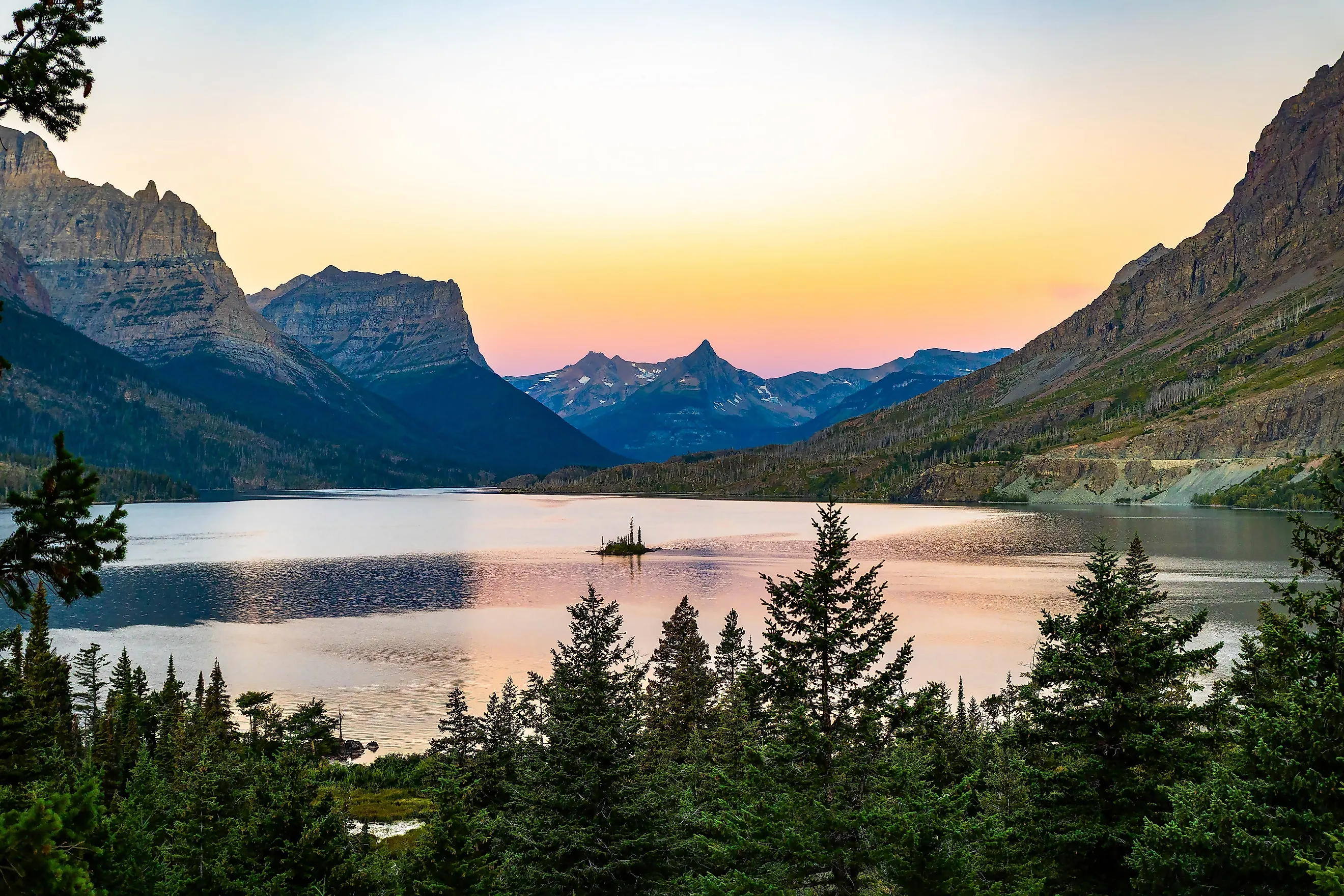
If you didn't get a chill down the spine during the opening scene of Stanley Kubrick's The Shining, you likely weren't paying attention. Based on the horror novel by Stephen King, the film starts with a helicopter shot following a yellow Volkswagen Beetle along a mountain road beside a long blue lake with a small island in it.
The route the car's taking is Going-to-the-Sun Road in Glacier National Park, the lake is St. Mary Lake, and the island is Wild Goose Island, all of them in Montana and pretending to be in Colorado.
That scene and its eerie music score set the mood for the arrival of Jack Torrance, played by Jack Nicholson, at the fictional Overlook Hotel. The hotel's exterior was actually Timberline Lodge on Mount Hood in Oregon, and the interiors were film sets built in England.
Going-to-the-Sun Road stretches 50 miles from West Glacier to St. Mary and crosses the Continental Divide at Logan Pass, 6,646 feet above sea level.
The final section over the pass was completed in 1932 after 11 years of construction. The Kubrick shots are all on the eastern side, between the St. Mary entrance and the Wild Goose Island Overlook on the north shore. A good way to see it all is aboard a Red Bus Tour, run by Glacier National Park Lodges in vintage roll-top buses dating from the 1930s.
Indiana Jones and the Last Crusade (1989), Arches National Park, Utah

The third Indiana Jones film opens in 1912 with a teenage Indy, played by River Phoenix, riding with his Boy Scout friends through red rock country. Slipping away from the group, the young Indy sees treasure hunters digging up a relic called the Cross of Coronado in a cave. While that cave was a set, everything around it is the real deal and part of Arches National Park.
The arch the scouts dismount beneath is Double Arch, a pair of openings that share a single foundation in the park's Windows Section. At 112 feet, it's the tallest arch in the park, and its 144-foot span is the second longest. The arch can be reached from the Windows Road parking area on a 0.8-mile round-trip walk. The three arches of the Windows loop are easier still, a 0.6-mile walk from the same lot.
Utah's Arches National Park has more than 2,000 arches, and all it costs is a $30 vehicle pass to get in. It's also handy to Moab, which has been a working film town since John Ford shot Wagon Master there in 1949. You can learn more about this and other classic films like Thelma & Louise at the Moab Museum of Film and Western Heritage.
Forrest Gump (1994), Glacier National Park, Montana, and the National Mall, Washington, D.C.

Two National Park Service sites appear in Robert Zemeckis's Forrest Gump, and they could hardly be more different. When Forrest describes to Jenny the lake that was so clear it looked like there were two skies, one on top of the other, the shot behind him is St. Mary Lake in Glacier National Park.
And that road he runs along? That, like the opening of The Shining, is Going-to-the-Sun Road near the park's St. Mary entrance.
The wheat fields Gump passes a few seconds earlier are near Cut Bank, east of the park. The famous moment where he finally stops running was filmed on US 163 in Utah, north of Monument Valley, a Navajo Nation tribal park on the Arizona-Utah state line, and the spot on US 163 where he turns around is now known as Forrest Gump Point.

The other site is the National Mall in Washington, D.C., where Forrest is pushed onto the stage at an anti-war rally in front of the Lincoln Memorial and then wades into the Reflecting Pool to meet Jenny. Zemeckis was given permission to film in the pool itself, a first for the site, and the crowd of 1,500 extras was digitally repeated around the pool to look like a far larger demonstration.
The Scenery Gets Top Billing
Tune in to any one of these classic Hollywood movies on your favorite streaming service (I mean, who watches DVDs these days...), and you'll be transported to film locations you can still visit.
The best of them are to be found in the country's national parks. Whether it's Death Valley's dunes, the striking columns of Devils Tower, or the Double Arch in Arches National Park, these locales look much as they did when the film crews and actors packed up and went home.