Port Townsend Was Built For A Railroad That Never Came
Port Townsend had six banks, 28 real estate offices, three streetcar lines, and a new city hall under construction by the end of 1890, all of it built for a transcontinental railroad that was supposed to arrive from Portland. The track got 20 miles south of town, met a mountain, and just stopped.
The Union Pacific subsidiary paying for the other end went bankrupt that same year, and within a decade, a quarter of Port Townsend's population had moved away. What stayed behind was a complete Victorian-era downtown on Puget Sound that nobody had the money to tear down. Here's how a railroad that never came gave the state of Washington its best-preserved 19th-century seaport.
The Railroad That Never Came
It all started with James G. Swan, a Massachusetts-born lawyer and ethnographer who moved to Port Townsend in 1859. Swan spent the next 30 years trying to connect Port Townsend to the rest of the country by rail, and from 1867 to 1871 worked as an agent for the Northern Pacific Railroad. His job? He was hired to recommend a western terminus for a line heading north from Portland into the Puget Sound area. Naturally, he recommended Port Townsend, but in 1873, the company picked Tacoma instead.
The town grew anyway, from 917 people in 1880 to 4,558 by3 1890. But Seattle, Tacoma, and Spokane grew many times faster. Then, in September 1887, a group of local businessmen incorporated the Port Townsend & Southern Railroad, with a plan to lay track south to Hood Canal and on to Olympia in the hope that one of the big railroads would buy the finished line. Construction began in early 1889, but the money ran out after just a single mile of track.
Fortune seemed to smile on Port Townsend again later that same year. The good news this time was an offer from Union Pacific to establish Port Townsend as the northernmost station along its transcontinental railroad. There were conditions, though: that it could take over the Port Townsend & Southern's franchise, and that the city would put up $100,000. The town agreed, and a groundbreaking ceremony was held two miles west of downtown on October 2, 1889.
Boom, Boom, Bust
Word of the new railroad soon spread, and real estate sales soared. In 1890 alone, real estate transactions reached $4.6 million, an astounding figure for a city of 4,500 people. The construction contract was signed on April 1, 1890, and by June, 2,000 men were building a depot, roundhouse, and rail yard on fill at Kah Tai Lagoon. By September, trains were running daily to Leland Lake, 20 miles to the south.
Then, as quickly as it started, it all fell apart. The Oregon Improvement Company, the Union Pacific subsidiary responsible for the Portland end, had blown its money on land speculation instead of track, and went into receivership in November 1890. At the Port Townsend end, the line reached Quilcene, a village on Hood Canal, and ran into Mount Walker, which there was no practical way around.
The Panic of 1893, a national depression triggered in part by railroad overbuilding, finished the job. Idle ships were left at anchor in the bay, the streetcar lines were torn up, and between 1890 and 1900, a quarter of the population left town. The stub line to Quilcene kept running at a loss until the 1980s.
What the Boom Is Left Standing

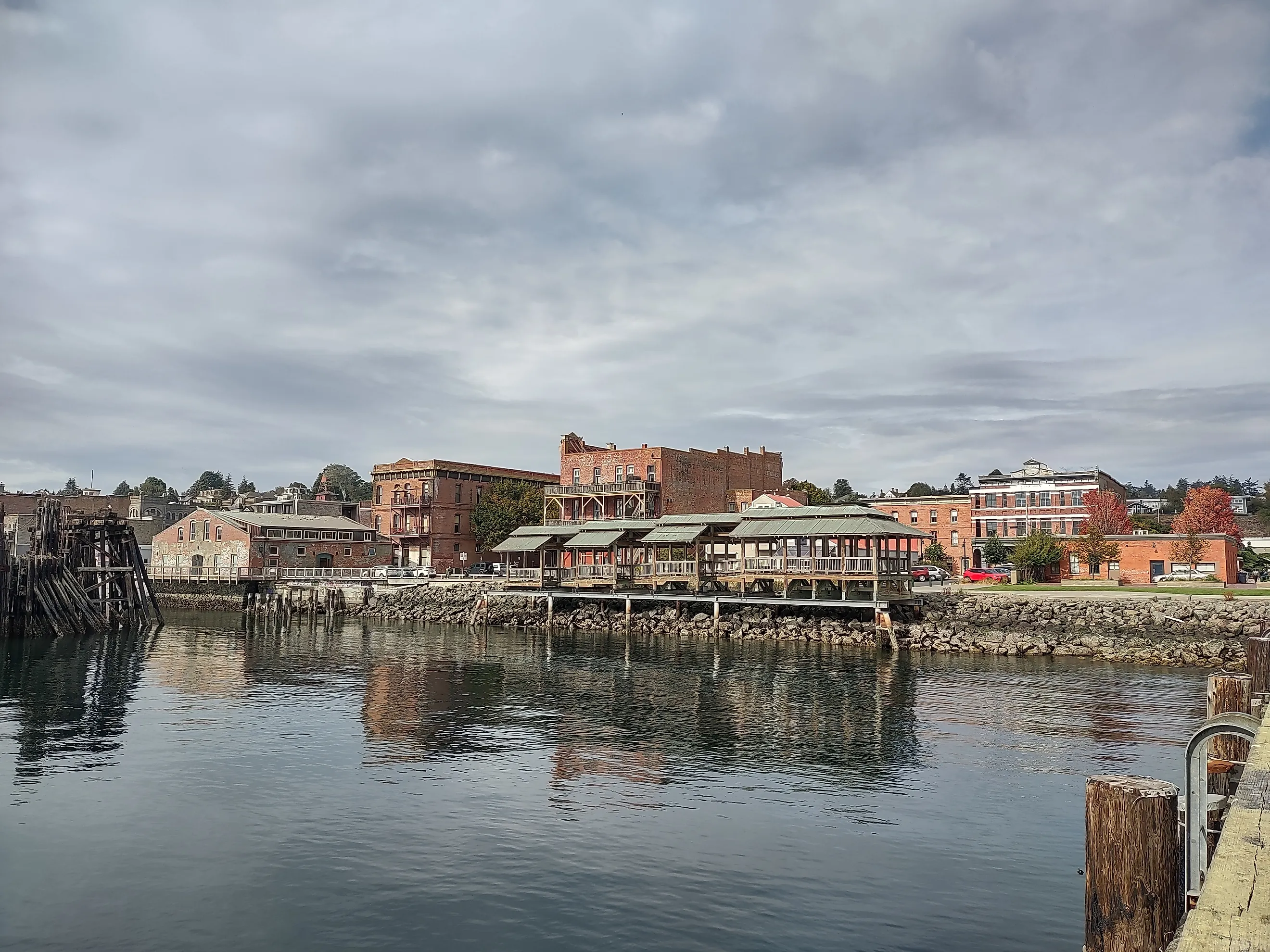
Water Street, the main commercial route along the bay, was built largely in 1889 and 1890, and most of it is still there. Seattle lost its pre-1890 downtown to fire in 1889; Port Townsend's survived because the money to replace it never arrived. The Hastings Building at Water and Taylor streets, built in 1889 for the family of town founder Loren B. Hastings, cost $45,000 and was described at the time as the handsomest building in town, with a 38-foot interior court rising to a skylight.
Across the street, the James & Hastings Building, also from 1889, occupies the spot where the town's first cabin went up in 1851. A block away, the Captain H. L. Tibbals Building, built in 1889 for $28,000 with a billiard parlor and three saloons on the ground floor, operates today as the Palace Hotel. Its upper floors ran as a brothel nicknamed the "Palace of Sweets" from 1925 until the sheriff closed it down in the mid-1930s. The restored hotel names its rooms after the women who worked there.
The Rose Theatre on Taylor Street opened as a vaudeville house in 1907 and still shows films. The old City Hall at 540 Water Street, started in the flush of 1890 and opened in 1892, has been home to the Jefferson County Historical Society since 1951. Its Jefferson Museum of Art & History fills the former municipal courtroom, fire hall, and jail, and does a good job of explaining the boom and the bust, starting with a short film called We Came with Dreams.
Walking Through History

A self-guided walking map from Enjoy Port Townsend, the city's tourism office, covers these and two dozen other buildings between the ferry dock and Point Hudson. The waterfront and the residential bluff above it are listed on the National Register of Historic Places and have been designated a National Historic Landmark District.
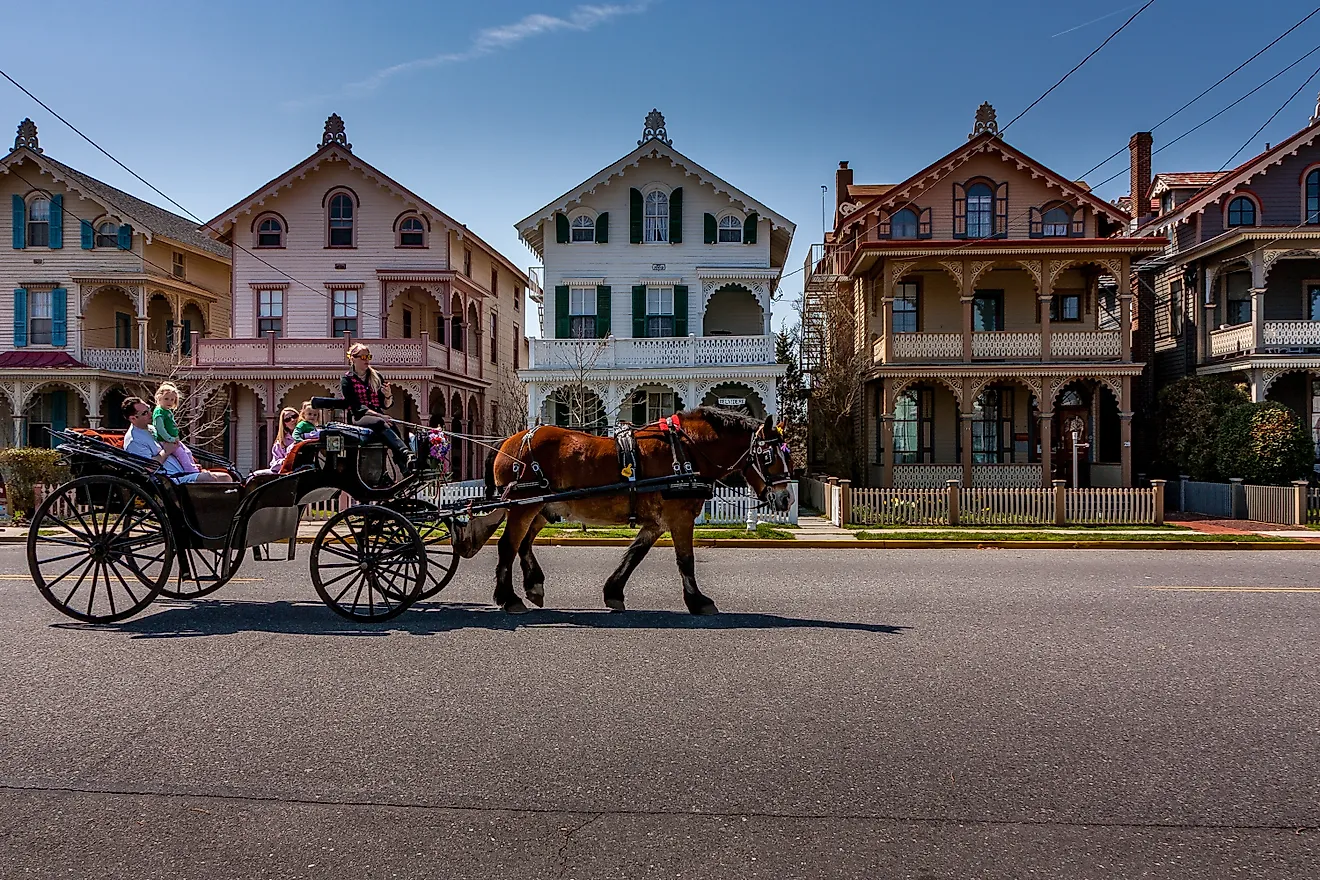
According to HistoryLink, the online encyclopedia of Washington state history, Port Townsend is one of only three surviving Victorian-era seaports in the country, the others being Galveston, Texas, and Cape May, New Jersey. In 2000, the town received the Great American Main Street Award, a national prize for preservation-led downtown revival.
The bluff above downtown is where the money went. The Jefferson County Courthouse on Jefferson Street, a red-brick Romanesque building with a 124-foot clock tower, was started in 1891 and opened late in 1892, just as the hopes for the railroad were dashed. It's still the county courthouse. Nearby, the Port Townsend Post Office, Court, and Customs House, a sandstone-clad federal building completed in 1893, several years late and well over budget, still serves as the town's post office.
The Main Attraction

As magnificent as its commercial and municipal buildings are, it's the opulent homes in Port Townsend that garner most attention. And for good reason. Rothschild House at Taylor and Franklin streets was built in 1868 for merchant D.C.H. Rothschild, who had opened a general store here ten years earlier. It predates the town's boom and has stayed virtually unchanged inside since the family gave it to Washington State Parks. It opened as a house museum in 1962 and is open in summer.
Ann Starrett House on Clay Street, built in 1889 by contractor George Starrett as a wedding gift for his wife, is the showpiece of the Uptown district. It features a four-story tower, a free-standing spiral staircase, and a domed ceiling fresco that works as a solar calendar, lighting a pane of red glass at each solstice and equinox. It has been a private home, a bed and breakfast, and a boutique hotel over the years.
Manresa Castle on Cleveland Street was built in 1892 by Charles Eisenbeis, a Prussian-born baker who became the town's first mayor in 1878 and made a fortune in bricks, lumber, and banking. He built the 30-room house with 12-inch brick walls from his own brickyard to look like the castles of his homeland. It stood empty for the better part of 20 years after his death in 1902, served as a Jesuit training college from the late 1920s, and has operated as a hotel since 1968.
Fort Worden and the Working Waterfront

Though the railroad never came to Port Townsend, the Army did. After the Puget Sound Naval Station opened at Bremerton in 1891, the federal government built three forts to cover Admiralty Inlet, the entrance to Puget Sound, with crossing artillery fire: Fort Casey on Whidbey Island, Fort Flagler on Marrowstone Island, and Fort Worden at Point Wilson on the northern edge of town. And it was the same railway lobbyist, James Swan, who chased Washington, D.C., for the money.
Fort Worden was activated in 1902, became headquarters of the harbor defenses, and closed in 1953. The state bought it and opened Fort Worden Historical State Park in 1973. Highlights of the 434-acre park include the parade ground, Officers' Row, six gun batteries on Artillery Hill, two miles of beach, and the Point Wilson Lighthouse, whose current concrete tower dates from 1914. It's also where Richard Gere and Debra Winger filmed An Officer and a Gentleman in 1981.
Perhaps unsurprisingly, the town's biggest annual event has nothing to do with trains. The Rhododendron Festival, started in 1936, has run every May since, apart from the war years of 1942 to 1945. The Grand Parade along Lawrence Street in Uptown can last two hours, and residents put out lawn chairs and sofas along the route days ahead to claim their spots. Bed races, a pet parade, a kiddie parade, and a cake picnic at Pope Marine Park fill the rest of the week.
A Boom Town Preserved
In 1961, Seattle architect Victor Steinbrueck told a Port Townsend audience that the town was a museum, and they were its caretakers. Two years later, the town's first Homes Tour expected a few hundred visitors and got a traffic jam and a crowd estimated at 2,000.
Today, many of the town's landmark buildings only exist because the Union Pacific's money ran out in 1890 and nothing replaced it for 40 years. The people who built them expected to be living in the "New York of the West." Instead, they got a quiet town on the Olympic Peninsula that looks just as it did when the railway went bust.