The State Parks With The Most Water Moccasins
Venomous snakes are often present on the trails of many state parks, where vegetation can camouflage them. Of them, the one that stays closest to the water is typically the water moccasin, better known as the cottonmouth. It hunts fish and frogs along sloughs, lake shallows, and cypress edges, and it reaches its greatest abundance in Coastal Plain swamps. The state parks with the highest recorded populations sit on that low, wet ground, on the Texas coastal plain and the Alabama coast, in Florida and southern Georgia, and up the Atlantic side into northeastern North Carolina and Virginia Beach. Their boardwalks, earthen dikes, and canoe trails follow the same slow water the reptiles use, and in most of these parks the cottonmouth is the snake visitors photograph and report more than any other.
Brazos Bend State Park, Texas

Southwest of Houston, Brazos Bend State Park is laced with sloughs and oxbow lakes, and its trails stay close to them. The 1.2-mile Pilant Slough Trail starts near the amphitheater at the nature center and follows Pilant Slough as it meanders through bottomland forest. On the park's east end, the 1.9-mile Hale Lake Loop circles an oxbow lake. The park spans about 5,000 acres, with 3.2 miles of its eastern boundary along the Brazos River, and Elm Lake and 40-Acre Lake are reliable places to spot wading birds and alligators. The George Observatory, a satellite of the Houston Museum of Natural Science, also stands inside the park.

Two snakes share the water along those trails in nearly equal numbers, and only one of them is venomous. Cottonmouths have 146 verified sightings in the park, and the harmless banded watersnake has 143. Cottonmouth sightings here climb in March and peak in September, with 27 over the years, then drop to two or three a month from December through February. November still has 9 on record. Mild days in spring and fall, or any mild winter day, are the best times to see the park's reptiles. The park's 16 recorded snake species include the eastern copperhead, with 76 sightings, and the Texas coral snake, with 19 sightings.
Gulf State Park, Alabama

Gulf State Park spans 6,150 acres at Gulf Shores on the Alabama coast, and several of its trails stay beside Lake Shelby. The largest of the park's three spring-fed freshwater lakes, Lake Shelby is also one of the freshwater lakes closest to saltwater on the Gulf shore, alongside Middle Lake and Little Lake. The paved, 1.5-mile Gopher Tortoise Trail follows the lake's edge, and the Lake Shelby Overlook is a 0.3-mile boardwalk. Beyond the lake, the paved Hugh S. Branyon Backcountry Trail system runs for more than 28 miles.

Hikers on the lakeside trails should watch for alligators and snakes. Both species of cottonmouth live here, and no snake in the park has more recorded sightings, 107 in all: 79 northern cottonmouths, 23 hybrids, and 5 Florida cottonmouths. Northern cottonmouths alone turn up more than twice as often as the next snake on the list, the North American racer. Sightings occur every month of the year and peak in September. Of the 18 snake species recorded in the park, the only other venomous one is the pygmy rattlesnake, with 11 sightings.
Fakahatchee Strand Preserve State Park, Florida

Farther down the peninsula, Fakahatchee Strand Preserve State Park is the largest state park in Florida. The boardwalk at Big Cypress Bend, off U.S. 41 about 7 miles west of State Road 29, is the easiest way into the Fakahatchee Strand swamp. It winds through the strand, ending at an alligator pond and an observation deck. Away from the boardwalk, on trails such as the East Main Tram at gate 12, the footing depends on the season, and the same path can be dry in one season and under standing water and mud in another.

The hybrids drop out of the record here. Every cottonmouth logged at Fakahatchee is a Florida cottonmouth, and with 117 sightings, it leads the park's 17 snake species, ahead of the harmless banded watersnake at 94. Sightings follow a different calendar than at Brazos Bend, peaking in March and falling to a handful a month from June through October. The cottonmouth is also the only venomous snake on the park's list, which includes two invasive Burmese pythons. Young cottonmouths are lighter in color than adults, and newborns have a sulfur-yellow tail tip.
Highlands Hammock State Park, Florida

A walk on the Cypress Swamp Trail at Highlands Hammock State Park, near Sebring in the middle of the peninsula, starts on a boardwalk over tea-colored water. The Cypress Swamp Trail is one of nine trails in the park, ranging from 975 to more than 3,000 feet long. Its boardwalk is ADA-accessible as far as the first scenic vista, and beyond that point, a narrow catwalk continues to the Hickory Trail. First opened to the public in 1931, the park protects old-growth hammock and cypress swamp and is home to Florida's Civilian Conservation Corps Museum.

Florida cottonmouths in this park outnumber every other snake in recorded sightings by a wide margin, 73 sightings against 14 for the banded watersnake. Most of those sightings come in the cooler months, and November is the busiest month of the year, while May through August average only two or three a month. The eastern ratsnake, at 11, is the only other species with double-digit sightings, and a single eastern coralsnake is the park's only other venomous snake on record. In Florida, female cottonmouths give birth to roughly one to 20 live young between August and October.
Paynes Prairie Preserve State Park, Florida

Old earthen dikes carry hikers out onto the wet prairie at Paynes Prairie Preserve State Park, just south of Gainesville. Cone's Dike is an 8.25-mile round trip from the visitor center parking area, out to the creek waterway at the center of the prairie, and the 2.6-mile Bolen Bluff Trail adds a half-mile spur onto the prairie along another old dike. Pets are barred from some trails because of alligators, snakes, and bison. The park became Florida's first state preserve in 1971 and was named a National Natural Landmark in 1974. A 50-foot observation tower near the visitor center offers views across the prairie, where wild horses also roam.

Snakes are among the animals commonly seen here, but harmless water snakes outnumber the cottonmouth. Banded watersnakes have been photographed in the park 310 times and green watersnakes 167 times, while the Florida cottonmouth, at 108, ranks fifth among 23 snake species. Its sightings are spread through the year, with no single month standing far above the rest. Details that set a cottonmouth apart include vertical pupils and a pit on each side of the face. The eastern coral snake, with 42 sightings, is the next most-recorded venomous snake. The specimen used to describe the Florida cottonmouth was collected about 7 miles southeast of Gainesville, not far from the prairie.
Okefenokee State Park, Georgia

North across the Georgia line, the state park at the western entrance to Okefenokee National Wildlife Refuge took a new name on September 1, 2026, when Stephen C. Foster State Park became Okefenokee State Park. Billy's Island lies 2 miles out in the Okefenokee Swamp from the park's boat ramp and can be reached only by water. Day-use motorboats, canoes, and kayaks are rented on a first-come, first-served basis; guided boat tours of the swamp should be reserved ahead, and sunset and night tours are sometimes offered. On foot, the 0.7-mile Trembling Earth Trail loops from behind the boat basin onto a long stretch of elevated boardwalk, with views into the swamp's interior.

The park's cottonmouths are Florida cottonmouths, along with five hybrids, and with 28 sightings, the cottonmouth leads the park's 15 recorded snake species. The harmless banded watersnake comes next, with 18, and the park's other commonly seen venomous snake is the timber rattlesnake, with 12. The Florida cottonmouth was recognized as a species separate from the northern cottonmouth in 2015. Its range runs from southern Florida to about Savannah and west into southeastern Alabama, and where it overlaps the northern cottonmouth's range, the two interbreed, which accounts for the hybrids logged here. Sightings at the park run from March through December, with none on record for January or February.
Merchants Millpond State Park, North Carolina

Paddling is the way through Merchants Millpond State Park, in northeastern North Carolina, where canoe trails leave the visitor center and boat ramp and cross a millpond more than 200 years old to canoe-in camps. Canoes and kayaks are rented by the hour, or overnight for those camps, and 10 miles of hiking trails lead to views of Lassiter Swamp. At the upper end of the millpond, Lassiter Swamp preserves remnants of an ancient bald cypress swamp, and the American alligator reaches the northernmost point of its range in the park.

Of all the snakes photographed in the park, the cottonmouth comes first, with 28 sightings, just ahead of two harmless lookalikes, the plain-bellied watersnake and the brown watersnake. Cottonmouth sightings run from March into November and peak in June. Some cottonmouths retreat when approached, while others are defensive and stand their ground. The park's cottonmouth record goes back to 1990, the earliest among these nine parks, and a single eastern copperhead is the only other venomous snake logged. Adult northern cottonmouths typically measure 30 to 45 inches, and the largest on record reached about 74 inches.
False Cape State Park, Virginia

Just across the state line from northeastern North Carolina, reaching Virginia's False Cape State Park takes some planning. Public vehicles are never allowed in the park, so people arrive on foot, by bicycle, by beach transport, or by boat, or book a seat on the tram in advance. The park spans 3,844 acres, including nearly 6 miles of Atlantic beachfront that runs to the North Carolina line. Once inside, five trails total 15.3 miles. In the cold months, the approach through the neighboring Back Bay National Wildlife Refuge narrows because the refuge's East and West Dike trails are closed from November 1 to March 31.

Venomous eastern cottonmouths are a known hazard in the park, which has 46 recorded cottonmouth sightings, more than any of the other 11 snake species logged there. No other snake comes close, as the common ribbon snake, in second place, has 8. Cottonmouth sightings, on record here since 2008, run from March through November and peak in June, with none from December through February. The cottonmouth is the only venomous snake on the park's list, which also includes a single rainbow snake, a harmless and secretive species that feeds mainly on eels.
First Landing State Park, Virginia

At the north end of Virginia Beach, First Landing State Park takes its name from the 1607 landing of the English colonists who went on to found Jamestown. Its habitats include bald cypress swamps, lagoons, and maritime forest, and the 1.8-mile Bald Cypress Trail, marked with red blazes, takes hikers into the swamp. The most visited state park in Virginia, First Landing spans 2,888 acres, with 1.5 miles of beach on the Chesapeake Bay and about 20 miles of trails, though bicycles are allowed only on the Cape Henry and Live Oak trails.

The park sits close to the northern edge of the cottonmouth's range. None have been found north or west of Colonial Heights, and most known populations live south of the James River. The cottonmouth is the second-most-photographed snake in the park, with 89 sightings, behind the harmless northern red-bellied watersnake at 122. The venomous copperhead and the cottonmouth may occasionally be seen on the park's trails, and the copperhead has 20 recorded sightings. Cottonmouth sightings at First Landing run from March through October and peak in June and September, with none on record from November through February.
Giving Cottonmouths Room in the Coastal South
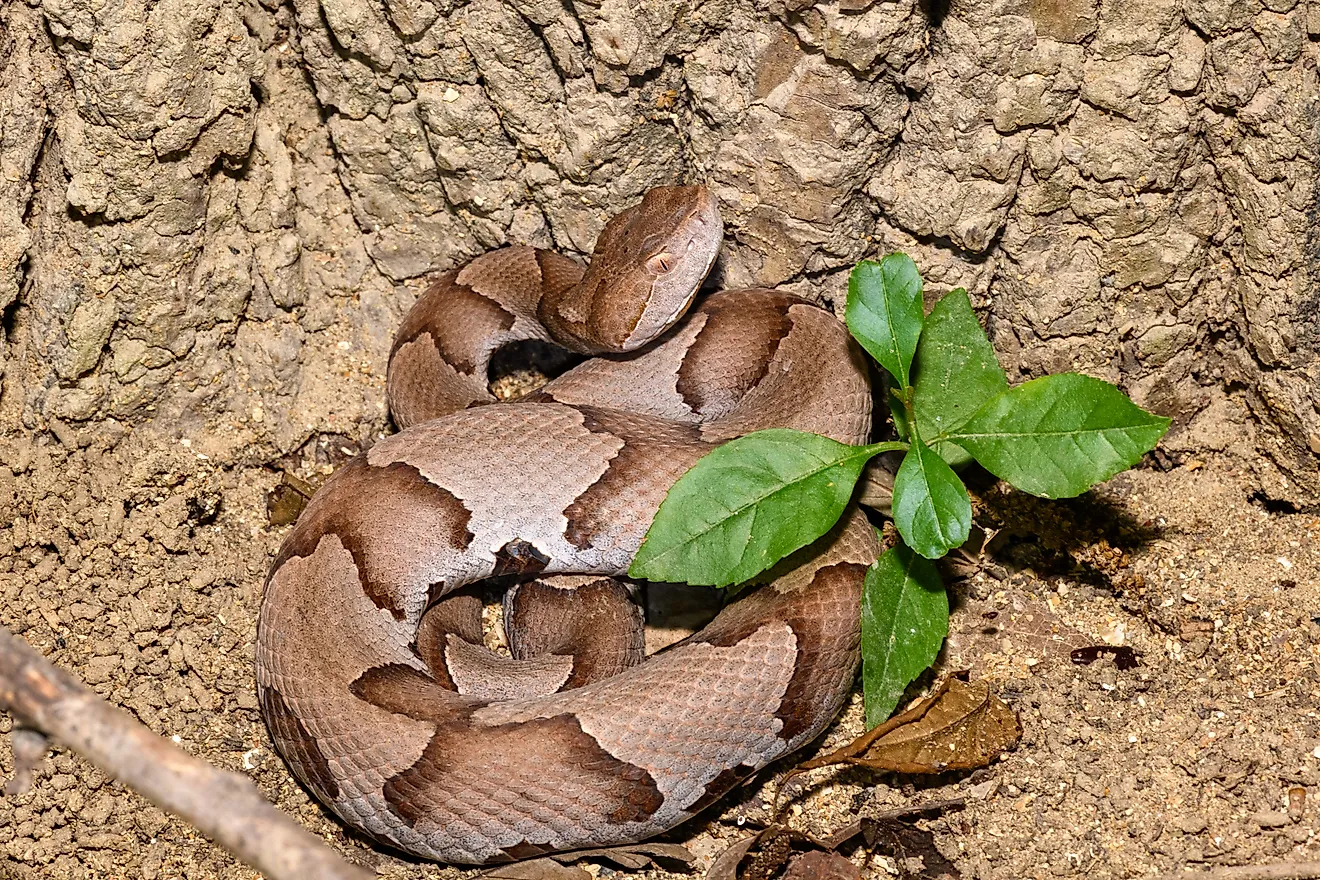
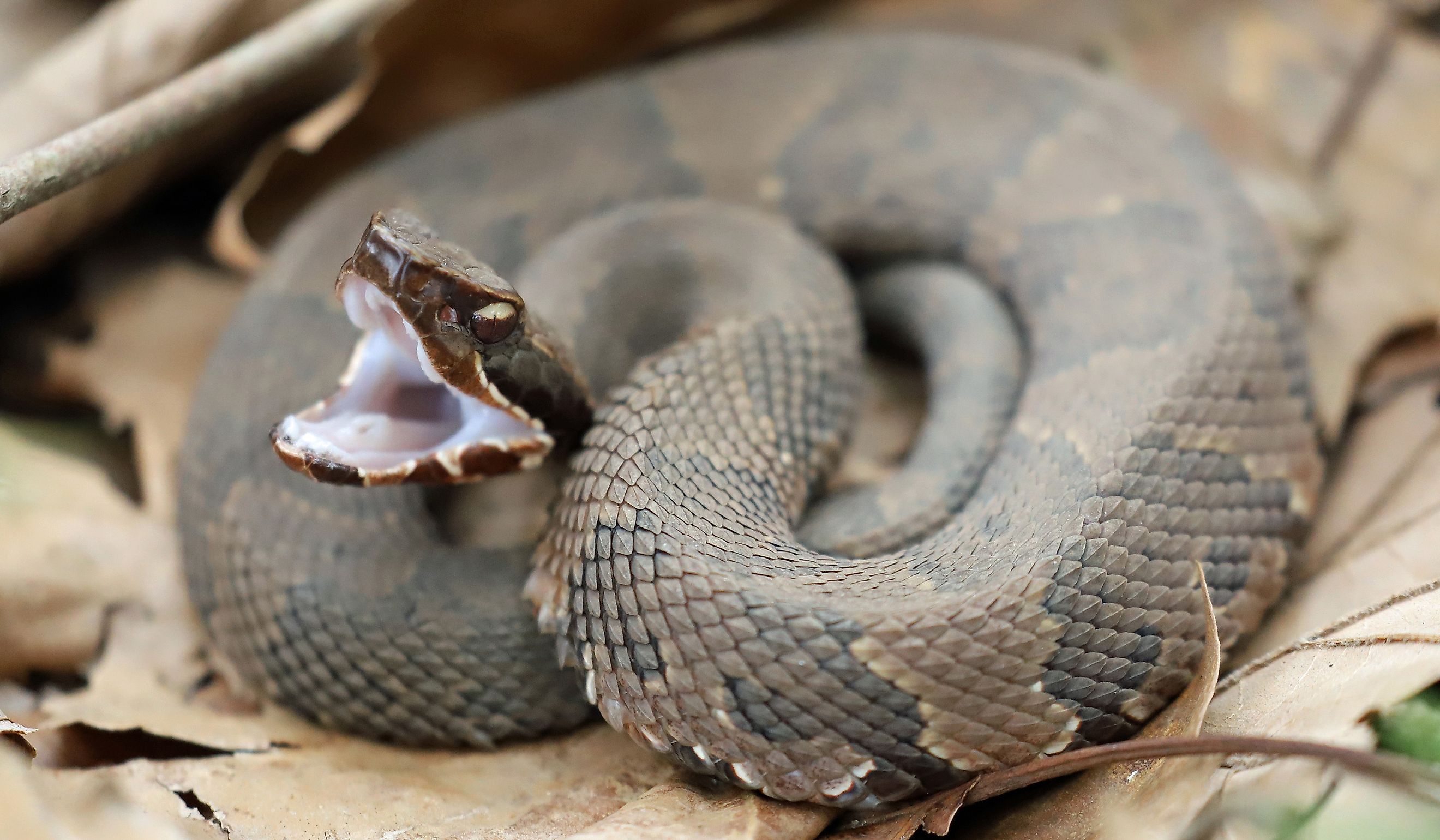
In all nine parks, a cottonmouth's common defense is to stay put. Cottonmouths frequently gape to deter a predator, opening wide to show the white or pinkish lining of the mouth that gives the species its name. They are not aggressive and avoid direct contact with people and pets, but they are venomous and should be avoided. The advice applies on the Big Cypress Bend boardwalk, which winds through the Fakahatchee Strand to an alligator pond, and on the Bald Cypress Trail at First Landing, close to the snake's northern limit. Brazos Bend logs cottonmouths in every month of the year, so a cottonmouth beside any of these paths, in any season, is best left where it is.