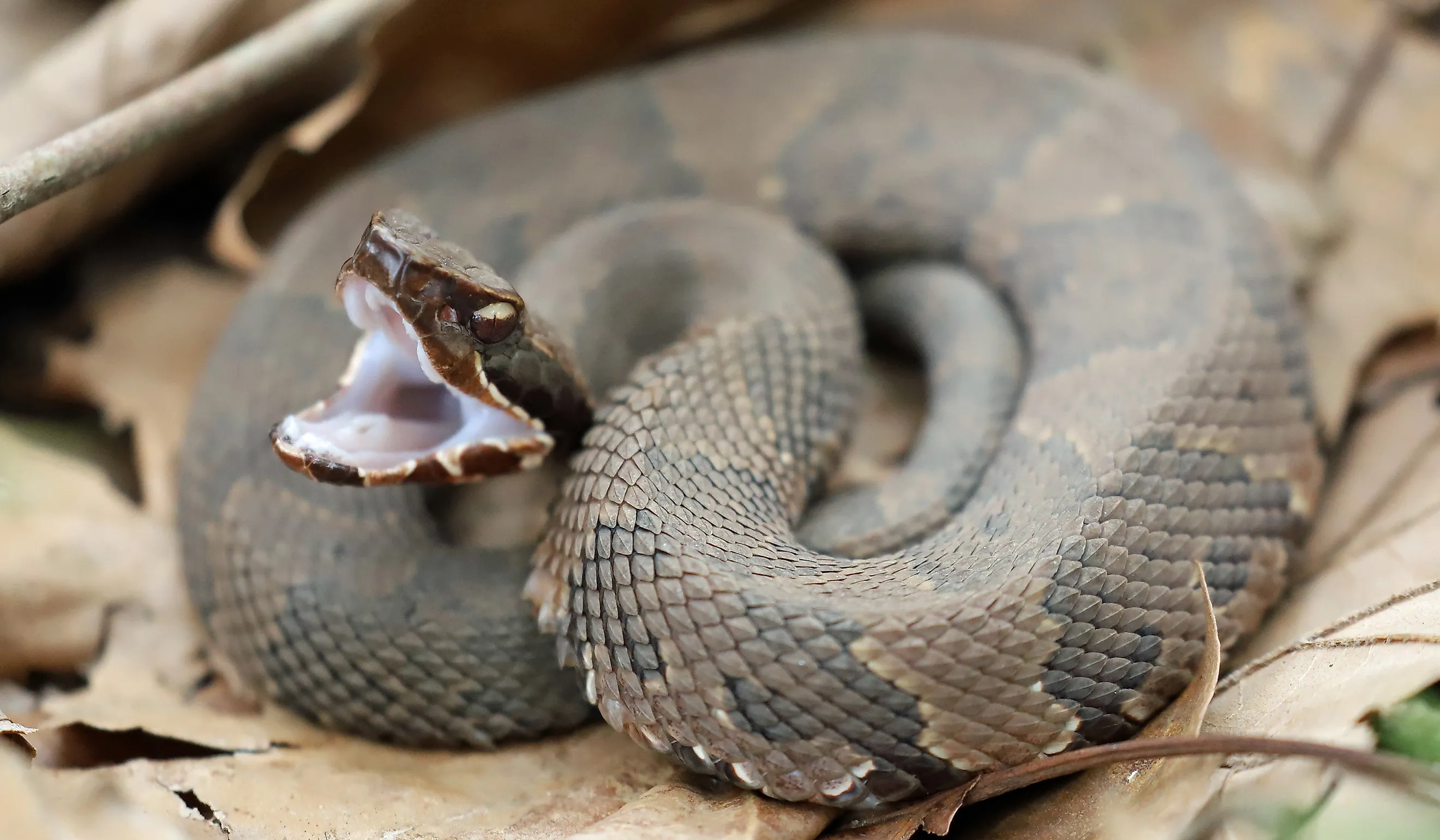
Where Cottonmouths And Copperheads Overlap
Georgia's wildlife agency describes the relationship in one sentence: copperheads are the upland ecological equivalent of cottonmouths. Same genus, same region, same job, different elevation. The two share a dozen southeastern states and almost never share a square foot, because one works the dry forest and the other works the water. They are also closely enough related to interbreed. Breeders have done it repeatedly in captivity, and it has never once been verified in the wild.
The Shared States
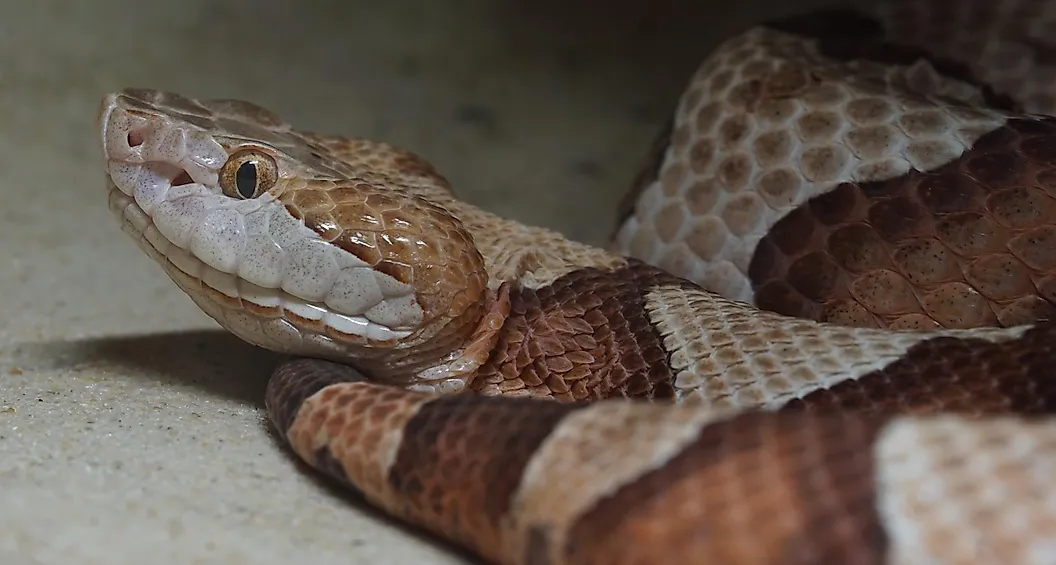
Both animals occupy the southeastern quarter of the country, and the overlap is wide rather than marginal.
They coincide across Virginia, the Carolinas, Georgia, Alabama, Mississippi, Louisiana, Arkansas, Tennessee, Kentucky, Missouri, southern Illinois and eastern Texas. In practical terms, anywhere in the Southeast with both woodland and standing water holds both species.
The copperhead's range is the larger of the two, running north into New England and west across the plains. The cottonmouth stops at the water.
Only One Of Them Gets Peninsular Florida

The clearest edge in the whole comparison sits at the Florida line, and it runs the way most people would not guess.
Copperheads do not extend beyond the Florida panhandle. Cottonmouths continue the length of the peninsula, with the Florida cottonmouth now recognized as a separate species, Agkistrodon conanti, after a 2014 taxonomic revision.
So anywhere in central or south Florida, a thick-bodied banded pit viper is a cottonmouth. There is no copperhead alternative to rule out.
They Divide By Habitat, Not Geography

Sharing a county does not mean sharing a habitat, and this is where the two separate cleanly. Copperheads use upland forest, rocky hillsides, talus, woodland edge and suburban margins. Cottonmouths use swamp, marsh, slow rivers, log jams and the vegetated edges of lakes. UGA notes that power line rights-of-way make excellent copperhead habitat if they are not mowed, which is about as far from a cypress swamp as the Southeast gets.
That partition is why two species with heavily overlapping ranges rarely meet. They are occupying the same region at different altitudes above the water table.
Southern Copperheads Blur The Line

There is one group that breaks the tidy division, and it is the source of most misidentifications.
Georgia recognises two copperhead subspecies, the northern in the mountain counties and the southern below the fall line, overlapping through the Piedmont where specimens take on appearances falling between the two patterns.
Southern copperheads prefer low-lying areas near streams and swamps, which puts them in genuine cottonmouth country. UGA states plainly that they are often confused with the cottonmouth as a result.
The Hybrid Question Has A Firm Answer
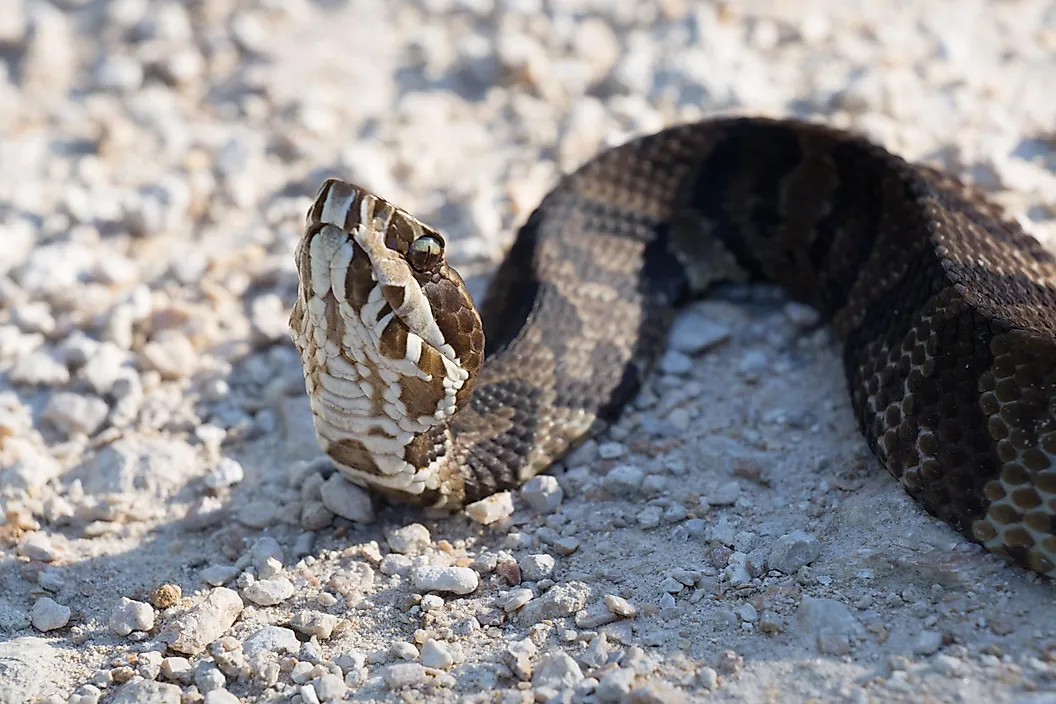
Two species in one genus with overlapping ranges raises an obvious question, and the answer is better documented than people expect.
Breeders have successfully produced cottonmouth and copperhead hybrids in captivity on multiple occasions. The genetic compatibility is real. What does not exist is a verified wild specimen, despite extensive study of both species across the entire overlap zone.
The reasons are the habitat partition above, different courtship behavior, and different seasonal timing. The two animals are capable of it and the circumstances never arise.
They Do Share Winter Quarters

The one place the partition breaks down is underground, and it happens because the alternative is dying.
Many temperate snakes overwinter communally in mixed-species hibernacula, and suitable sites become scarcer and therefore more crowded in colder parts of the range. Copperheads are documented sharing dens with timber rattlesnakes, black rat snakes, racers and garter snakes.
Cottonmouth and copperhead co-denning is plausible in the overlap zone and poorly documented, which is an honest gap rather than a finding. What is established is that both species abandon habitat preferences entirely when the choice is a shared crevice or none.
Copperheads Use Wetlands More Than Expected

Recent telemetry work complicates the upland label in a way worth knowing. A study of eastern copperhead habitat selection found that population-level core habitat was a shared wetland, while the same observations broken down by individual showed individual core habitat as upland forest. The animals gather at wet sites episodically and live in the woods the rest of the time.
So the species is not purely terrestrial. It is terrestrial with communal exceptions, and those exceptions are exactly where a cottonmouth might be.
Telling Them Apart In The Overlap

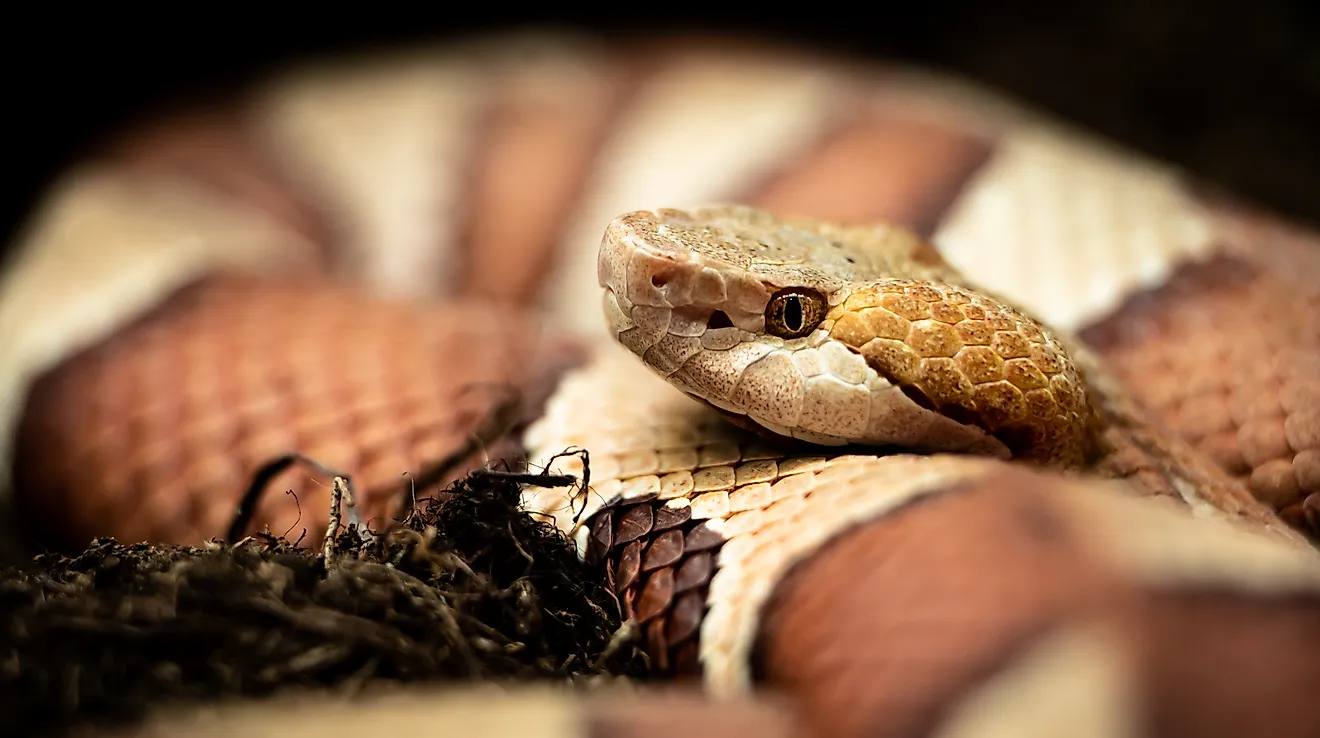
Where both occur, three features separate them reliably. Build is the first. The cottonmouth is the larger and distinctly heavier-bodied of the two, and it swims readily with its body riding on the surface. The copperhead is slighter and generally stays out of open water.
The face is the second. A cottonmouth carries a dark band from the eye to the jaw angle, giving a masked look the copperhead lacks. The third is the bands themselves: a copperhead's hourglass markings are narrow across the spine and widen down the flanks, and they stay visible for life, while cottonmouths darken toward uniform black with age.
One Lives Much Longer Than You Would Think

One detail from the Georgia records has nothing to do with range and is worth having anyway.
One northern copperhead was documented surviving 29 years and 10 months, though the agency notes few attain anything close to that. Copperheads are also assumed to wander little except when searching for mates.
A snake using the same patch of woodland for decades, returning to the same den each autumn, is a more settled animal than the word snake usually suggests.
The Short Answer

Cottonmouths and copperheads overlap across roughly a dozen southeastern states, from Virginia to east Texas and north to southern Illinois, with copperheads extending far beyond that range inland and cottonmouths holding peninsular Florida alone.
Inside the shared ground they separate by habitat rather than by territory, one in the uplands and one in the water, which is why two species capable of interbreeding have never been confirmed doing it. The exception is winter, when both will take whatever crevice stays above freezing and the distinction stops mattering.