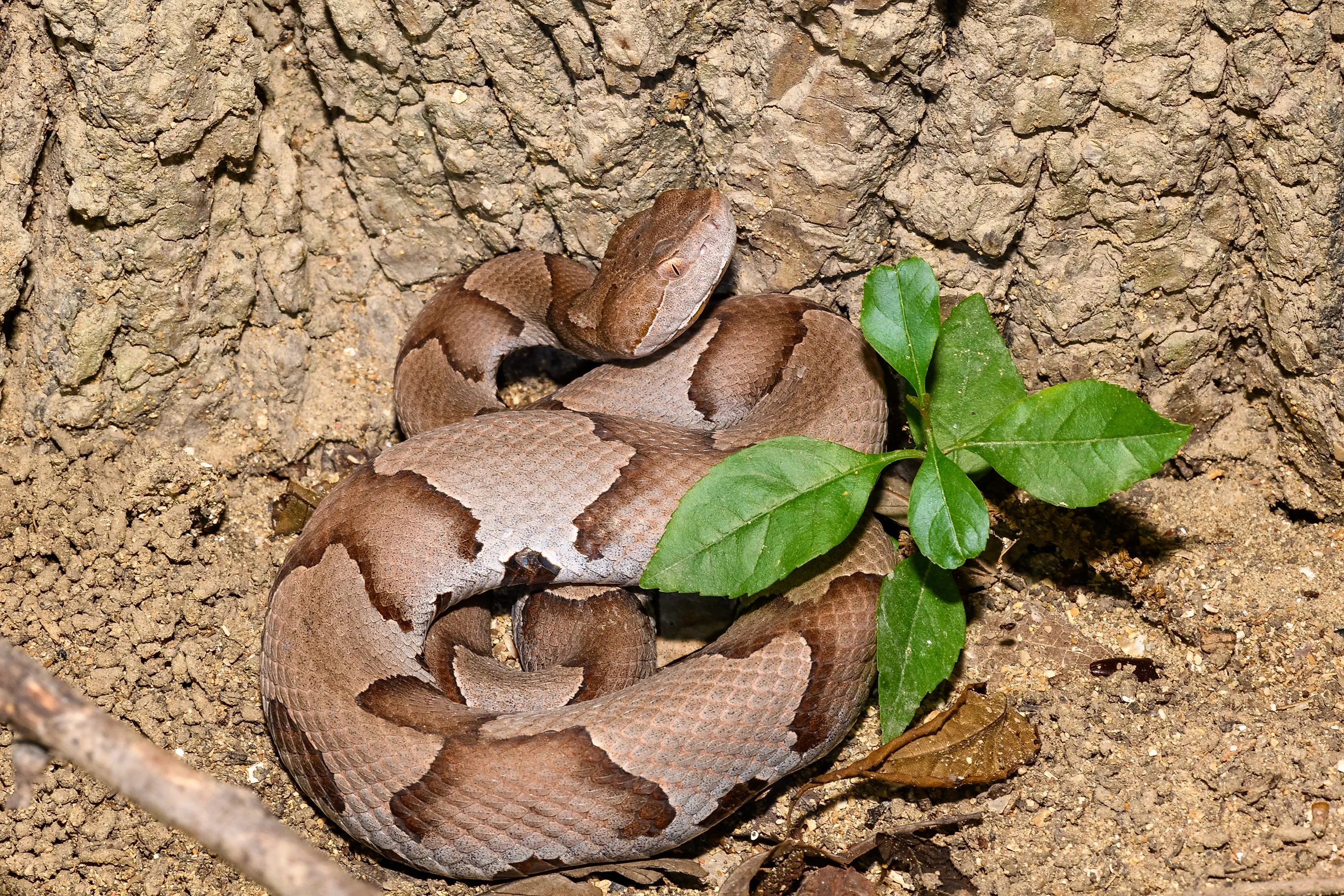
The National Forests Where Copperheads Stay Active Into December
Copperheads do not hibernate. They brumate, which is a slowed-down state rather than a shutdown, and a North Carolina wildlife biologist describes them as snapping out of it whenever temperatures reach roughly 60 degrees. That means a warm December afternoon can put a copperhead back on the surface. In the national forests at the southern edge of the range, where December routinely clears 60, that is not an occasional freak event. It is most of the month.
Sixty Degrees Is The Threshold

Everything about winter copperhead activity turns on one number.
Falyn Owens, a wildlife extension biologist with the North Carolina Wildlife Resources Commission, says snakes snap out of brumation when temperatures are roughly 60 degrees or higher, meaning they can be active in the dead of winter.
Below 60 they retreat. Above it they can move, hunt and bask. The line is that clean.
They Are Not True Hibernators
The distinction between brumation and hibernation is what makes December activity possible at all.
Copperheads become lethargic but are not asleep. They stop eating, though they still need water, and they can rouse and return to shelter repeatedly through a winter.
Published accounts record copperheads basking on warm days in December and January. A mammal in hibernation cannot do that.
Apalachicola Sits At The Range Edge

The southernmost qualifying forest is also the warmest in December.
The copperhead range reaches its southeastern limit at the Florida panhandle, and Apalachicola National Forest covers a large share of it. December highs there sit in the low sixties.
That is above the activity threshold on a typical day rather than an unusual one. Copperheads in this forest have no reason to commit to a den.
Conecuh Runs Just As Warm

Southern Alabama produces the same conditions a short distance north.
Conecuh National Forest sits against the Florida line in Covington and Escambia counties, with December highs around 61 to 63 degrees. Its longleaf pine and pond landscape is prime copperhead ground.
The Open Pond area is the most visited part of it, which puts people and active snakes in the same place in midwinter.
De Soto Covers South Mississippi

Mississippi's southern forest sits in the same thermal band.
De Soto National Forest spreads across the southern part of the state toward the Gulf, with December highs near 62 degrees. Homochitto, in the southwest of the state, runs similarly warm.
Both hold the mixed pine and hardwood bottomland that copperheads favor through the warmer months and never need to leave entirely.
Kisatchie Is Louisiana's Only One

Louisiana has a single national forest and it qualifies comfortably.
Kisatchie National Forest spreads across seven parishes in the central and northern part of the state, with December highs around 60 to 62 degrees depending on the district.
Its southern districts clear the threshold more reliably than its northern ones. Within one forest, the same month behaves differently.
East Texas Has Four Of Them

The western end of the copperhead range holds a cluster of qualifying forests.
Sam Houston, Davy Crockett, Angelina and Sabine national forests cover the piney woods of east Texas, where December highs run around 60 to 63 degrees. Sam Houston sits closest to Houston and sees the heaviest recreational use.
The broad-banded copperhead occupies this part of the range rather than the eastern subspecies. The behavior is the same.
Francis Marion Is The Coastal Case

South Carolina's coastal plain is borderline on temperature and still qualifies on behavior.
Scott Parker, biology department chair at Coastal Carolina University, put it directly: certainly on the coastal plain, and probably most of the state excluding the mountains, copperheads continue to be active.
Francis Marion National Forest sits on that plain north of Charleston, with December highs around 59 to 60. It is the northern limit of this list rather than a comfortable member of it.
Winter Activity Is Daytime Activity

The time of day a December copperhead is out is the opposite of the summer pattern.
Copperheads are nocturnal through the hottest months and shift to a diurnal pattern in cooler weather, because they need the sun rather than need to avoid it.
So a December encounter happens at midday on the warmest part of a warm day, not at dusk. That is precisely when people are out walking.
The Mountains Are Different

The same state can hold forests on both sides of this line.
In the mountains, Parker notes, copperheads likely have not retreated deep underground but are hanging around den entrances where they can drop below when temperatures finally fall.
Talladega in Alabama and the Appalachian forests further north see December highs in the mid-fifties. There the snakes are at the door rather than out of it.
The Risk Is Low But Not Zero

Winter activity does not translate into winter danger at anything like summer rates.
Snake expert Jeff Hall has said the chance of being bitten by a copperhead in winter is super low, while noting that copperheads cause more than 90 percent of North Carolina's venomous snakebites overall.
Fewer snakes are out, and those that are move slowly. The practical advice is to do cold-month yard and trail work knowing they could be there.
The Short Answer

Apalachicola in Florida, Conecuh in Alabama, De Soto and Homochitto in Mississippi, Kisatchie in Louisiana, and Sam Houston, Davy Crockett, Angelina and Sabine in east Texas all see December highs at or above the 60 degree threshold that ends brumation. Francis Marion in coastal South Carolina sits right on the line.
Copperheads in those forests never fully commit to a den. They are out at midday rather than dusk, moving slowly, and they have been recorded basking in December and January wherever the thermometer cooperates.