What Is The Sun Made Of?
Quick Take: The Sun is a roughly 4.6-billion-year-old ball of plasma made mostly of hydrogen and helium. Hydrogen fusion in its core produces the energy that lights and warms our planet, and the sunlight you see today began its journey out of that core hundreds of thousands of years ago.
A Star We Can Actually Study
Most stars are pinpoints of light too far away to examine in detail. The Sun is the exception. It sits about 93 million miles from Earth, close enough that spacecraft, ground telescopes, and underground particle detectors can take its temperature, sample its wind, and even listen to it ring. Everything we know about how stars work, from how they fuse hydrogen to how they age and die, started with what we figured out about this one.

So what is the Sun actually made of, and how do we know? The short answer is that it is a giant sphere of hot plasma, around 73% hydrogen and 25% helium by mass, with a sprinkle of heavier elements making up the rest. The longer answer, which is more interesting, involves layers, fusion, neutrinos, and a swimming-pool-sized tank buried under a Japanese mountain.
Size, Distance, And Temperature
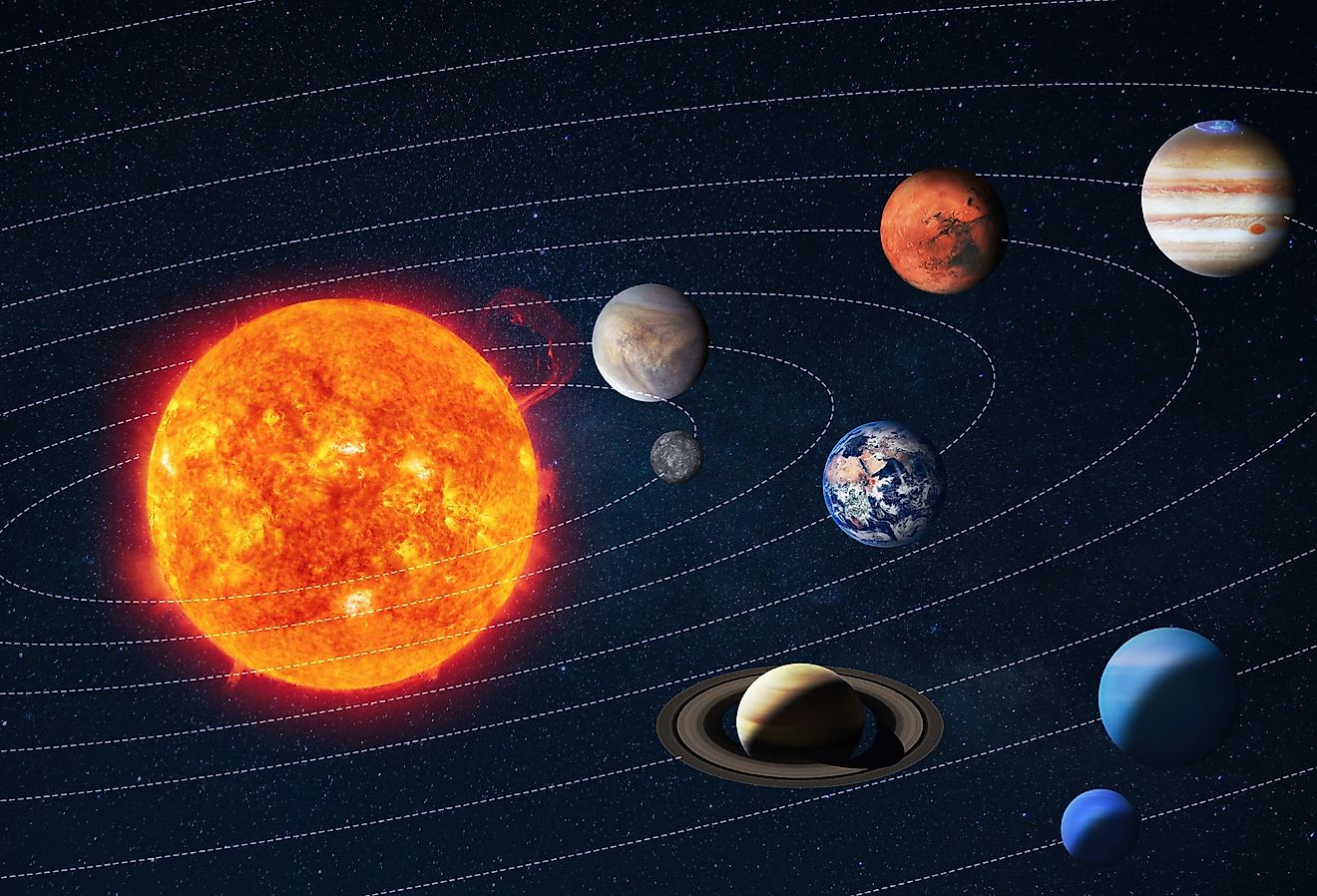
The Sun is enormous by Earth standards and unremarkable by stellar ones. Its diameter is about 864,000 miles, roughly 109 times wider than Earth. You could line up 109 Earths across its face and still have room. Its mass is about 333,000 times Earth's, and it accounts for roughly 99.86% of the mass of the entire solar system. The planets, moons, asteroids, and comets together make up the leftover 0.14%.
The average distance from Earth to the Sun is about 93 million miles, a figure astronomers use as the astronomical unit (AU). Light covers that distance in about 8 minutes and 20 seconds, so the sunlight hitting your face right now left the Sun's surface less than nine minutes ago. The energy itself, however, is much older than that, and the reason why is one of the strangest facts about our star.
Surface temperature on the visible disk runs about 10,000°F (around 5,500°C). That sounds extreme, and it is, but it is actually the coolest part of the Sun's outer structure. The corona above it reaches over 1,800,000°F. The core deep below runs hotter still, at roughly 27 million°F. Why the thin outer atmosphere is hundreds of times hotter than the surface beneath it is a real, unsolved problem in stellar physics called the coronal heating problem.
The Six Layers, From Core To Corona
Astronomers usually divide the Sun into six layers. Three are interior, and three make up the solar atmosphere. They are not crisp shells like an onion's, but the boundaries are real and each layer behaves differently.
The core. This is the innermost 20 to 25% of the Sun's radius, where temperatures hit about 27 million°F and pressures crush hydrogen nuclei together hard enough to fuse them into helium. Roughly 99% of the Sun's energy is generated here. The core is also extraordinarily dense, about 150 times the density of water, despite being made of gas.
The radiative zone. Surrounding the core out to about 70% of the Sun's radius, this region transports energy outward by radiation. Photons born in the core do not travel in straight lines here. They bounce, get absorbed, and get re-emitted countless times as they slowly random-walk outward. Estimates vary, but a single photon takes somewhere between 100,000 and a few million years to cross this zone.
The convective zone. The outer roughly 30% of the solar interior. Here the plasma is cool enough and opaque enough that radiation alone cannot move energy efficiently, so the gas itself starts churning. Hot plasma rises, cools at the surface, and sinks back down, much like water boiling in a pot. The granular pattern you see in close-up photographs of the Sun's surface is the top of these convection cells.
The photosphere. This is the visible "surface" of the Sun, only a few hundred miles thick. Almost all the light we see comes from here. Sunspots, the cooler, darker patches that come and go on the disk, live in the photosphere. They look black only by comparison; on their own they would still be brighter than a full moon.
The chromosphere. A thin reddish layer above the photosphere, normally drowned out by the bright surface below. You can see it for a few seconds during a total solar eclipse as a pinkish ring around the blacked-out disk. Temperatures climb sharply here, from about 6,000°F at the bottom to tens of thousands at the top.
The corona. The outermost atmosphere, extending millions of miles into space and visible as a pearly halo during a total eclipse. The corona is hotter than the surface, sparsely populated with extremely high-energy plasma, and it is also the source of the solar wind, a constant stream of charged particles that flows past Earth and helps create the northern lights.

What The Sun Is Actually Made Of
By mass, the Sun is roughly 73% hydrogen, 25% helium, and about 2% everything else. That last 2% is a thin sampling of heavier elements: oxygen, carbon, neon, iron, nitrogen, silicon, magnesium, and sulfur, in roughly that order of abundance. Astronomers lump everything heavier than helium under a single dismissive label, "metals," even though most of it is what a chemist would call non-metals.
By number of atoms, hydrogen dominates even more, around 91% of all atoms in the Sun, with helium at about 8.9% and the heavy elements making up only a few tenths of a percent. The discrepancy is because helium atoms are four times heavier than hydrogen atoms, so a small percentage of helium nuclei accounts for a much larger percentage of the total mass.
The composition is not static. Over the Sun's lifetime, hydrogen in the core has been steadily converted to helium. When the Sun formed about 4.6 billion years ago, its core was nearly pure hydrogen. Today, the core is roughly 60% helium by mass, the leftover from billions of years of fusion. That helium is denser than the surrounding hydrogen and stays put, gradually building up until conditions in the core change enough to alter the Sun's structure entirely.
How Fusion Powers Everything
The Sun's energy comes from the proton-proton chain, a sequence of reactions that takes four hydrogen nuclei and fuses them into one helium nucleus. The helium nucleus is slightly less massive than the four protons that went in. The missing mass becomes energy, following Einstein's famous equation. Each second, the Sun converts about 600 million tons of hydrogen into about 596 million tons of helium, with the missing four million tons radiated away as energy.
That energy starts as gamma-ray photons in the core. As those photons random-walk outward through the radiative zone, they lose energy at every interaction and gradually shift from gamma rays to X-rays to ultraviolet to visible light. By the time they break free of the photosphere, they are the warm yellow-white sunlight we recognize. This is why the energy you feel on your skin is so old: the photon that delivered it was created hundreds of thousands of years ago, even though it crossed the last 93 million miles in a brisk eight minutes.
The reaction also produces neutrinos, ghostly particles that barely interact with anything. Neutrinos do not random-walk. They fly out of the core in roughly two seconds, zip across the solar interior, and reach Earth a little over eight minutes later. Trillions of them are passing through your body right now, and almost none of them will ever bump into a single atom along the way.
How We Know All Of This
Scientists work out the Sun's composition and behavior using several complementary tools, none of which involve actually flying into it.
Spectroscopy. When sunlight is split into its rainbow, dark absorption lines appear at specific wavelengths. Each chemical element absorbs light at its own characteristic set of wavelengths, so the pattern of dark lines is essentially a fingerprint. This is how helium was discovered in the Sun in 1868, decades before it was found on Earth. Helium is named for Helios, the Greek sun god, for exactly that reason.
Helioseismology. The Sun rings like a bell. Pressure waves bounce around its interior and cause the surface to oscillate by tiny but measurable amounts. By tracking those oscillations, astronomers can map the interior structure the same way geologists use earthquakes to map Earth's interior. Helioseismology is how we know the depth of the convective zone, the rotation rate at different latitudes, and even the rough composition at various depths.
Spacecraft. NASA's Parker Solar Probe, launched in 2018, has flown through the corona itself, closer to the Sun than any human-made object. The European-American SOHO observatory has watched the Sun continuously since 1995. The Solar Dynamics Observatory takes high-resolution images every few seconds. Together they monitor solar flares, coronal mass ejections, and the structure of the magnetic field.

Neutrino detectors. Buried deep underground to shield them from cosmic-ray noise, detectors like Super-Kamiokande in Japan catch the rare neutrino that does interact with ordinary matter. Super-K is a tank holding 50,000 tons of ultra-pure water, watched by more than 11,000 photomultiplier tubes, located about a kilometer beneath Mount Ikenoyama. When a solar neutrino occasionally collides with a water molecule, the resulting flash of light tells researchers that, yes, fusion really is happening in the Sun's core right now. In the 1990s these detectors helped solve the long-standing "solar neutrino problem" by showing that neutrinos change types in flight, a discovery that earned the 2015 Nobel Prize in Physics.
Solar Activity And The 11-Year Cycle
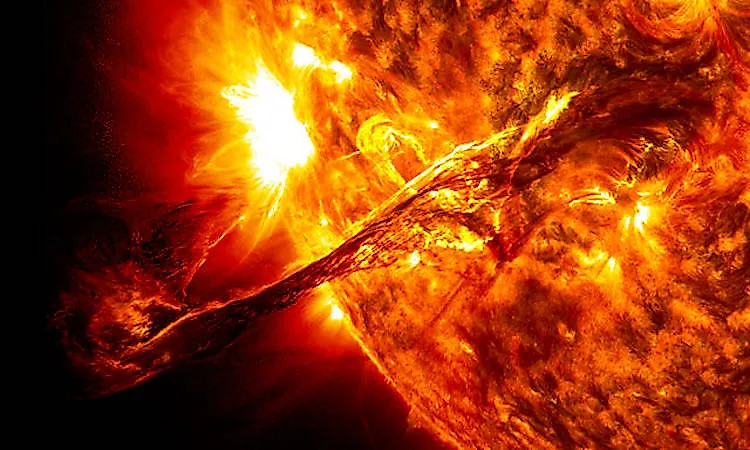
The Sun is not steady. It runs on an approximately 11-year cycle of magnetic activity. At solar minimum, the disk is nearly featureless. At solar maximum, sunspots crowd the surface, flares erupt frequently, and coronal mass ejections fling billions of tons of plasma into space. When that plasma sweeps past Earth, it can disturb satellites, interrupt radio communications, and push the auroras far from the poles. The current cycle, Solar Cycle 25, peaked around 2024 and 2025.

The cycle is driven by the Sun's tangled and constantly shifting magnetic field, which gets wound up by the differential rotation of the plasma. The equator rotates faster than the poles, twisting the magnetic field lines until they break through the surface, spawn sunspots, and eventually reset with a polarity flip. Why exactly the cycle averages 11 years is still not fully understood.

The Sun's Future
The Sun is roughly halfway through its main-sequence life. In about another 5 billion years, the hydrogen in its core will run low, the core will contract, and the outer layers will swell. It will become a red giant, eventually growing large enough to engulf Mercury, Venus, and possibly Earth. After that phase, it will shed its outer envelope as a planetary nebula and leave behind a slowly cooling white dwarf, an Earth-sized ember of carbon and oxygen.

That is how stars like ours end. Bigger stars do something far more violent, but the Sun does not have the mass for that. Its long, quiet retirement is part of why a stable planet like Earth could exist around it for so long in the first place.
Knowing The Star Next Door
For an object that has shaped every culture, calendar, and crop on Earth, the Sun stayed mostly mysterious until embarrassingly recently. Scientists did not understand fusion until the 1930s, did not directly confirm solar neutrinos until 1968, and did not fly through the corona until 2021. Each of those steps changed not just our picture of the Sun but our picture of every star in the sky. Hydrogen, helium, gamma rays, neutrinos, plasma loops the size of planets: all of it is out there, working away, 93 million miles up. And every morning, more or less on schedule, a fraction of it shows up at your window.
By The Numbers: Roughly 4.6 billion years old. About 73% hydrogen and 25% helium by mass. Diameter: 864,000 miles. Surface temperature: ~10,000°F. Core temperature: ~27 million°F. Distance from Earth: ~93 million miles. Light travel time to Earth: 8 minutes 20 seconds. Photon journey from core to surface: 100,000+ years. Mass of the Sun as a fraction of the solar system: 99.86%.