What Is The Earth's Atmosphere Made Of?
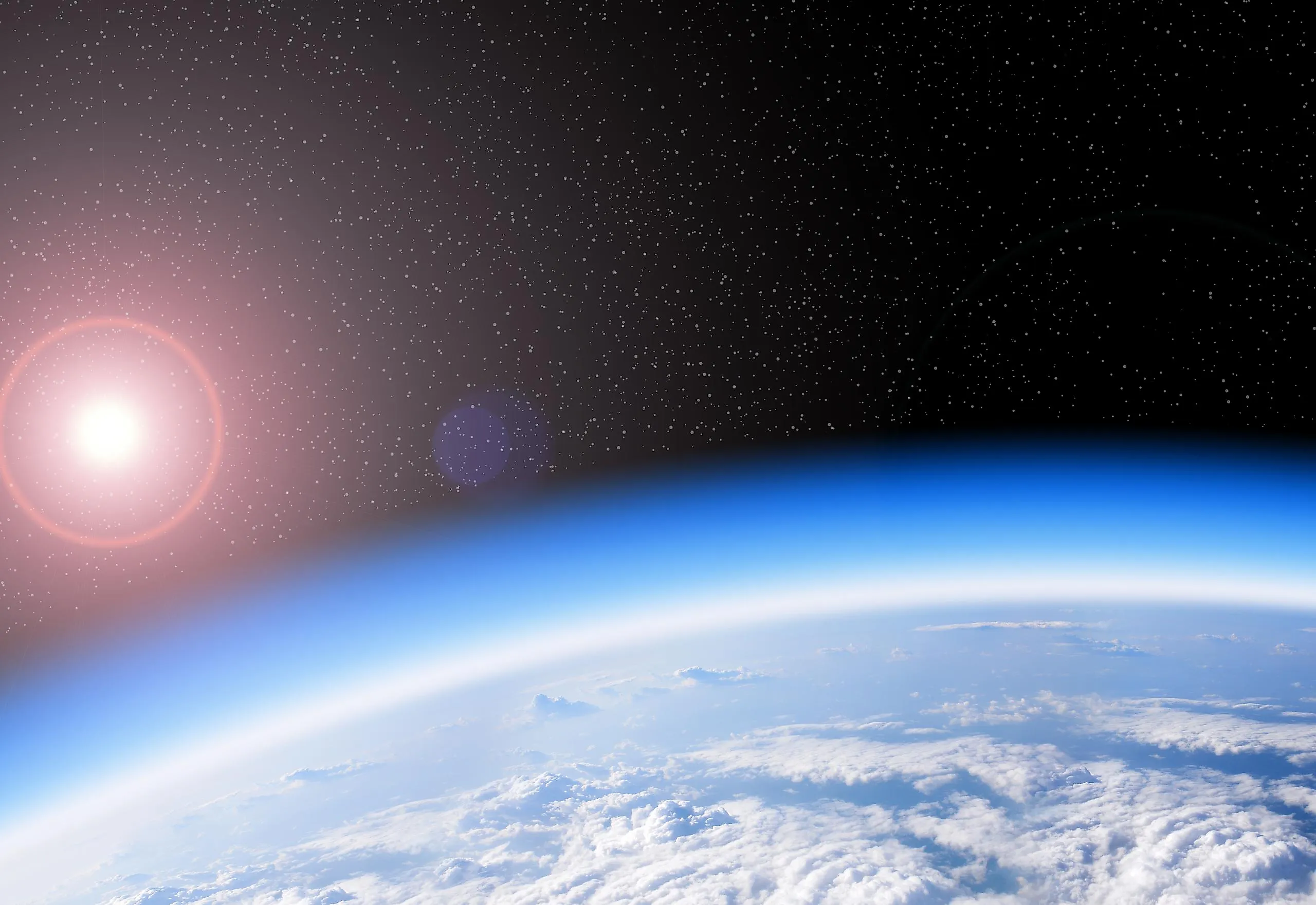
- The atmosphere starts at the ground and extends to 10,000 km (6,214 miles) above the surface.
- Most of earth’s atmosphere is not oxygen.
- Most of the atmosphere's mass is located 8-15 km above Earth’s surface.
Earth's atmosphere, by volume of dry air, is about 78.08 percent nitrogen, 20.95 percent oxygen, 0.93 percent argon, and roughly 0.043 percent carbon dioxide (a figure that reached a record monthly average of 430.5 ppm at NOAA's Mauna Loa Observatory in May 2025, up from approximately 280 ppm before the Industrial Revolution). Trace amounts of neon, helium, methane, krypton, hydrogen, and xenon make up the rest of the dry mixture, while water vapor varies between 0 and 4 percent by volume depending on temperature and humidity. The atmosphere also carries tiny solid and liquid particles such as dust, pollen, sea salt, smoke from wildfires, and various human-made aerosols, some of which contribute to air pollution. Humans depend on this gaseous envelope for breathing, for protection from solar ultraviolet and cosmic radiation, for the moderation of surface temperatures (a roughly 33°C natural greenhouse effect that keeps Earth livable rather than frozen), and for the pressure that keeps liquid water stable at the surface. The total mass of the atmosphere is about 5.15 quintillion kilograms (5.15 × 10¹⁸ kg), which sounds enormous but is only about one millionth of Earth's total mass.

What Is The Atmosphere?
The atmosphere is the gaseous layer that surrounds Earth, extending outward to roughly 10,000 km (about 6,200 miles) above the surface before becoming functionally indistinguishable from interplanetary space. For practical purposes, the conventional boundary of space is the Kármán line at 100 km altitude, named after the Hungarian-American physicist and aerospace engineer Theodore von Kármán; above this altitude, conventional aircraft cannot fly because the air is too thin to generate lift. Most of the atmosphere's mass is packed near the surface: about 75 percent lies within the lowest 11 km, and 99 percent within the lowest 30 km. This is why higher elevations have "thinner" air and why climbing tall mountains too quickly can cause altitude sickness, the body's reaction to lower oxygen partial pressures.
Air pressure decreases with altitude because the weight of the air column above any given point gets smaller the higher you go. This is a consequence of hydrostatic equilibrium rather than weakening gravity (gravity itself drops by only about 0.3 percent over the first 10 km of altitude). The popping sensation in the ears during a flight or rapid elevation change is the eardrum equalizing between the lower outside pressure and the higher pressure trapped behind it in the middle ear.
The Layers Of The Atmosphere
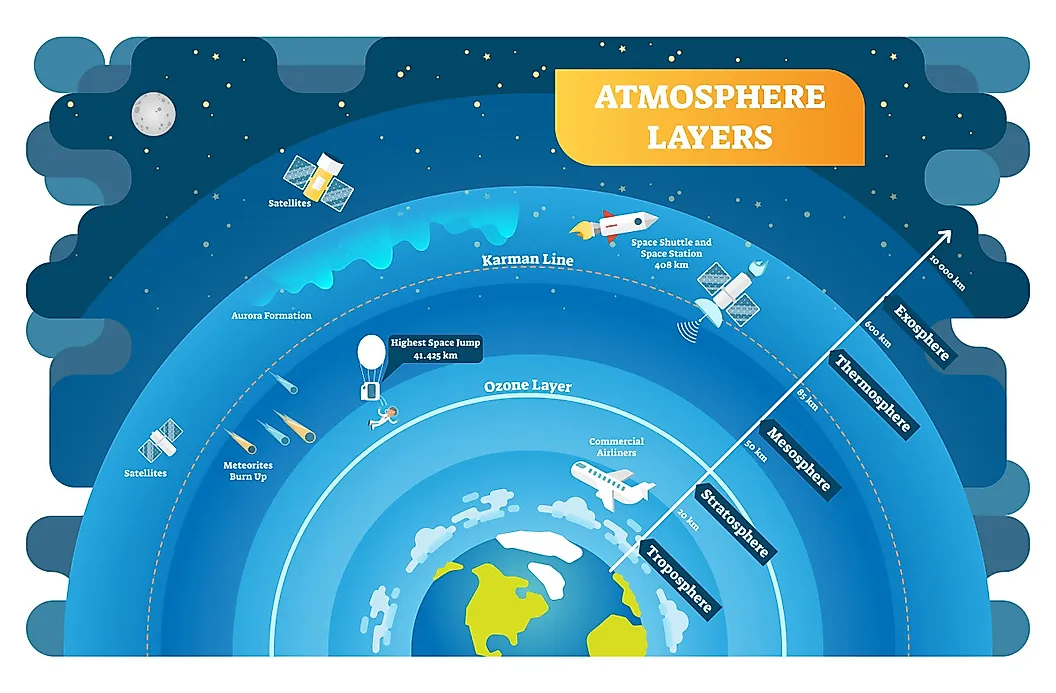
Because the atmosphere reaches so far above Earth's surface, scientists divide it into five main layers based on how temperature changes with altitude: the troposphere, stratosphere, mesosphere, thermosphere, and exosphere. The French meteorologist Léon Teisserenc de Bort and the German meteorologist Richard Assmann are jointly credited with the discovery of the first two layers in 1902, after Teisserenc de Bort sent up more than 200 instrumented balloons from his private observatory at Trappes, near Versailles, to map temperature against altitude. He coined the names "troposphere" and "stratosphere"; the naming convention was extended as later researchers identified the higher layers.
Troposphere
The troposphere is the layer closest to the surface, extending up to about 7 km at the poles and 17-20 km at the equator (averaging roughly 12 km globally). The name comes from the Greek tropos, meaning "turning," reflecting the constant vertical mixing and overturning that produces the planet's weather: virtually all clouds, storms, rain, snow, and lightning occur in this layer. The troposphere holds roughly 75 to 80 percent of the atmosphere's total mass and almost all of its water vapor. Temperature decreases steadily with altitude at a rate of about 6.5°C per kilometer, averaging about 15°C at sea level and reaching roughly -57°C at the tropopause, the temperature inversion that marks the top of the layer.
Stratosphere

The stratosphere sits above the tropopause and reaches up to about 50 km (31 miles). It contains the ozone layer, where ozone (O3, a three-atom allotrope of oxygen) is concentrated at altitudes of roughly 20 to 30 km. Ozone absorbs almost all of the sun's UV-B and UV-C ultraviolet radiation, which would otherwise damage the DNA of surface life; this absorption also warms the upper stratosphere, which is why temperature in this layer increases with altitude rather than decreasing (the opposite of the troposphere). On May 16, 1985, British Antarctic Survey scientists Joseph Farman, Brian Gardiner, and Jonathan Shanklin published a paper in Nature documenting a dramatic seasonal thinning of stratospheric ozone over Antarctica, soon called the "ozone hole". Their discovery, traced to chlorofluorocarbons (CFCs) used in refrigerants and aerosol sprays, led to the 1987 Montreal Protocol, which has now been ratified by every country on Earth and is credited with halting and slowly reversing ozone layer depletion; full recovery to 1980 levels is currently projected for around 2066.
The stratosphere is also the layer of choice for extreme high-altitude jumps. Austrian skydiver Felix Baumgartner fell from a helium-balloon capsule at about 39 km above New Mexico on October 14, 2012, briefly becoming the first human to break the sound barrier in free fall. The record was broken on October 24, 2014, by Google executive Alan Eustace, who jumped from 41.4 km. Above the stratosphere lies a transition zone called the stratopause.
Mesosphere
The mesosphere extends from the stratopause up to roughly 85 km (about 53 miles) above the surface, and temperature drops again with altitude here, reaching about -90°C (-130°F) at the mesopause. That makes the mesopause the coldest part of the entire atmosphere, colder than the polar surface in winter. The mesosphere is dense enough to slow incoming meteoroids, which burn up in this layer at altitudes typically between 75 and 100 km; the streaks of light we see as shooting stars happen almost entirely in the mesosphere. This layer also hosts rare noctilucent clouds, composed of ice crystals on meteor dust at altitudes around 80 km, visible at high latitudes during summer twilight when the sun illuminates them from below the horizon. The mesosphere has the informal nickname "the ignorosphere" among atmospheric scientists because it is too high for weather balloons and conventional aircraft to reach but too low for satellites to orbit in stable trajectories, leaving it among the least directly sampled layers of the atmosphere.
Thermosphere
Above the mesopause sits the thermosphere, extending up to roughly 500 to 1,000 km depending on solar activity, with 600 km a commonly cited upper bound. Temperatures here can exceed 2,000°C (3,600°F) during periods of high solar activity, but not because the layer is "closer to the sun" (in a 150-million-kilometer journey, an extra few hundred kilometers is a rounding error). The thermosphere is heated because solar ultraviolet and X-ray radiation strips electrons from the few molecules present, transferring enormous kinetic energy per particle. Crucially, the gas is so thin in absolute terms that an astronaut floating in the thermosphere would actually feel cold rather than hot despite the technical temperature, because too few molecules are available to actually transfer heat to a body.
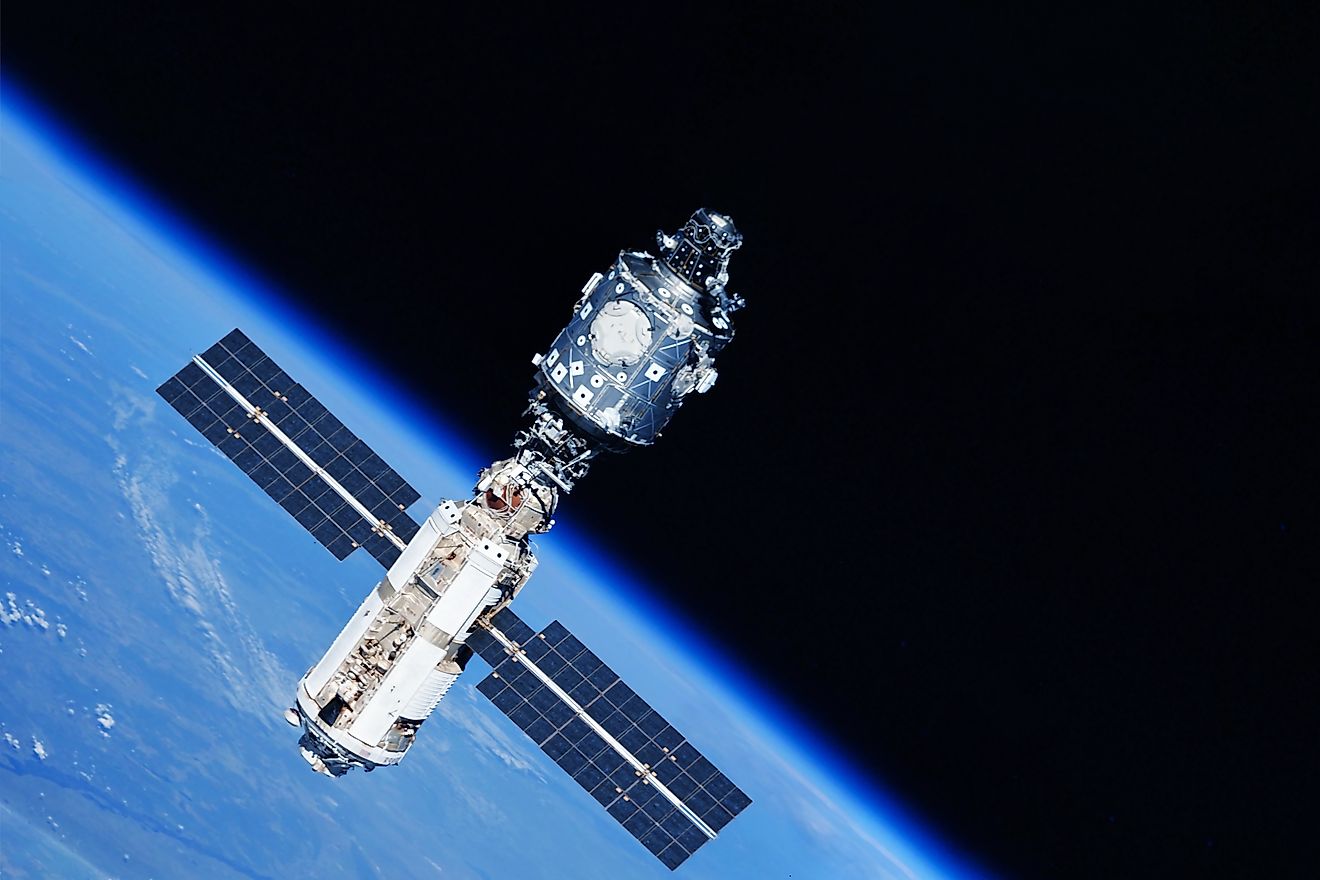
The International Space Station orbits at an average altitude of about 400 km, well inside the thermosphere. The lower thermosphere is also where most aurora occur (Aurora Borealis in the north, Aurora Australis in the south): solar wind particles funneled by Earth's magnetic field collide with oxygen and nitrogen atoms, exciting them and producing the characteristic green and red light of atomic oxygen and the blue and purple of molecular nitrogen. The thermosphere overlaps with the ionosphere, the partly ionized portion of the upper atmosphere whose charged particles reflect shortwave radio signals; this is how AM radio transmissions can travel beyond the horizon, by bouncing off the ionized layers and back to Earth.
Exosphere
The exosphere is the outermost atmospheric layer, beginning at the thermopause and extending to roughly 10,000 km (about 6,200 miles) before fading gradually into the solar wind and interplanetary space. The gas here is so thin that individual molecules can travel hundreds of kilometers before colliding with another particle, and the lightest molecules (mainly hydrogen and helium) can reach escape velocity and leak slowly into space. Geostationary communications satellites orbit at about 35,786 km altitude, technically still inside the exosphere by some definitions. Despite the enormous nominal thickness of the atmosphere, almost everything we colloquially think of as "the air" is concentrated within the lowest 30 km, less than the straight-line distance from downtown Manhattan to Newark Liberty International Airport.
Why The Atmosphere Matters
The atmosphere is not a passive backdrop. It supplies the oxygen we breathe, regulates surface temperature through a roughly 33°C natural greenhouse effect (without which Earth's average surface temperature would be about -18°C instead of the actual 15°C), shields the surface from harmful UV through the stratospheric ozone layer, and burns up the vast majority of incoming meteoroids before they reach the ground. The recent surge in atmospheric CO2, climbing from around 280 ppm before the Industrial Revolution to a monthly peak of 430.5 ppm at Mauna Loa in May 2025, has begun to amplify that natural greenhouse effect and warm the global surface; the same atmosphere that has kept life viable on Earth for billions of years is now responding measurably to industrial-era changes in its composition. The five-layer structure described above (a roughly 10,000 km vertical extent but with three-quarters of all atmospheric mass concentrated in the lowest 11 km) is what makes that response globally consequential despite the very small percentages involved.