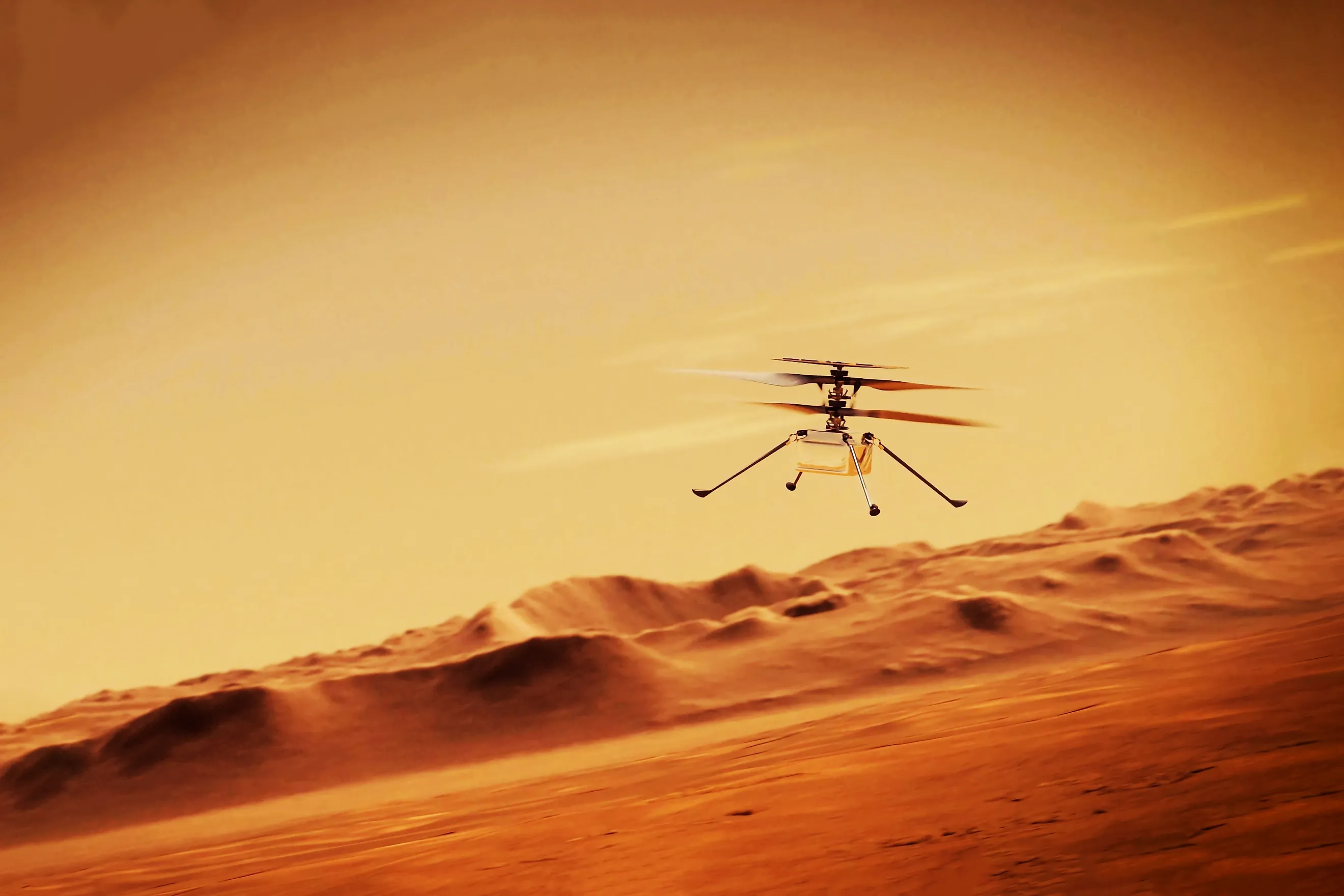
What The Latest Mars Helicopter Flights Taught Us
The engineers at NASA's Jet Propulsion Laboratory (JPL) and AeroVironment likely had little idea of the impact their Mars helicopter concept would have when development work began in the early 2010s. By the time NASA announced on May 11, 2018, that the Mars 2020 mission would carry a deployable helicopter, excitement was already building throughout the scientific and spaceflight communities. What ultimately emerged from the project, however, would prove far more significant than many initially expected.
The original concept was relatively straightforward. Ingenuity, first developed as a "risk reduction vehicle," was designed as a technology demonstrator. Its primary objective was to show that a lightweight, counter-rotating rotorcraft could generate lift and operate reliably in Mars' extremely thin atmosphere. If successful, the technology could support future missions by providing aerial reconnaissance ahead of rover traverses, helping mission planners identify hazards and safer routes. An aerial perspective could also reveal geological features that are difficult or impossible to detect from the ground, while reducing the need for time-consuming backtracking and improving the efficiency of surface exploration.
A Martian Wright Brothers moment

Ingenuity's achievements were significant because they expanded humanity's ability to explore Mars and demonstrated an entirely new mode of planetary exploration. Many observers have compared the helicopter's first flight to the Wright Brothers' historic achievement at Kitty Hawk, a comparison NASA itself embraced by carrying a small piece of fabric from the original Wright Flyer aboard the aircraft. On April 19, 2021, Ingenuity became the first vehicle to achieve powered, controlled flight on another planet.
What followed exceeded nearly every expectation. Originally intended as a short technology demonstration consisting of five flights over approximately 30 Martian days, Ingenuity ultimately completed 72 flights over nearly three years of operation. By the time its mission ended in January 2024, the helicopter had transformed from a simple technology demonstrator into an invaluable scouting tool for the Perseverance rover. Its success provided compelling evidence that future planetary missions can benefit greatly from incorporating aerial vehicles.

Achieving flight on Mars was far from straightforward. The planet's atmosphere is only about 1% as dense as Earth's at sea level, making lift generation exceptionally difficult. To compensate, Ingenuity's twin carbon-fiber rotors spun at speeds of roughly 2,400 to 2,900 revolutions per minute, which is far faster than those of most terrestrial helicopters. Engineers also had to contend with abrasive dust, intense radiation, and nighttime temperatures that could plunge to around -130°F (-90°C).
Beyond proving that powered flight is possible on Mars, Ingenuity demonstrated the durability of modern electronics in an unforgiving extraterrestrial environment. The helicopter relied in part on commercially derived hardware, including a smartphone-class processor, showing that carefully adapted consumer technologies can play a role in future space missions. Its longevity and performance provided valuable lessons that are already influencing the design of next-generation aerial explorers destined for Mars and beyond.
Ingenuity, Indeed

Before the arrival of aerial scouts such as Ingenuity, moving a Mars rover was a painstaking process that required careful planning, extensive analysis, and extremely cautious progress. Without an aerial perspective, mission teams often had to make navigation decisions using only limited ground-level imagery. Even with sophisticated cameras and detailed route planning, identifying the safest and most efficient path across rugged Martian terrain remained a challenge.
Rovers such as Opportunity and Curiosity occasionally had to alter their routes or retrace portions of their paths when unexpected obstacles or hazardous terrain were identified. One notable example occurred in 2014, when Opportunity became trapped in a patch of soft terrain. Engineers spent weeks testing recovery strategies on Earth before successfully freeing the rover. Situations like this highlighted the limitations of surface-only exploration and underscored the potential value of an aerial reconnaissance platform.

Somewhat ironically, Ingenuity's mission did not end because of mechanical failure or environmental degradation, but because its navigation system struggled to track surface features while attempting to land. During its 72nd flight in January 2024, the helicopter lost visual reference points near the surface, resulting in a hard landing that damaged its rotor blades beyond repair.
Although the incident brought the mission to a close, it also provided valuable lessons for future aerial explorers. Engineers now have a clearer understanding of the challenges associated with navigating feature-poor environments, where visual navigation systems can struggle to identify sufficient reference points. Improved sensors, navigation software, and terrain-mapping capabilities will likely play an important role in the next generation of planetary drones, helping them operate more safely and effectively across the diverse landscapes of Mars and other worlds.
Opposition to Ingenuity

Interestingly, not everyone within NASA and JPL initially supported the idea of adding a helicopter to the Mars 2020 mission. While the concept was undeniably innovative, some scientists and mission planners questioned whether a technology demonstration was worth the additional cost, complexity, and operational time. Among those expressing reservations was Perseverance project scientist Kenneth Farley, who noted that dedicating roughly 30 days of mission time to a flight experiment did little to advance the rover's primary scientific objectives. From that perspective, the helicopter represented a trade-off: every day spent testing a new technology was a day not spent collecting samples and conducting surface science.
Such concerns were understandable. Mars missions are extraordinarily expensive, technically challenging undertakings built upon decades of accumulated experience. Adding an entirely new flight system introduced additional risk, while the practical benefits of aerial reconnaissance had yet to be demonstrated. To many mission planners, the proposal may have seemed like an uncertain investment compared with continuing to refine proven rover-based exploration strategies.
Even after its early successes, mission leaders occasionally reminded teams to remain focused on the primary objectives of the Mars 2020 mission. After all, Ingenuity was originally intended to support the broader exploration effort, not overshadow it. Yet as the helicopter continued to exceed expectations, it became increasingly difficult to view it as merely a side experiment. By the end of its mission, it had transformed from a technology demonstration into one of the most influential robotic explorers ever sent to another world.
What Has Ingenuity Really Taught Us?

First and foremost, it is worth remembering that Ingenuity did not emerge overnight. The helicopter was the product of decades of research and development, led by Bob Balaram and a team of engineers who pursued the idea of powered flight on Mars long before it became a mission reality. In many ways, the project demonstrates the value of long-term planning, persistence, and incremental technological progress.
So what, specifically, did Ingenuity teach us? Perhaps most importantly, it demonstrated that powered, controlled flight is not only possible on Mars but can serve as a practical tool for planetary exploration. The mission also showed that certain commercially derived technologies, when carefully adapted and integrated, can perform reliably in the harsh conditions of another world. Engineers now have a far better understanding of how lightweight aerial vehicles operate in the Martian atmosphere, which design choices are most effective, and which limitations future aircraft will need to overcome.

Critically, the mission also revealed areas where additional innovation is required. Navigation in feature-poor terrain, for example, remains a significant challenge for drones and other autonomous aerial systems. Lessons learned from Ingenuity's final flight are already helping engineers develop more capable sensors, navigation software, and flight systems for future planetary drones.
Ultimately, Ingenuity accomplished far more than proving a technological concept. It established an entirely new method of exploring other worlds and provided a wealth of engineering data that will inform future missions for years to come. As humanity continues its push deeper into the solar system, the small helicopter that once flew above the sands of Jezero Crater may be remembered as the aircraft that opened the skies of another planet.