Where Does Outer Space Begin?
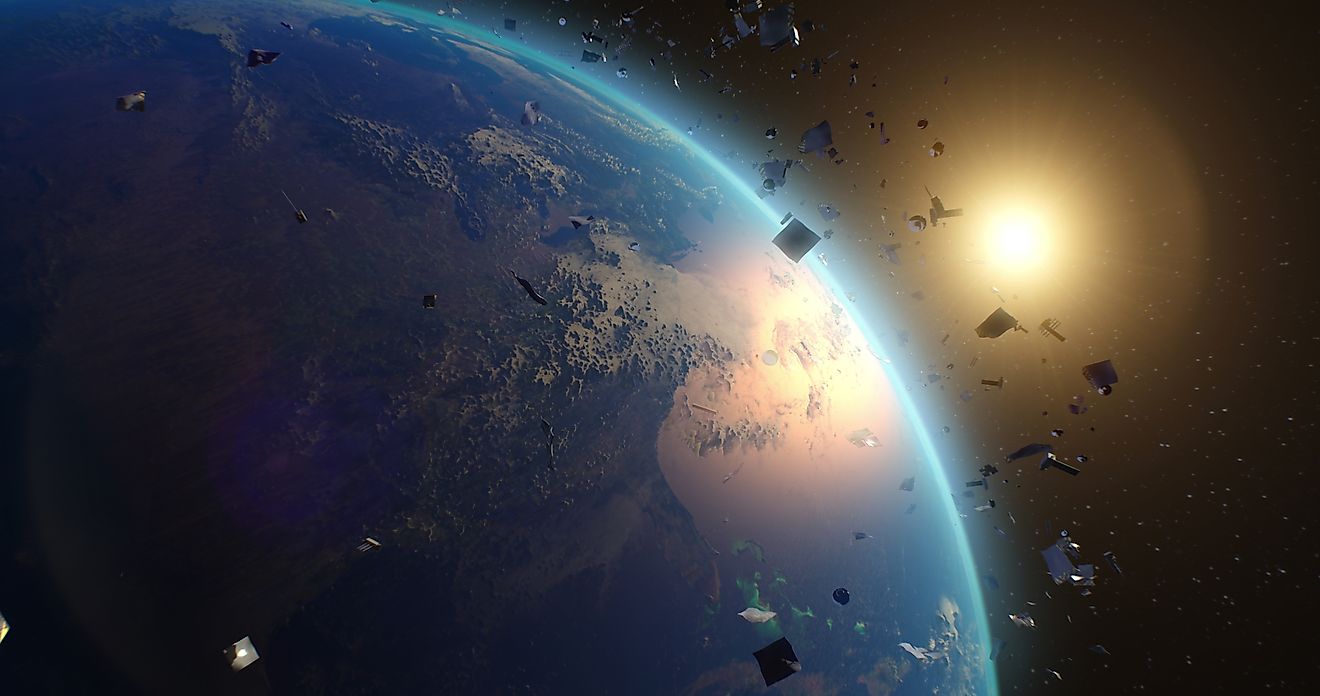
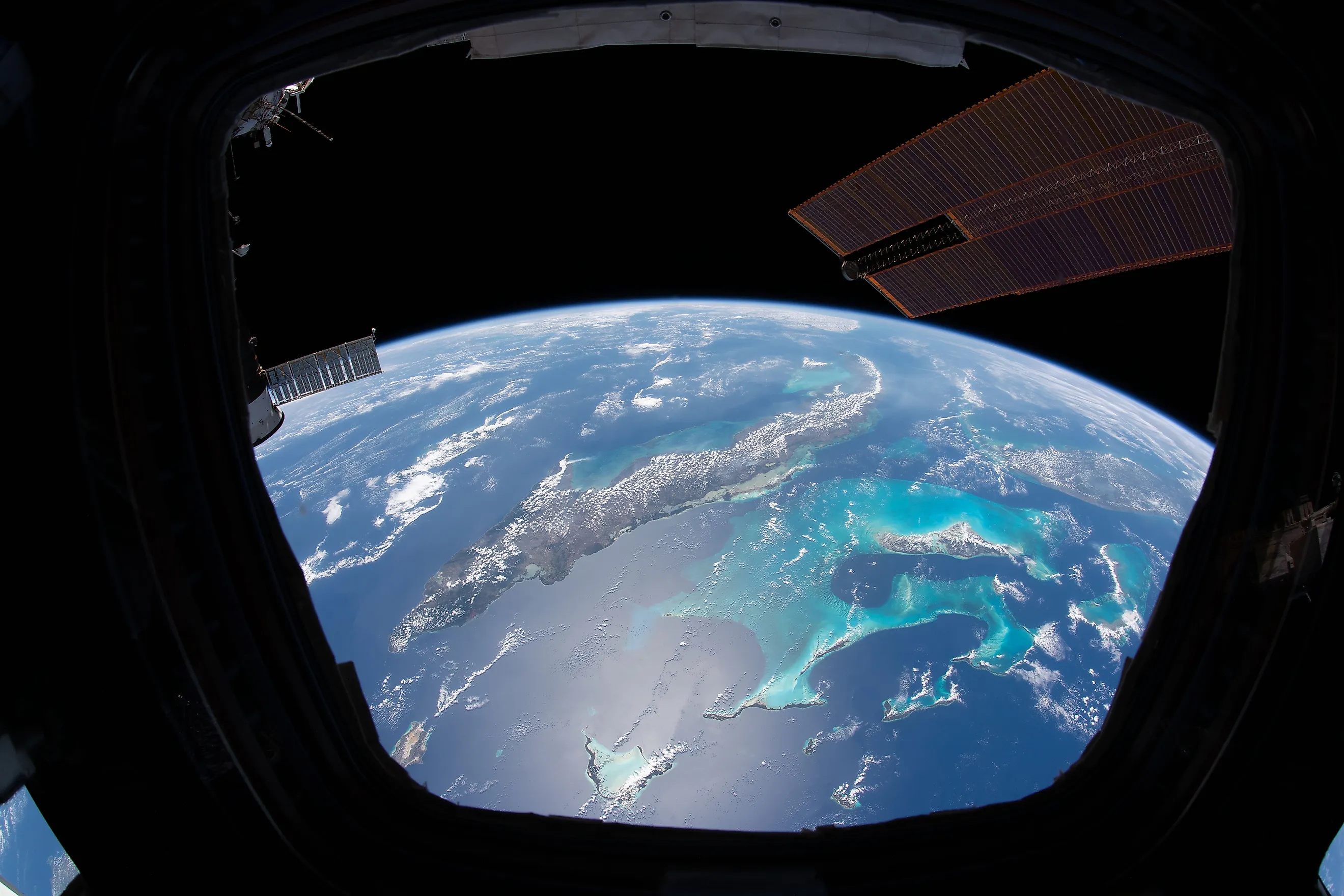
Outer space is the volume that lies beyond the atmospheres of celestial bodies. It is not a perfect vacuum: even the emptiest stretches of intergalactic space contain hydrogen atoms, plasma, electromagnetic radiation, cosmic rays, neutrinos, and traces of dust. The harder question is where space actually begins. Earth's atmosphere does not end at a clean line. It thins out gradually until there is essentially nothing left, and different organizations have drawn the boundary at different altitudes for different reasons. The most widely cited answer, used by the Fédération Aéronautique Internationale (FAI) for record-keeping, is the Kármán Line at 100 kilometers (about 62 miles) above mean sea level. The United States, however, uses 80 kilometers (50 miles), and at least three other competing definitions have serious scientific support.
The Kármán Line: The 100-Kilometer Standard

The 100-km boundary is named after Theodore von Kármán (1881-1963), a Hungarian-American physicist and aerospace engineer whose research laboratory at Caltech later became NASA's Jet Propulsion Laboratory. In the 1950s, Kármán worked through the physics of high-altitude flight and asked at what altitude an aircraft would have to travel so fast to generate aerodynamic lift that it would essentially be in orbit. The answer was an altitude where the speed needed to stay aloft equals orbital velocity, roughly 7.9 kilometers per second.
Kármán's own rough calculation came out closer to 84 kilometers (about 52 miles), not 100. The round number was a later choice. An associate of Kármán's, the lawyer Andrew G. Haley, proposed using Kármán's altitude as a legal and aeronautical boundary between airspace and outer space, and named it after him. The FAI, the international body that ratifies aviation and astronautics records, adopted 100 kilometers as the working figure in 1960. The reasons were practical rather than physical. The number was easier to remember, easier to verify in flight records, and close enough to Kármán's calculation given that atmospheric density at that altitude varies considerably with solar activity, time of year, and time of day.
The 50-Mile Boundary: NASA and the FAA

The United States never adopted the FAI's 100-kilometer line. Since the 1960s, NASA, the Federal Aviation Administration (FAA), and the US Air Force have used 80 kilometers, or 50 miles, as the boundary of space. That figure is closer to Kármán's original calculation than the FAI's rounded 100 km, and during the X-15 rocket-plane program of the 1960s, the Air Force awarded astronaut wings to pilots who crossed it. Eight X-15 pilots earned military astronaut wings under that rule, even though three of them never crossed the FAI's 100-km line.
The discrepancy reappeared with the rise of commercial suborbital tourism. Blue Origin's New Shepard vehicle flies above 100 km, qualifying its passengers as astronauts under both the US and the international definitions. Virgin Galactic's SpaceShipTwo peaks closer to 86 to 90 km, above the 50-mile US line but below the FAI's Kármán line. Blue Origin used this difference in its early marketing, pointing out that its passengers would be considered astronauts in every country, while Virgin Galactic's would be recognized only by the US definition.
Other Proposed Boundaries

The Kármán line and the 50-mile line are not the only candidates. American astrophysicist Jonathan McDowell published an influential reanalysis in 2018 in the journal Acta Astronautica, arguing that the boundary should sit at 80 ±10 kilometers. McDowell tracked the orbits of more than 40,000 satellites and found that satellites can complete at least one full orbit at altitudes as low as roughly 80 km before atmospheric drag pulls them down. Above that altitude, gravity dominates over atmospheric resistance. Below it, atmospheric resistance dominates. In 2018, the FAI announced it was considering moving the Kármán line down to 80 km in line with McDowell's findings, but it ultimately reaffirmed the 100-km figure.
A different research direction places the boundary higher. In 2009, a team at the University of Calgary, led by physicist David Knudsen, used an instrument called the Supra-Thermal Ion Imager flown on NASA's JOULE-II sounding rocket from Alaska in January 2007. The instrument measured the transition zone where the relatively gentle winds of the upper atmosphere give way to the much faster ion flows driven by space weather, with charged particles moving over 1,000 km/h. The team found this dynamic boundary at about 118 kilometers (73 miles), a figure published in the Journal of Geophysical Research. The Calgary boundary is not a competing definition for record-keeping. It is a measured physical transition.
The Layers of Earth's Atmosphere

Understanding where space begins requires understanding what it begins above. Earth's atmosphere is conventionally divided into five layers, defined by the way temperature changes with altitude. From the surface upward, they are:
- Troposphere (surface to roughly 8-15 km): the densest layer, where weather happens and where commercial aircraft cruise. Holds about 75% of the atmosphere's mass.
- Stratosphere (about 15 to 50 km): home to the ozone layer, which absorbs most of the Sun's ultraviolet radiation. Temperature increases with altitude here because of ozone heating.
- Mesosphere (about 50 to 85 km): the coldest layer, with temperatures falling to around -90°C. Most meteors burn up in this region.
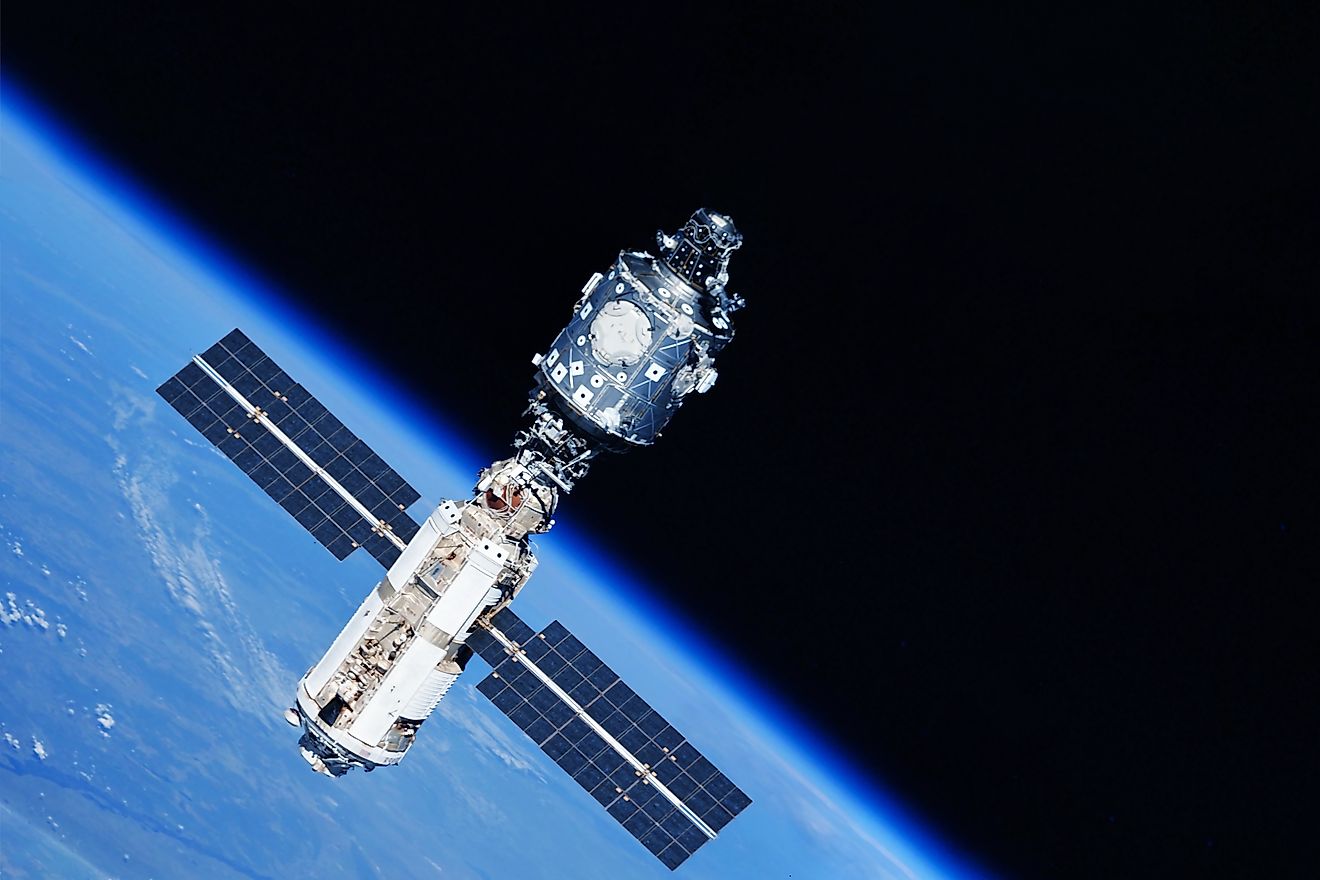
- Thermosphere (about 85 to 600 km): where temperatures climb dramatically (up to 2,000°C or higher during high solar activity), although the air is so thin that the heat would not feel hot to a human. The International Space Station orbits within this layer at about 420 km. The Kármán line runs through it.
- Exosphere (above about 600 km, fading out at roughly 10,000 km): the outermost layer, made up of widely scattered hydrogen and helium atoms that can travel hundreds of kilometers between collisions and sometimes escape into space entirely.
The mixing behavior of these layers also changes at altitude. Below about 100 km, the atmosphere is well mixed, with nitrogen at 78%, oxygen at 21%, and trace gases including argon and carbon dioxide making up the rest. This well-mixed region is called the homosphere. Above 100 km, in the heterosphere, gases stratify by molecular weight: heavier gases like oxygen and nitrogen sit lower, while lighter hydrogen and helium dominate higher up. This shift roughly coincides with the Kármán line.
What "Empty" Space Actually Contains

Outer space is the closest natural approximation of a vacuum, but it is not truly empty. In the space between stars, the density drops to roughly one hydrogen atom per cubic centimeter. In intergalactic space, the density falls further still, to roughly one atom per cubic meter. Compare this to surface air, which contains around 25 quintillion molecules per cubic centimeter, and the difference is staggering, but it is not zero.
What space does contain matters. The cosmic microwave background, the leftover radiation from the early universe, fills all of space at an effective temperature of about 2.7 kelvin (-270°C), making this the coldest "temperature" of empty space. The interstellar medium contains plasma, dust grains, and complex organic molecules. Cosmic rays, high-energy particles accelerated by supernovae and other events, stream through the void. Neutrinos pass through the entire universe and through everything in it. And the universe contains an estimated five times more dark matter than visible matter, the nature of which remains unknown.
Temperature in space is not as straightforward as it sounds. The cosmic microwave background sets a floor, but anything in direct sunlight in space heats rapidly, with surfaces facing the Sun reaching temperatures above 120°C in low-Earth orbit. Surfaces in shadow can drop to -150°C. The thermosphere, despite being mostly considered "space," can have kinetic temperatures of 2,000°C, but the gas is so thin that there are not enough molecules to transfer that heat to a passing object.
The Armstrong Limit
Long before reaching either the Kármán line or the 50-mile boundary, humans hit a different physical wall. At about 18 to 19 kilometers (60,000 to 63,000 feet) above sea level, atmospheric pressure drops to the point where water boils at human body temperature, around 37°C. This altitude is called the Armstrong Limit, named after US Air Force General Harry George Armstrong, who first identified it in the 1940s. Above this altitude, an unprotected human's saliva, tears, and the water in their lungs would boil away within seconds. Survival above the Armstrong Limit requires a pressurized cabin or a full pressure suit. The Armstrong Limit is well below the boundary of space, but for the human body it is a more meaningful threshold.
Why There Is No Single Boundary
The deeper reason for the disagreement among the FAI, NASA, McDowell, and the Calgary team is that no single physical event marks the end of the atmosphere. Atmospheric density falls smoothly, not in steps. The transition from a gas-dominated environment to a vacuum-dominated one happens gradually over tens of kilometers. Different criteria pick out different altitudes within that range, and each has a defensible claim:
- If "space" means where aerodynamic flight becomes impossible, Kármán's calculation gives roughly 84 km.
- If it means where orbits become possible without immediate decay, McDowell's analysis gives roughly 80 km.
- If it means where atmospheric chemistry transitions to the heterosphere, the answer is near 100 km.
- If it means where the dynamic transition from atmospheric winds to space-driven ion flows occurs, the Calgary measurement gives 118 km.
All of these answers describe real physical transitions. None of them is the boundary, because there is no single boundary to find. The 100-km Kármán line persists because it is a useful convention, easy to verify, and broadly close to most of the contenders.
Origin of the Term "Outer Space"

The shorter word "space," meaning the region beyond Earth's sky, predates the concept of a defined boundary by centuries. John Milton used it in Paradise Lost in 1667. The phrase "outer space" first appeared in astronomy in 1845, in the writing of the German naturalist and explorer Alexander von Humboldt, although a similar phrase, "outward space," appeared in an 1842 poem by the English poet Lady Emmeline Stuart-Wortley. The term "outer space" reached a wider audience through the work of English science fiction writer H. G. Wells, particularly his 1901 novel The First Men in the Moon, which describes a journey to the Moon in a spherical craft built from a fictional gravity-blocking material called cavorite. The novel was serialized in The Strand Magazine from late 1900 through mid-1901 before its hardcover release.
The legal status of outer space was eventually formalized through the 1967 Outer Space Treaty, which prohibits any nation from claiming sovereignty over space or any celestial body. The treaty does not, however, define where outer space begins, leaving the legal boundary as undetermined as the scientific one.