How Big Are the Largest Known Asteroids?
The largest known asteroid, 4 Vesta, is about 525 kilometers across, the size of the state of Arizona laid end to end. After Vesta, the size drops slowly through Pallas, Hygiea, Interamnia, and Europa, all of them between roughly 315 and 512 kilometers in diameter. The often-cited "largest asteroid," 1 Ceres at 940 kilometers, was reclassified as a dwarf planet in 2006 and is no longer counted as an asteroid by NASA or the International Astronomical Union. NASA's own pages explicitly call Vesta "the largest asteroid" for that reason. Most of what we know about the top five up close came from a single NASA spacecraft (Dawn, 2011 to 2018) and a series of Very Large Telescope observations between 2017 and 2020. Below are the five largest known asteroids by diameter, what they are made of, and what spacecraft and ground telescopes have learned about them in the past decade.
What An Asteroid Actually Is
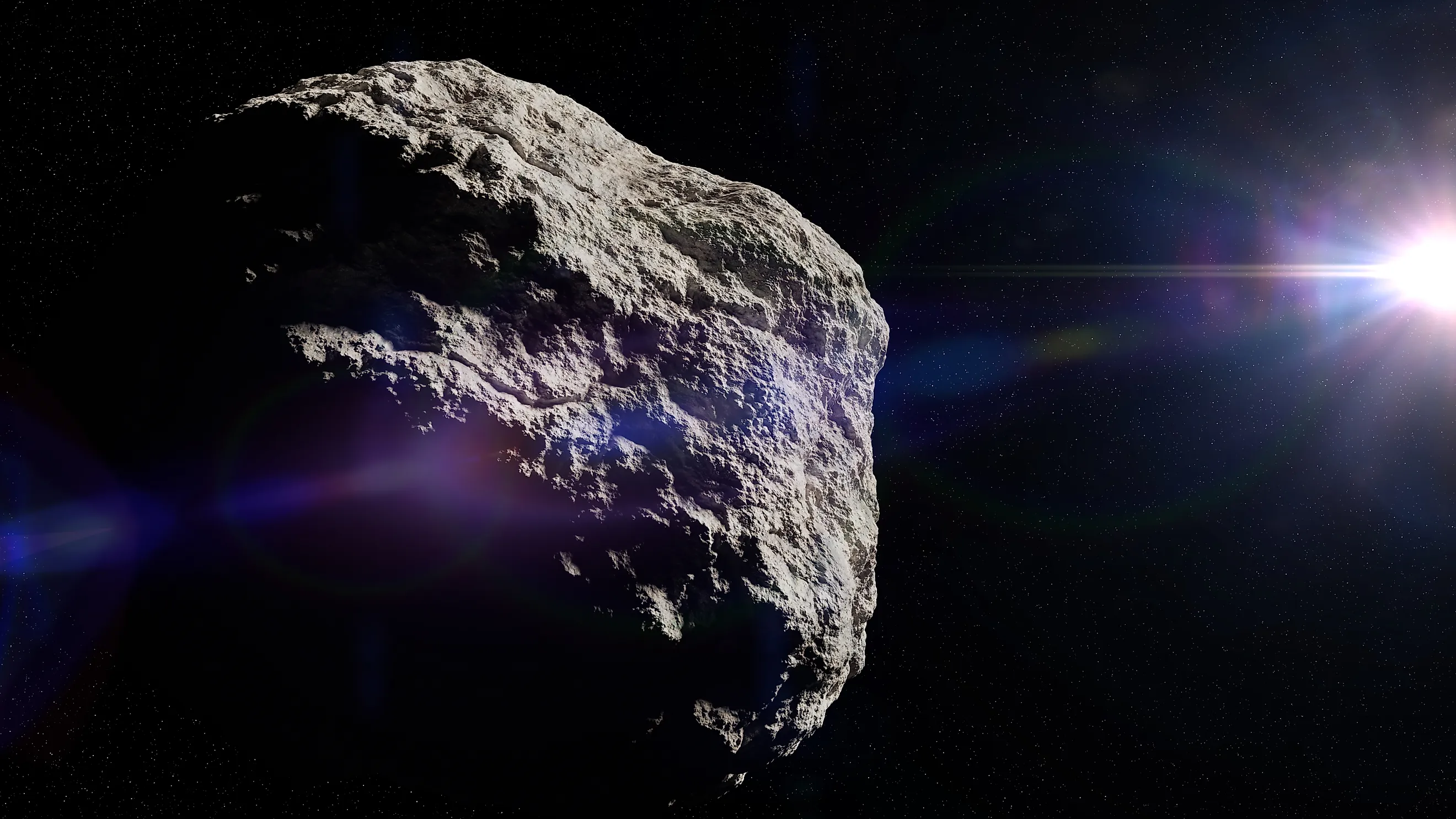
Asteroids are rocky and metallic bodies left over from the formation of the solar system about 4.6 billion years ago. The vast majority orbit the Sun in the asteroid belt, a roughly torus-shaped region between the orbits of Mars and Jupiter that runs from about 2.2 to 3.2 astronomical units from the Sun (one AU is the Earth-Sun distance, roughly 93 million miles). The belt now contains over a million catalogued objects. Despite the popular image of a dense field of tumbling rocks, the average distance between asteroids in the belt is around 600,000 miles. NASA spacecraft routinely cross the belt without incident.
The total mass of all asteroids combined is only about 3 percent of the mass of Earth's Moon. Most of that mass is concentrated in a handful of the largest objects, which is why so much research focuses on them.
Why Ceres Is Not On This List

For most of the 20th century, 1 Ceres was the answer to the question "what is the largest asteroid?" Italian astronomer Giuseppe Piazzi discovered Ceres on January 1, 1801, and at 940 kilometers across (about 585 miles), it accounts for roughly 40 percent of the entire asteroid belt's mass. But Ceres turned out to be unusual: it is the only object in the asteroid belt large enough for its own gravity to pull it into a sphere. In 2006, the International Astronomical Union introduced the "dwarf planet" category alongside its formal definition of "planet," and Ceres became the first dwarf planet ever named. It is no longer classified as an asteroid in standard NASA usage. The dual designation does still appear in some sources, and the IAU's Minor Planet Center notes that dwarf planets can carry both labels, but the cleaner answer is that the largest object in the asteroid belt is not, technically, an asteroid.
NASA's Dawn spacecraft entered orbit around Ceres in March 2015 and mapped its surface for over three years. The data showed Ceres to be a water-rich world: roughly 25 percent ice by mass, more water than any other body in the inner solar system except Earth. Dawn imaged the bright spots inside Occator Crater, a 92-kilometer impact basin near the equator. The brightest of those, Cerealia Facula, turned out to be sodium-carbonate salt deposits left behind when briny water from a deep subsurface reservoir percolated to the surface and evaporated. The reservoir sits about 40 kilometers below the surface and extends hundreds of kilometers across. Dawn ran out of fuel in October 2018 and now sits in a long-term, silent orbit around Ceres. With Ceres set aside as a dwarf planet, here are the five largest objects still classified as asteroids.
How Astronomers Measure Asteroid Size
Sizing an asteroid from Earth is harder than it sounds. Through a telescope, even the largest asteroids appear as single points of light. To work out a real diameter, astronomers use a few main techniques. Infrared measurements record the heat that an asteroid radiates back into space after being warmed by sunlight, which gives a better estimate of surface area than visible light alone (a dark surface and a bright surface of the same size reflect very different amounts of visible light, but both warm up similarly). Stellar occultations time how long an asteroid blocks the light of a background star as the rock passes in front of it, giving a precise chord across the asteroid. Adaptive-optics imaging from instruments like SPHERE on the Very Large Telescope in Chile produces resolved disc images of the largest asteroids. And in the case of Vesta and Ceres, the Dawn spacecraft mapped both objects directly from orbit between 2011 and 2018.
The combination of these techniques has tightened the size and shape estimates for the top asteroids significantly since 2010. Some older numbers in textbooks and websites are now out of date.
1. 4 Vesta

Vesta has a mean diameter of 525 kilometers (about 326 miles) and is the most massive object in the belt that is still classified as an asteroid. It holds about 9 percent of the belt's total mass. German astronomer and physician Heinrich Wilhelm Olbers discovered it on March 29, 1807, making it the fourth asteroid identified, after Ceres, Pallas, and Juno. Vesta is also the only asteroid bright enough to be visible to the naked eye from Earth under good conditions.
Dawn orbited Vesta between July 2011 and September 2012 before continuing on to Ceres, the first spacecraft ever to orbit two extraterrestrial destinations. The mission confirmed that Vesta is structurally more like a small planet than a typical asteroid: it has a differentiated interior with an iron-nickel core (about 220 kilometers across), a rocky mantle, and a basaltic crust. For that reason, planetary scientists often call Vesta a protoplanet, a building block left over from the era when terrestrial planets were forming. The most prominent feature is the Rheasilvia impact basin at the south pole, 505 kilometers across (95 percent of Vesta's mean diameter). The central peak inside Rheasilvia rises 19 to 22 kilometers from its base, making it one of the tallest mountains in the solar system, second only to Olympus Mons on Mars. The impact that formed Rheasilvia about a billion years ago ejected an estimated 1 percent of Vesta's volume, much of which became the Vesta family of asteroids and the howardite-eucrite-diogenite (HED) meteorites that are routinely found on Earth. About 6 percent of all meteorite finds on Earth are pieces of Vesta.
2. 2 Pallas

Pallas has a diameter of around 512 kilometers (318 miles) and accounts for about 7 percent of the asteroid belt's total mass. Olbers discovered it on March 28, 1802, while looking for the recently lost Ceres, making Pallas the second asteroid ever found. It was at first considered a planet alongside Ceres.
What makes Pallas unusual is its orbit. Most asteroids orbit close to the same plane as the planets, but Pallas is tilted about 34.8 degrees off that plane, almost as steeply as Pluto. This sends Pallas plunging in and out of the main belt twice per orbit and dramatically increases the speed at which it collides with other asteroids. The result, revealed by VLT/SPHERE images published in 2020, is a surface so heavily cratered that the research team nicknamed it the "golf ball asteroid." Astronomers identified at least 36 craters larger than 30 kilometers across, with crater impacts covering at least 10 percent of the surface. Pallas is thought to be a partially differentiated protoplanet whose composition is mostly silicate rock with little water or iron. NASA considered extending the Dawn mission to Pallas after Ceres, but Pallas's steep orbital inclination put it out of reach for the spacecraft's available propellant.
3. 10 Hygiea (Possible Dwarf Planet)

Hygiea has a mean diameter of 433 kilometers (about 269 miles) and is currently classified as the third-largest asteroid by both volume and mass. The qualifier "currently" matters here, because Hygiea may not stay on this list for long. Italian astronomer Annibale de Gasparis discovered it on April 12, 1849, from the Capodimonte Astronomical Observatory in Naples (an older WorldAtlas entry listed the year as 1854, which is incorrect). Hygiea sits in the outer main belt and is so dim from Earth, despite its size, that six smaller asteroids were spotted before it.
For most of its known history Hygiea was assumed to be lumpy and irregular, the survivor of a massive collision around 2 billion years ago that produced the 7,000-member Hygiea asteroid family. That assumption changed in October 2019, when a team led by Pierre Vernazza published high-resolution VLT/SPHERE images showing Hygiea is, in fact, nearly spherical. The shape is now understood to be the result of the same family-forming collision: the impact pulverized the parent body, and the largest fragments collapsed back together under their own gravity, cooling into a near-perfect sphere. Because Hygiea orbits the Sun, has not cleared its orbital neighborhood, is not a moon, and now appears to be in (or near) hydrostatic equilibrium, it meets all four criteria the IAU uses to define a dwarf planet. If the IAU formally accepts the reclassification, Hygiea would become the smallest dwarf planet in the solar system and, like Ceres, would be removed from the list of asteroids. As of 2026, the proposal is still under discussion. For now, Hygiea remains officially an asteroid.
4. 704 Interamnia
Interamnia, with a diameter of about 332 kilometers (206 miles), is the fourth-largest asteroid and a sharp drop in size from Vesta, Pallas, and Hygiea. Italian astronomer Vincenzo Cerulli discovered it on October 2, 1910, from the observatory he founded in Teramo, Italy, and named it after Interamnia, the ancient Latin name for the city. Interamnia is the largest member of the F-type spectral class, a dark, primitive subgroup of carbonaceous asteroids.
Interamnia is the least-studied of the top five and was, until recently, also the least-understood. VLT/SPHERE imaging in 2017 to 2019 finally produced resolved images and gave a precise size and shape: a slightly oblate ellipsoid similar to Vesta, with an estimated density of 1.98 grams per cubic centimeter. That low density, plus surface signatures of hydrated minerals, suggests Interamnia is part-ice, part-rock, with characteristics similar to Ceres and Hygiea. Unlike Hygiea and Vesta, Interamnia has no associated asteroid family, which means it has likely avoided any catastrophic impact for at least the last 3 billion years. The 2020 study that produced these results described Interamnia as "a transition object between a dwarf planet and a typical irregular-shaped minor body."
5. 52 Europa
Europa rounds out the top five with a volume-equivalent diameter of about 315 kilometers (196 miles). Its shape is a clear ellipsoid measuring roughly 380 by 330 by 250 kilometers, much less spherical than Vesta or Hygiea. German-born astronomer Hermann Mayer Salomon Goldschmidt discovered it on February 4, 1858, from his apartment balcony in Paris. The asteroid is named after Europa from Greek mythology and is not to be confused with the much-better-known moon of Jupiter that shares the name.
Europa is a dark C-type carbonaceous asteroid with a low albedo and a density of about 1.5 grams per cubic centimeter. Modern resolved imaging using the Very Large Telescope and adaptive optics has refined its volume-equivalent diameter to 315 ± 7 kilometers, and its mass is currently estimated at around 19 to 33 × 10^18 kg, depending on the study. Despite searches in 1988 and again in the 2000s, no satellite or dust ring has ever been detected around Europa. It is a member of the same general region of the outer belt as Hygiea and Interamnia, and shares many of their characteristics: dark, carbon-rich, primitive, and largely unchanged since the formation of the solar system.
What About 31 Euphrosyne?
Older lists of the largest asteroids often place 31 Euphrosyne in the top five by mass, including the previous version of this article. That ranking is now out of date. James Ferguson discovered Euphrosyne on September 1, 1854, from Washington, the first asteroid found from North America. In 2019, a team using the VLT discovered a small moonlet orbiting Euphrosyne (about 4 kilometers across), which finally allowed astronomers to measure the asteroid's mass directly using Kepler's laws. The 2020 result was about 1.7 × 10^19 kg, far smaller than older indirect estimates of 5.8 × 10^19 kg. Euphrosyne is now known to be ice-rich and approximately spherical, but only about 268 kilometers across. It falls outside the top five by both mass and diameter, with 511 Davida and 87 Sylvia (both around 270 to 290 kilometers) also competing for spots in the top ten. Other asteroids that round out the top ten by mass include 15 Eunomia, 532 Herculina, and 3 Juno.
The Threat From Asteroids And What We Can Do About It

This composite image shows the comparative sizes of eight asteroids.
The dinosaurs were almost certainly killed off (along with three-quarters of all species on Earth) by an asteroid roughly 10 to 15 kilometers across that struck the Yucatán Peninsula about 66 million years ago, leaving the 180-kilometer Chicxulub crater. Asteroids of that size are extremely rare in the inner solar system. Smaller objects are common, and even an object a few hundred meters across could destroy a city if it hit one. Most asteroids are far too small to do meaningful damage, and most do not have orbits that cross Earth's path. NASA's Planetary Defense Coordination Office and similar programs in Europe and elsewhere now track tens of thousands of near-Earth objects, with the survey effort accelerating each year.
For the first time in history, humans now have a demonstrated way to push back. On September 26, 2022, NASA's Double Asteroid Redirection Test (DART) spacecraft deliberately collided with Dimorphos, a 160-meter moonlet orbiting the larger asteroid Didymos, at about 6.6 kilometers per second. The impact shortened Dimorphos's orbital period around Didymos by 32 minutes (from 11 hours 55 minutes to 11 hours 23 minutes), proving that a kinetic impactor can change the trajectory of a small asteroid by a measurable amount. Neither object posed any threat to Earth before or after the test. The European Space Agency's Hera mission, launched in October 2024, is on its way to the Didymos system and is scheduled to arrive in late December 2026 to study the aftermath in detail. Past asteroid impacts on Earth have shaped life on the planet repeatedly, and DART is the first concrete demonstration that future impacts can be avoided.
The Top Five By The Numbers
| Rank | Asteroid | Mean diameter | Mass (×10^18 kg) | Discovered | Discoverer |
|---|---|---|---|---|---|
| 1 | 4 Vesta | 525 km (326 mi) | 259 | 29 Mar 1807 | Heinrich Olbers |
| 2 | 2 Pallas | 512 km (318 mi) | 205 | 28 Mar 1802 | Heinrich Olbers |
| 3 | 10 Hygiea* | 433 km (269 mi) | 87 | 12 Apr 1849 | Annibale de Gasparis |
| 4 | 704 Interamnia | 332 km (206 mi) | 38 | 2 Oct 1910 | Vincenzo Cerulli |
| 5 | 52 Europa | 315 km (196 mi) | ~24 | 4 Feb 1858 | Hermann Goldschmidt |
*Hygiea is a candidate dwarf planet based on 2019 VLT/SPHERE observations and could be reclassified pending IAU review.
Closing Notes
The list of the largest asteroids has shifted over the past two decades, and it is likely to shift again. Ceres, long the answer to the question of which asteroid is biggest, was reclassified as a dwarf planet in 2006 and is no longer on the list at all. Hygiea, sitting at #3 today, may follow in the next decade if the IAU accepts the 2019 case for reclassification. Vesta, currently #1, has been mapped from orbit and is well understood. Pallas, Interamnia, and Europa have all received their first resolved images only in the past few years. A decade ago, Pallas was assumed to be a smooth oblate spheroid; today it is the cratered "golf ball." Five years from now, the rankings of the largest asteroids may shift again. The asteroid belt is far more dynamic, and far better resolved, than the textbook image of it would suggest.