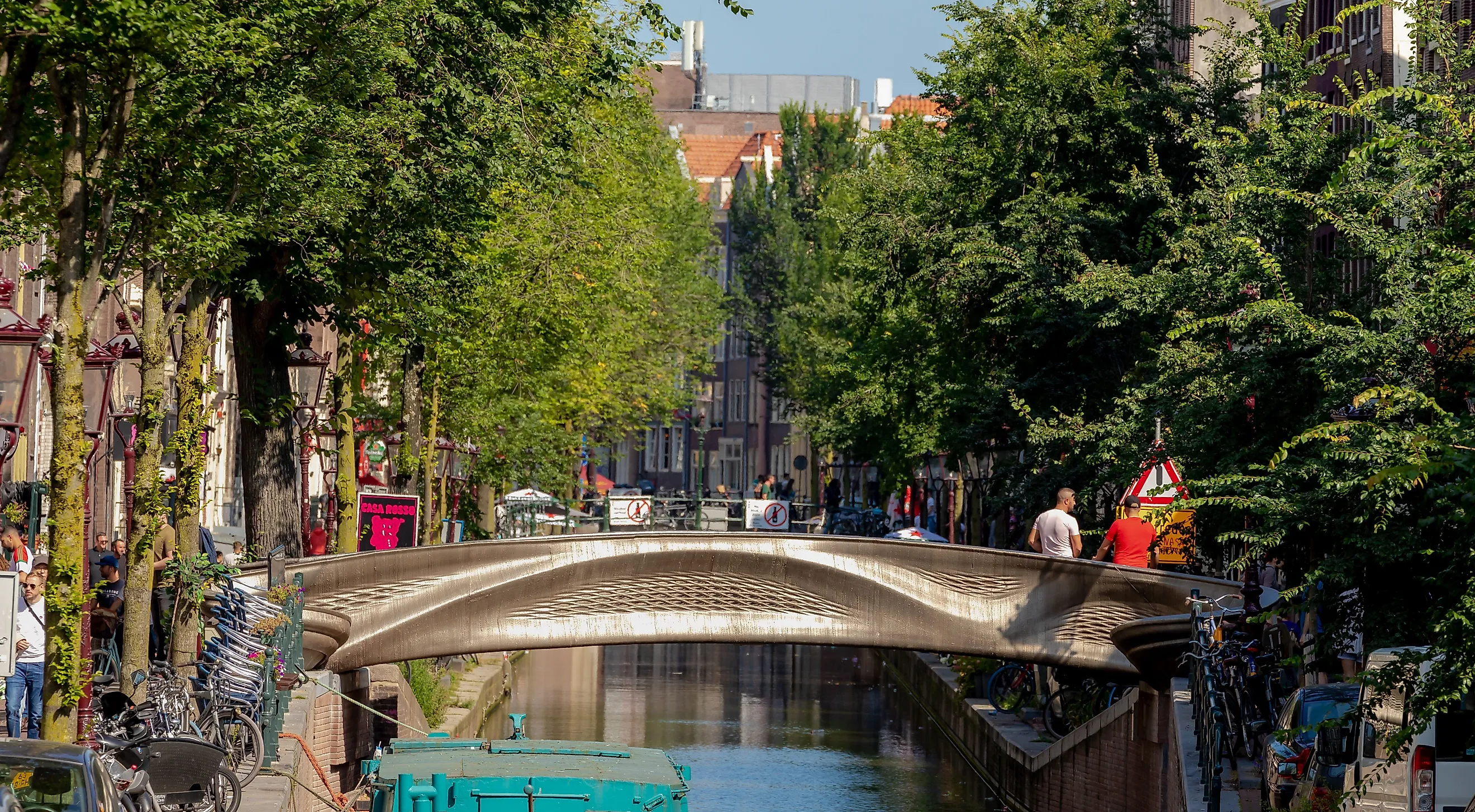
World’s First 3D-Printed Steel Bridge In Amsterdam
The MX3D bridge in Amsterdam was 12.2 meters long, 6.3 meters wide, 2.1 meters high, and made of about 4,500 kilograms of stainless steel that four industrial robots welded into shape over six months in 2017 and 2018. Queen Máxima of the Netherlands opened it to pedestrians and cyclists on July 15, 2021, where it spanned the Oudezijds Achterburgwal canal in the city's Red Light District. It was the first full-size 3D-printed stainless steel pedestrian bridge anywhere in service. A two-year permit from the City of Amsterdam ran out in October 2023, and the bridge was removed and crated for relocation. While it stood, it was both a working footbridge and a long-running materials experiment, with more than a hundred sensors feeding a digital twin maintained by Imperial College London and the Alan Turing Institute.
How It Was Printed

The technical process is called Wire Arc Additive Manufacturing, or WAAM. It is essentially welding repurposed as 3D printing. An industrial six-axis robot arm holds a welding torch that deposits beads of stainless steel rod, layer by layer, along a path defined by a digital model. The Dutch company MX3D, co-founded by designer Joris Laarman in 2014, wrote the control software that turns off-the-shelf ABB welding robots into metal printers operating from a CAD file. For the bridge, four such robots worked in parallel at MX3D's facility in the NDSM shipyard in north Amsterdam, building the span continuously by laying weld onto weld.
The original plan, formed in 2015, was more ambitious and considerably more cinematic: print the bridge in situ across the canal, with robots stationed on each bank welding toward the middle until the two halves met. That approach was abandoned as impractical. The final bridge was printed off-site in two pieces. The main span was finished in April 2018, the deck in October of the same year. The structure was then strengthened to satisfy municipal regulations and to absorb potential boat strikes from below before being lifted into position over the canal in 2021.
How The Design Was Generated
The bridge was designed by Joris Laarman Lab with engineering firm Arup as lead structural engineer. Rather than draw the bridge in conventional CAD and then check whether it would stand up, the team ran the design through generative algorithms: Grasshopper and Karamba working inside the Rhino modeling environment, iterating shapes against a set of constraints such as load paths, deflection limits, and available steel volume. The result was an S-shaped span with curving balustrades and lattice-cut perforations, with material concentrated where the structure carried load and removed where it did not. Departing from the conventional U-shaped pedestrian bridge was the point: the design existed to demonstrate what becomes possible once the limits of rolled and bolted steel sections drop out of the equation.
Arup and MX3D also co-developed the production toolchain. Gijs van der Velden, MX3D's chief executive, has said that Arup's experience with generative design was decisive for the project, and that the partnership has continued well past the bridge itself.
Testing At Imperial College London

No structural design code existed for 3D-printed steel, so the Steel Structures Research Group at Imperial College London had to characterize the material from scratch. Professor Leroy Gardner and Dr Craig Buchanan led that work. The team ran destructive and non-destructive tests on printed specimens at scales ranging from the microstructure of individual welds up to full-bridge load tests. The point was to understand how the printed material behaved, since deposited weld metal does not behave identically to rolled or cast steel, and to demonstrate that the finished structure could safely carry the loads it would actually see in service.
"For over four years, we have been working from the micrometer scale, studying the printed microstructure up to the meter scale, with load testing on the completed bridge," Buchanan said when the project wrapped up. The Imperial team's findings have since fed into early proposals for design rules covering 3D-printed structural steel.
The Sensor Network And The Digital Twin

More than a hundred sensors were built into the bridge to record strain, displacement, vibration, pedestrian load, temperature, humidity, and corrosion. The Alan Turing Institute's Data-Centric Engineering programme designed and installed the network, with collaborators at Cambridge and York University handling specific elements. Dr Liam Butler, then at Cambridge's Centre for Smart Infrastructure and Construction, led the sensor design.
The data flowed continuously into a digital twin: a software model of the bridge that updated in real time using the sensor feed. The twin tracked how the bridge actually deflected under crowds, how its weld-deposited steel behaved through Amsterdam winters, and how predicted performance from the lab models compared against measured performance in service. The intent was to use the comparison to refine the design rules and the predictive models so that the next 3D-printed steel structure could be designed with more confidence.
Professor Mark Girolami of the Alan Turing Institute described the goal at the time of installation: "When we couple 3D printing with 'digital twin' technology, we can then accelerate the infrastructure design process, ensuring that we design optimal and efficient structures with respect to environmental impact, architectural freedom and manufacturing costs."
What It Cost In Carbon

One unflattering piece of arithmetic ran in parallel with the project's celebrations. Stainless steel carries an embodied carbon factor of roughly 6.15 kg of CO2 per kg of material, which means the bridge's roughly 4,500 kg of steel embodied around 27.7 tonnes of CO2 before any sensors or finishing were added. Philip Oldfield, head of the school of art, design and architecture at the University of New South Wales, raised the figure publicly when the bridge opened. Stainless steel is roughly four to five times as carbon-intensive per kilogram as ordinary structural steel.
The project's sustainability case is therefore mostly a shape-efficiency argument rather than a material argument. WAAM allows steel to be placed only where it is structurally necessary, which can reduce material demand for any given structure relative to a sawed-and-bolted equivalent. That benefit accrues most clearly at scale. As a one-off prototype intended to demonstrate the technology, the MX3D bridge cannot really be assessed by the same yardstick as a production run of identical components.
Who Paid For It
The bridge was funded primarily by Lloyd's Register Foundation, which has supported MX3D's work on infrastructure since 2017. Industry partners on the project included Autodesk (digital production tools), ArcelorMittal (metallurgical expertise), ABB Robotics (robot arms and welding controls), Air Liquide (welding gases), Heijmans (construction), and Lenovo (computational hardware). Academic and public partners included TU Delft, the AMS Institute, Cambridge, Imperial College London, Newcastle University, the Alan Turing Institute, and the Municipality of Amsterdam, which issued the original permit and acted as the project's first municipal client.
Removal, Award, And What MX3D Is Doing Now
The City of Amsterdam's permit ran for two years from the 2021 opening. When it expired in October 2023, the bridge was removed from the canal and crated for relocation, with MX3D stating that it would be reinstalled at a new site for continued research. The bridge has since been awarded the American Welding Society's "Outstanding Development in Welded Fabrication" award, joining a list of past winners that includes the Hoover Dam.
MX3D itself has used the bridge project as a launch pad rather than as an end product. The company has built the WAAM technology into a commercial line, including its M1 metal 3D printer and the larger MX systems, and now sells parts into maritime, automotive, aerospace, nuclear, and oil-and-gas tooling. Whether the bridge ever has a successor of similar scale and visibility is an open question. The case for 3D-printed steel as urban infrastructure rests on whether shape-efficiency gains and design freedom can outweigh the cost and embodied carbon of stainless steel at production volume, and that answer will come from commercial work, not from the bridge.
What the MX3D bridge actually proved is more modest and more specific than the early publicity claimed. It showed that a continuous-deposition welding process could produce a structurally sound stainless-steel pedestrian bridge at full architectural scale, that the resulting structure could be densely instrumented and tracked in service, and that a major European city could be persuaded to put a one-off prototype over one of its busiest canals for two years. Those are real demonstrations. The bridge was decommissioned, not because it failed, but because the experiment it was built to run had ended.