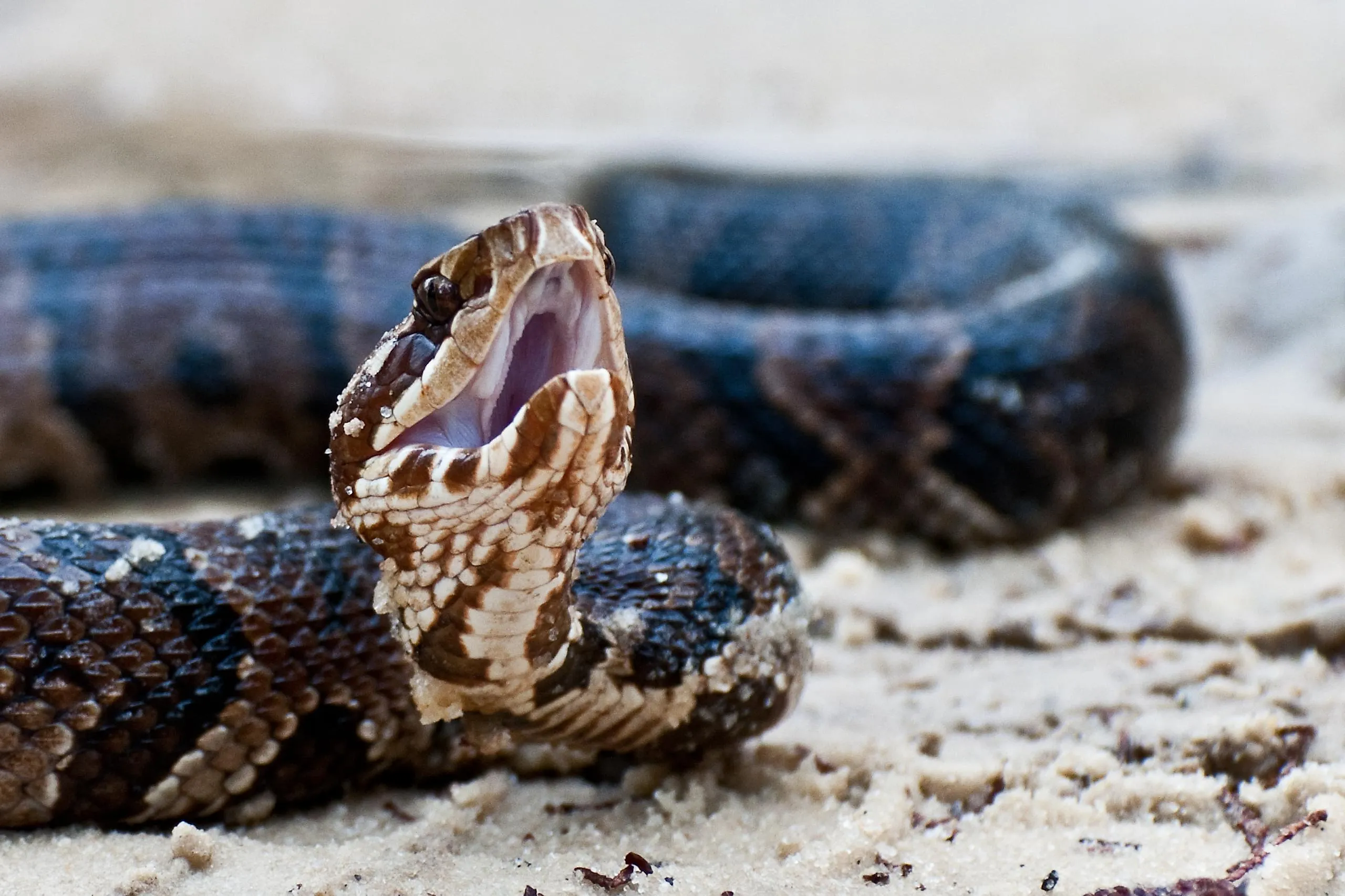
Where Water Moccasins And Diamondback Water Snakes Overlap
From east Texas across to Alabama, almost every thick brown snake found near water gets called a moccasin. Most of them are not. The diamondback water snake is the single most misidentified snake in Texas, and the mistake is usually fatal for the snake.
The two species share a great deal of ground, and the overlap is far wider than most people assume. Here is where they actually meet, and how to tell them apart without getting close enough to regret it.
The Overlap Zone

The cottonmouth, Agkistrodon piscivorus, occupies the southeastern United States: southeastern Virginia down through Florida, west to central Texas, and north up the Mississippi Valley into southern Illinois.
The diamondback water snake, Nerodia rhombifer, runs through the centre of the country. Its stronghold is the Mississippi River valley, extending from Texas and Louisiana north as far as Iowa and Indiana, and south into northern Mexico.

Where those two maps sit on top of each other is a broad belt covering east Texas, Louisiana, Arkansas, Mississippi, western Alabama, southeastern Oklahoma, western Tennessee, southeastern Missouri, and the far southern tip of Illinois, where state records list both species as locally common.
That is a much larger shared range than the cottonmouth has with the northern water snake, which meets it only along a narrow northern and eastern margin. In the lower Mississippi valley the two are genuinely co-resident, often in the same oxbow, bayou, or farm pond.
Why The Confusion Is So Persistent

Both are heavy-bodied, both are brown to olive, both have keeled scales that give them a rough matte finish, and both are found in exactly the same slow water: rivers, oxbows, swamps, drainage ditches, and stock ponds.
Size does not help. Cottonmouths run 24 to 48 inches. Diamondbacks run 30 to 48 inches and the record is five feet nine. The harmless one is frequently the larger animal.
Behaviour does not help as much as people think either. A cornered diamondback flattens its head into a broad triangle on purpose, hisses, strikes repeatedly, and discharges a foul musk. It looks exactly like what a frightened person expects a venomous snake to look like, and that performance is a large part of why so many get killed.
The Reliable Tells

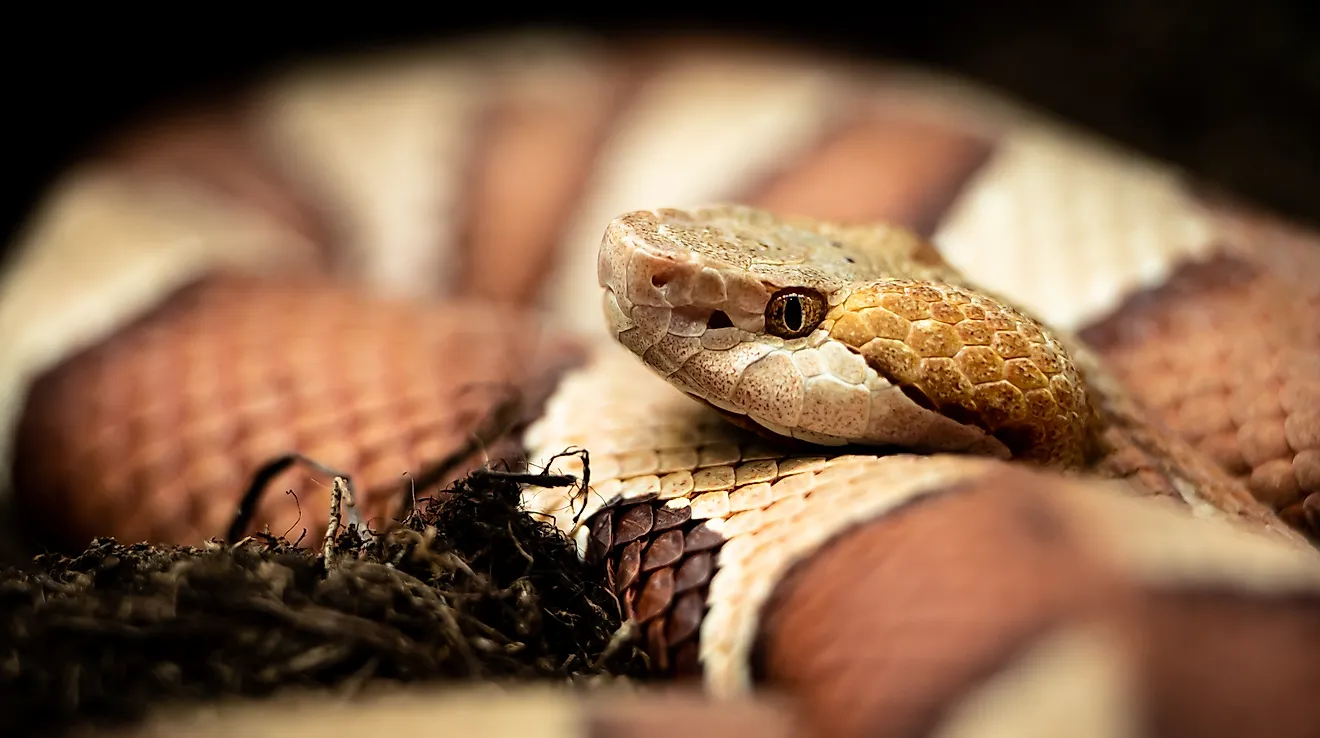
Start with the eyes, from a safe distance and ideally through a camera zoom. A cottonmouth has vertical, cat-like pupils and a heat-sensing loreal pit between the eye and the nostril. A diamondback has round pupils and no pit.
Better still, look at the snake from above if you can do so safely. The cottonmouth has a heavy brow ridge over each eye, so from directly overhead its eyes are hidden. The diamondback's eyes sit high on the head and remain visible from above, which gives the species the slightly startled expression that herpetologists tend to describe affectionately.

The lip scales are the detail most guides skip and the one worth knowing. A diamondback water snake has distinct vertical dark bars running down the labial scales along its jaw, like stitching. The cottonmouth does not; it has a broad dark band running back from the eye, bordered above and below by paler scales.
Snout shape separates them too. The cottonmouth's is blunt and squared off. The diamondback's is pointed, even when the head is flattened in display.
The Swimming Rule, And Its Limits

The most repeated field test is buoyancy. A cottonmouth swims high, with much of its body riding on the surface and its head held up at an angle. A water snake swims with its body submerged and only the head and a little neck showing.
It is a genuinely useful rule and it is broadly true. It is also not absolute. A water snake crossing open water at speed can ride higher than the rule suggests, and a cottonmouth moving with purpose can sit lower. Treat it as supporting evidence rather than a verdict.

Basking position is a softer clue in the same direction. Diamondbacks habitually drape themselves on branches overhanging water, sometimes several feet up, and drop in when disturbed. They also hunt from those branches, hanging with the head dipped below the surface waiting for fish. Cottonmouths are poor climbers and are more often found on logs, banks, and mud at ground level.
Pattern And Colour Over A Lifetime

A diamondback water snake carries a net or chain-link pattern of dark blotches down the back, outlined in black or dark brown, with the pale gaps between them forming the rough diamond shapes that give the species its name. The belly is yellow with dark half-moons or spots.
Cottonmouth banding works the other way. The crossbands are widest along the spine and narrow toward the belly, and the pattern fades with age. Many adults go nearly uniform dark brown or black, losing the markings entirely, which removes pattern as a tool for the animals most likely to concern you.

Juveniles are a separate problem. A young cottonmouth is boldly patterned and carries a bright yellow or greenish tail tip, which it twitches as a lure to draw in frogs and lizards. A juvenile diamondback is also boldly patterned but has no coloured tail tip. If you can see a yellow tail on a small snake near water in this region, treat it as a cottonmouth.
They Are Not The Only Lookalike Here

The overlap zone holds several other Nerodia species that get the same treatment. The broad-banded water snake, the yellowbelly water snake, and the Mississippi green water snake all share this country, and all are harmless, as are their relatives further north.
In the lower Mississippi valley a given stretch of bayou may hold four or five water snake species and one cottonmouth, which means the odds on any individual snake strongly favour the harmless option. The diamondback is described by state agencies as one of the most common snakes within its entire range.
That ratio is the useful thing to carry. In places frequented by people, harmless water snakes substantially outnumber cottonmouths, and a thick brown snake by a Louisiana pond is more likely than not to be something that cannot hurt you.
What To Do About Either Of Them

The answer for both is the same and it is boring: leave it alone. Most bites of either kind happen when someone tries to kill, catch, or move the animal, and a cottonmouth left undisturbed will usually gape, hold its ground briefly, and then leave.
A diamondback bite is not venomous but it is not nothing. They have long recurved teeth, they bleed freely, and the snake will twist while holding on. Clean it properly and watch for infection; the risk is bacterial, not toxic.

A cottonmouth bite is a medical emergency. The venom is hemotoxic and more potent than a copperhead's, and the correct response is to get to a hospital rather than attempt anything in the field.

So the practical summary for anyone in east Texas, Louisiana, Arkansas, or Mississippi: assume any snake you cannot identify is the venomous one and give it room, but do not assume it actually is. Statistically, in the overlap zone, you are probably looking at a diamondback, and it would very much like you to go away.