Where Is The Oldest Library In America?
In 1785 the town of Franklin, Massachusetts wrote to its namesake asking for a bell for the new meeting house. Benjamin Franklin sent 116 books instead, on the grounds that sense was more important than sound. At a town meeting on November 20, 1790, the residents voted to let anybody borrow them free of charge. That is one answer to the oldest library in America. There are at least five others, all defensible, and which one is correct depends entirely on what you think a library is.
The Oldest Of Any Kind: Harvard, 1638
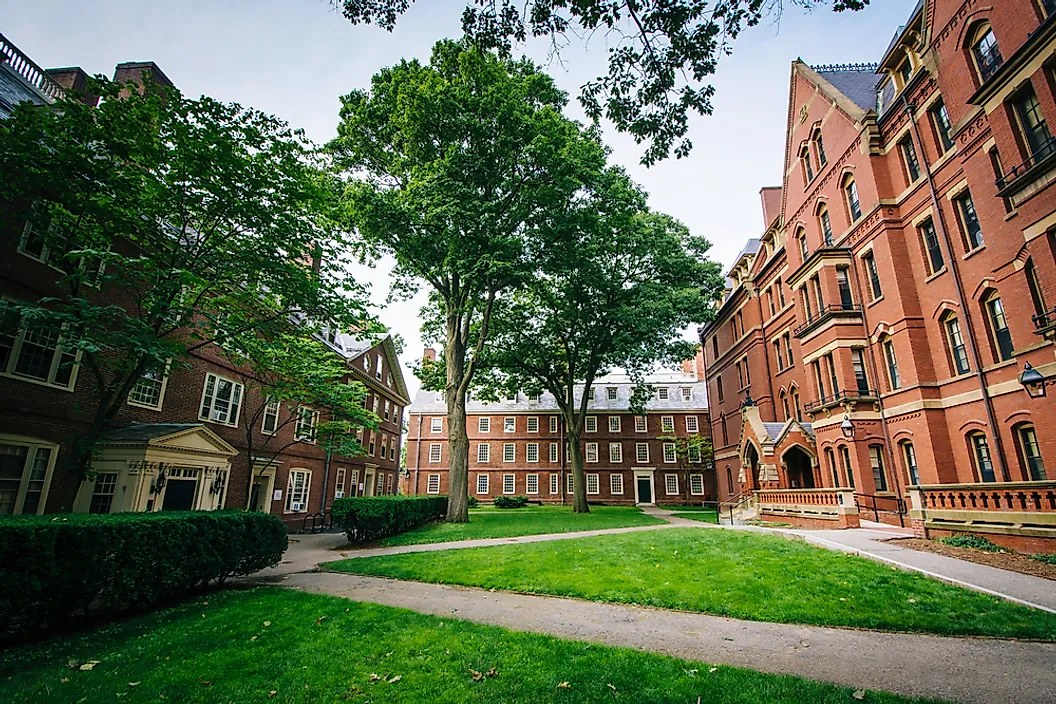
If the question is simply which collection of books has been operating longest, nobody disputes the answer. Harvard College Library was established in 1638, two years after the college itself and 138 years before the Declaration of Independence. It began with a bequest from the Reverend John Harvard of roughly 400 volumes, which is also how the college got its name.
It now holds over 20 million items. What it was not, and is not, is public. Access was restricted to the college, which is why the question stays open.
The First Lending Library: Philadelphia, 1731

Benjamin Franklin appears twice in this story, and the first appearance is the more consequential. In November 1731 Franklin and the members of his discussion club, the Junto, founded the Library Company of Philadelphia. The first 50 members each put in 40 shillings, pooling money for books none of them could afford alone. Notably the collection included volumes in English, at a time when private and university libraries stocked mostly Latin.
It was a subscription library rather than a free one, though non-members could borrow with collateral. Its best credential is what happened later: when the Continental Congress met in 1775 and the Constitutional Convention in 1787, they used the Library Company as their de facto Library of Congress, a role it held until 1800.
The Oldest In Continuous Public Service: Darby, 1743

Twelve years after Franklin's effort a smaller one started a few miles away, and it has never stopped. The Darby Library Company was organized on March 10, 1743 by 29 subscribers in Darby, Pennsylvania, with the first books arriving from England that November. The botanist John Bartram helped source them, the same man who had done the job for Franklin's library.
Darby became free and open to the public in 1898, and today claims to be America's oldest public library in continuous service since 1743. The claim turns on the word continuous, which is doing a lot of work.
The Oldest Lending Library Still In Its Building: Newport, 1747

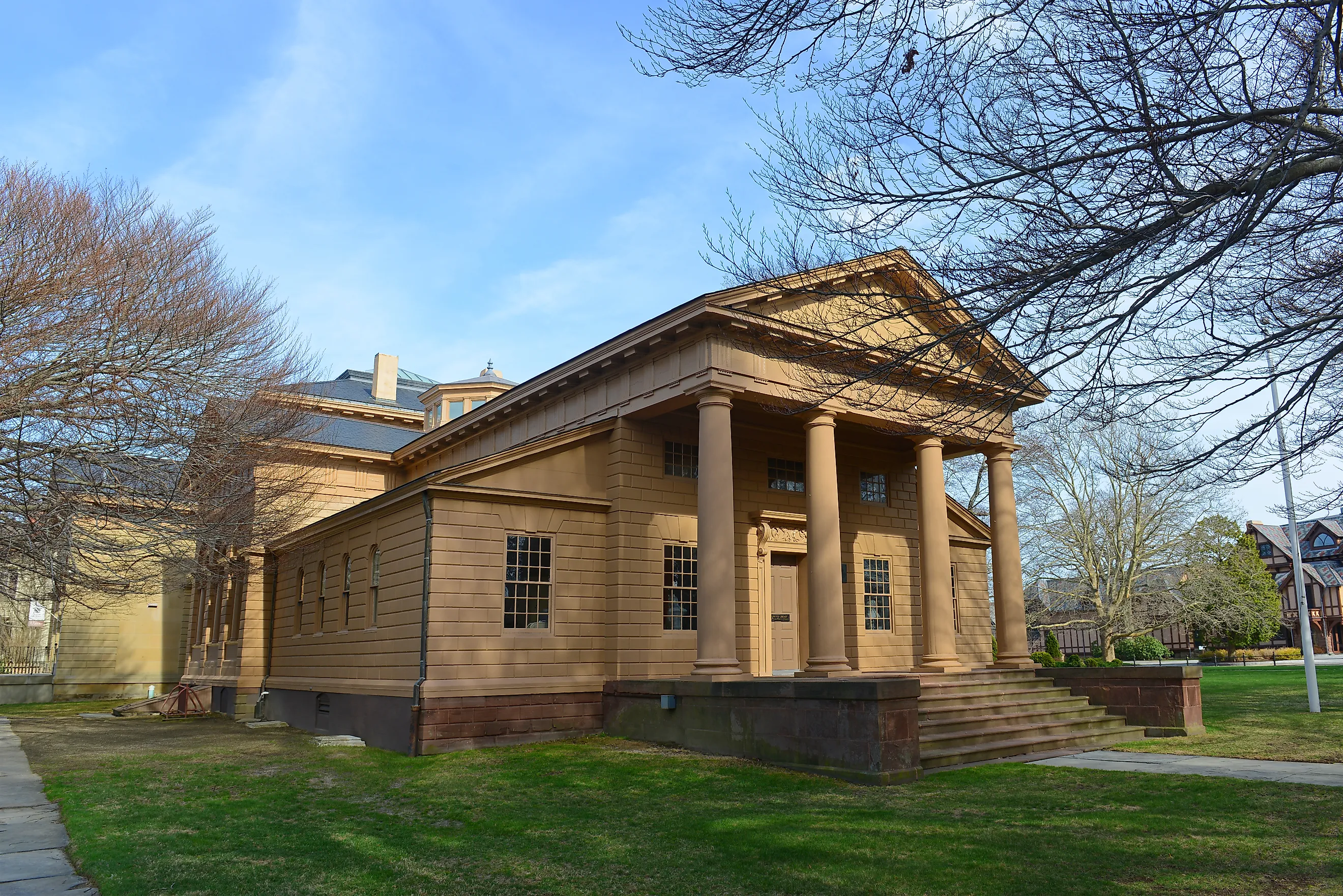
This is the entry with the strongest physical claim, and here the building matters as much as the collection. Abraham Redwood and 45 other Newport residents founded the Redwood Library and Athenaeum in 1747. The building, designed by Peter Harrison and completed in March 1750, was the first purpose-built library in the United States and remains the oldest neoclassical building in the country.
Redwood describes itself as the oldest lending library in America and the oldest library building in continuous use. Only the Library Company of Philadelphia is older as an institution, and the Library Company has moved.
The Oldest Building Housing A Library: Barnstable, 1644

One claim beats all of them on sheer age of structure, and it is a technicality worth knowing. Sturgis Library in Barnstable on Cape Cod occupies a house built in 1644 for the Reverend John Lothrop, one of the earliest European settlers of the town. It is the oldest building housing a public library in the United States and one of the oldest houses left on Cape Cod.
The building predates every library on this list. It was not a library in 1644, which is the catch.
The First Free Public Library: Franklin, 1790

Back to the bell, because the story is better than any summary of it. The town of Franklin, Massachusetts had named itself after Benjamin Franklin in 1778, partly in hope of a gift. When the residents wrote asking for a bell for their meeting house, Franklin sent 116 books instead with the observation that sense was preferable to sound.
On November 20, 1790, a town meeting voted to allow residents to borrow those books free of charge, which many accounts treat as the first public library in the United States. It is still open, though a nonprofit rather than the town ran it for much of its history.
The First Tax-Supported Library: Peterborough, 1833
If the defining feature of a public library is that the public pays for it, the answer moves to New Hampshire and the claim gets considerably stronger.
In 1833 the Reverend Abiel Abbot urged the citizens of Peterborough to establish a library free to all and funded by taxation. The town did it, making Peterborough Town Library the first completely tax-supported free public library not only in the United States but in the world.
This is the version most librarians would pick, because it is the moment the modern public library is invented: open to all, free of charge, and paid for collectively rather than by subscription or charity.
The First Big City System: Boston, 1848

Boston is frequently given the title and does not quite deserve it, though it deserves something. Founded in 1848, the Boston Public Library was the first large free municipal library in the United States and the first to lend books to the general public on the scale of a city rather than a town. It was not the first tax-supported library, which Peterborough had managed fifteen years earlier.
What Boston proved was that the Peterborough model worked at scale, which is arguably why the idea spread across the country rather than remaining a New England curiosity.
There Are Other Claimants
The list above is not exhaustive, and several more institutions have reasonable cases. Scoville Memorial Library in Salisbury, Connecticut claims to be the first publicly funded library in the United States, established in 1803. The Charleston Library Society, founded in 1748, is the third oldest subscription library in the country after Philadelphia and Newport. The Library Company of Burlington in New Jersey received a charter in 1758 and built that state's first library building in 1789.
Going back further, the English clergyman Thomas Bray established the first free lending libraries in the American colonies in the late 1600s, which predates everything here except Harvard.
So Which One Is It
Pick your definition and the answer follows cleanly, which is the useful way to hold all of this.
Oldest library of any kind is Harvard, 1638. Oldest lending library is the Library Company of Philadelphia, 1731. Oldest in continuous public service is Darby, 1743. Oldest still in its original purpose-built building is Redwood in Newport, 1747. Oldest building housing a library is Sturgis in Barnstable, built 1644. First free public library by town vote is Franklin, Massachusetts, 1790. First tax-supported one is Peterborough, 1833. First big-city system is Boston, 1848.
The one worth remembering is Peterborough, because it invented the thing most people actually mean by a public library. The one worth telling at a dinner party is Franklin, Massachusetts, where a town asked a famous man for a bell and got a reading list instead.