This Connecticut Scenic Byway Is The Road Trip Of A Lifetime
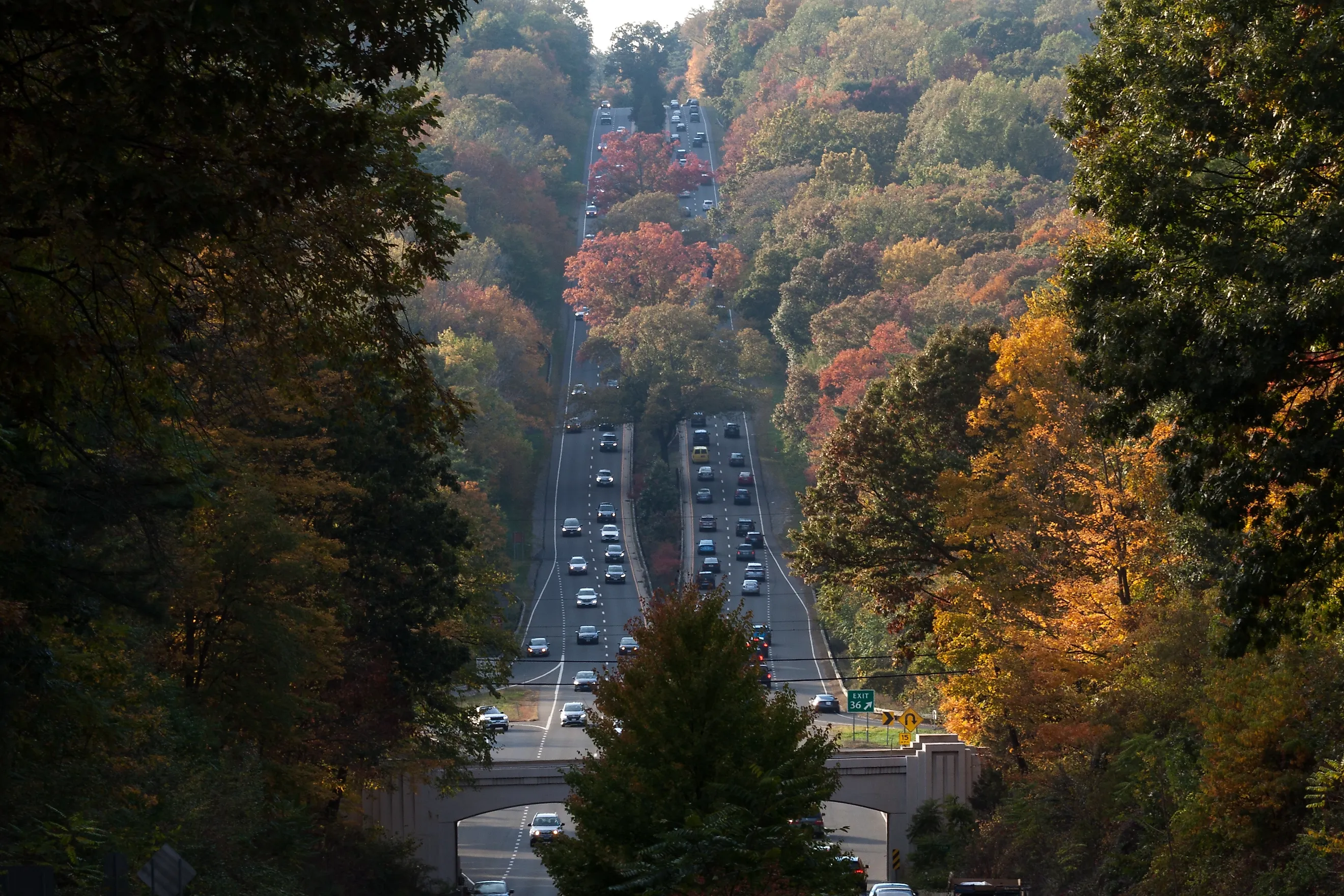
Connecticut's Merritt Parkway has been called the "Queen of Parkways," a title that anyone who has traveled it will agree is a good one. Completed in 1940, this 37.5-mile National Scenic Byway runs the length of Fairfield County from the towns of Greenwich to Stratford, passing beneath some of America's most elegantly designed bridges along the way. Here's how to turn a drive along the Merritt into the Connecticut road trip of a lifetime.
A Depression-Era Answer to a Traffic Jam

Merritt Parkway's story began in the 1920s when the Boston Post Road, the old shoreline route between New York and New England (now U.S. Route 1), had become one of the most clogged highways in the country. State planners and local advocates sought an inland alternative, while Schuyler Merritt, a U.S. congressman from Stamford, helped secure political support for the project. Rather than creating another roadside commercial strip, designers envisioned a landscaped limited-access parkway that would preserve the character of the surrounding countryside.
Ground was broken in 1934, and the new road took Merritt's name. Its first section opened on June 29, 1938. To mark the occasion, then Governor Wilbur Cross cut ribbons at each town along the first 17.5 miles between the New York state line and Norwalk. The final link, a bridge over the Housatonic River at Stratford, was officially opened on September 2, 1940.
What set the project apart was its landscaping. Between 1935 and 1942, landscape designer Weld Thayer Chase planted 22,000 trees and 40,000 shrubs within the parkway's 150-foot-wide right of way, preserving native maples and birches during excavation and replanting them once construction ended. Take a drive along this scenic route today, and it feels less like a highway and more like a drive through a forest.
More "Artway" Than Highway

Now on the National Register of Historic Places, a trip along Merritt Parkway features some of the fanciest bridges anywhere. A junior draftsman with the Connecticut Highway Department, George Dunkelberger was tasked with designing all 69 of the parkway's original bridges. To his credit, he treated each as an independent work of art, working in styles ranging from French Renaissance and Gothic to Rustic, Neoclassical, Art Deco, and Art Moderne.
Most were cast in concrete before being tinted, carved, and sculpted, while others combined steel frames with bands of stone. However, most were finished with wing walls that merge into the surrounding slopes, an effect that has been described as growing out of the landscape, rather than interrupting it.
Prime examples include Lake Avenue Bridge in Greenwich, whose arches carry cast-iron ornament made by Kenneth Lynch, the metalworker whose firm also produced the stainless-steel eagles crowning New York's Chrysler Building. Merwins Lane Bridge in Fairfield is the most whimsical of the lot. Each seven-foot panel of its metal railings depicts a spiderweb complete with resident spider, bordered by butterflies on stalks, with larger precast butterflies perched on the pylons.
First Miles: Greenwich and Stamford

Open year-round and off-limits to many large vehicles, the Merritt Parkway is a delight to travel, whatever the season. The drive starts where the Hutchinson River Parkway crosses the state line into Greenwich. Within the first few miles, a detour north via Round Hill Road leads to the Greenwich Audubon Center, the National Audubon Society's first nature education center.
The next stop is the Stamford Museum & Nature Center, in Stamford. A former summer estate of a New York department store mogul, the elegant Tudor-style Bendel Mansion now hosts rotating art exhibitions. The grounds include Heckscher Farm, a working farm stocked with heritage breed animals plus an otter pond, a planetarium, and an observatory. More than 80 acres of trails can be enjoyed, some of which connect to neighboring Bartlett Arboretum & Gardens.
Like most other major attractions in the parkway's vicinity, both are just minutes from the route, making a road trip relatively easy. As the Merritt has no billboards and little visible roadside development at its exits, you'll need to do your homework when it comes to knowing when to turn off. Ultimately, that's all just part of the fun.
Other Road Trip Stops

Travel a little further, and you'll come to New Canaan. Reached from the parkway via Route 124, it's famous for its modernist architecture and experimental homes, including the wonderful Glass House. Now a museum and gallery, the Glass House is accessible only through a reserved ticketed experience, with guided and self-guided options available. Tours operate seasonally and begin at the visitor center in downtown New Canaan rather than at the house itself.
Grace Farms is another good place to break your journey. Its River building features a sinuous roof that extends roughly 1,400 feet down the hillside, linking five glass-walled pavilions. Among them is a 700-seat amphitheater overlooking the surrounding landscape. If art's your thing, add the Silvermine Arts Center to your itinerary. Founded in 1922, its five galleries regularly mount new exhibits and represent a guild of more than 300 professional artists.
North of Fairfield, you'll find yourself in Connecticut's famous orchard country. If possible, pull off and visit Silverman's Farm in Easton. It sells its own cider and offers pick-your-own apple experiences, as well as peaches and pumpkins in season. Tractor rides through the hillside orchards are must-do family activities, but bear in mind, this is mostly a seasonal stop.
The Home Stretch

You'll know you're getting close to the end of the parkway when your GPS tells you Stratford's Boothe Memorial Park & Museum is close by. This fun (and free) 32-acre park preserves the estate of brothers David and Stephen Boothe, wealthy collectors who filled the grounds with 20 architecturally odd buildings. Highlights include a windmill, a miniature lighthouse, a blacksmith shop, and a clock tower. Altogether the buildings house more than 10,000 artifacts.
Of interest to road trippers is a preserved Merritt Parkway toll booth. Retired when Connecticut abolished highway tolls in 1988, the booth's rustic log design and construction is reminiscent of the parkway's original character.
The route ends at the Sikorsky Memorial Bridge, where it spans the Housatonic River. Named after the aviation pioneer who developed America's first practical helicopter in Stratford, it's here the Merritt Parkway becomes the Wilbur Cross Parkway, a great 29-mile add-on for those wanting to extend their road trip to New Haven and eventually Meriden.
The Queen of Parkways
Nearly nine decades after the first ribbon was cut, the Merritt Parkway remains one of the prettiest scenic drives in New England. Although it can be driven end to end in under an hour, its many attractions substantially slow down the adventure. Allow a day, or better still a weekend, and the parkway becomes a string of memorable detours that all add up to making it Connecticut's road trip of a lifetime.