The US Airports With The Shortest Runways
Most airports have runways so long they tend to disappear from view (the longest in the US is over 16,000 ft long), but a handful of major airports have incredibly short runways that create major challenges. While smaller airports with shorter runways exist across the United States and can accommodate aircraft like Cessnas, this list highlights busy commercial airports where hundreds of jets land each day. Ranging from a mere 5,000 to 5,800 feet, pilots have limited pavement to work with when landing at specific airports in Florida, South Carolina, and California. Busy urban areas, dense tree cover or ocean water create impediments in runway expansion in these shortest runways that somehow manage to make the most of every foot.
Hilton Head Island Airport, South Carolina - 5,000 ft

Hilton Head Island Airport, measuring in at barely 5,000 feet, has one of the shortest runways for commercial airlines in the United States given that it's built on a resort island that's surrounded by trees, neighborhoods, and developed structures. The runway was initially only 4,300 feet, which severly limited what aircraft could land, but in 2018 aviation authorities recommended a major expansion so standard jets could fly in without restrictions. Local residents pushed back against the expansion, hoping to limit noise pollution and protect nearby neighborhoods like the historic Mitchelville located near the end of the runway.
Pilots can land safely on this exceptionally short runway, but the FAA enforces strict weight-and-balance restrictions, like at other airports, especially during the hot summer months. Extremely high temperatures reduce engine thrust and aerodynamic lift, forcing commercial flights from Hilton Head to carry less fuel or leave with empty seats to safely take off before running out of pavement.
Key West International Airport, Florida - 5,076 ft

The island of Key West covers such a small area, that it’s no surprise Key West International Airport has a short runway measuring in at only 5,076 feet. The entire island is only about 4 miles long and 1 mile wide, surrounded by water, leaving little room for the runway, which is squeezed between the ocean on both sides and developed land around it. The runway used to be a historic 4,801 feet, but in 2018 the FAA approved a major construction project that extended it by 227 feet.
The Key West Airport was initially built in the early 20th century for mail and passenger flights, but when it was paved for commercial use in the 1950s, aircraft of the time didn’t require long, expansive runways for landing. Because of the airport's limited length and tropical, humid temperatures that reduce engine thrust, airlines flying in now face strict weight restrictions and limit cargo and passengers to land safely. For additional safety measures, the airport installed Engineered Material Arresting System (EMAS) beds at the end of the airport to absorb any plane that overruns the runway.
Ronald Reagan Washington National Airport, Virginia - 5,204 ft

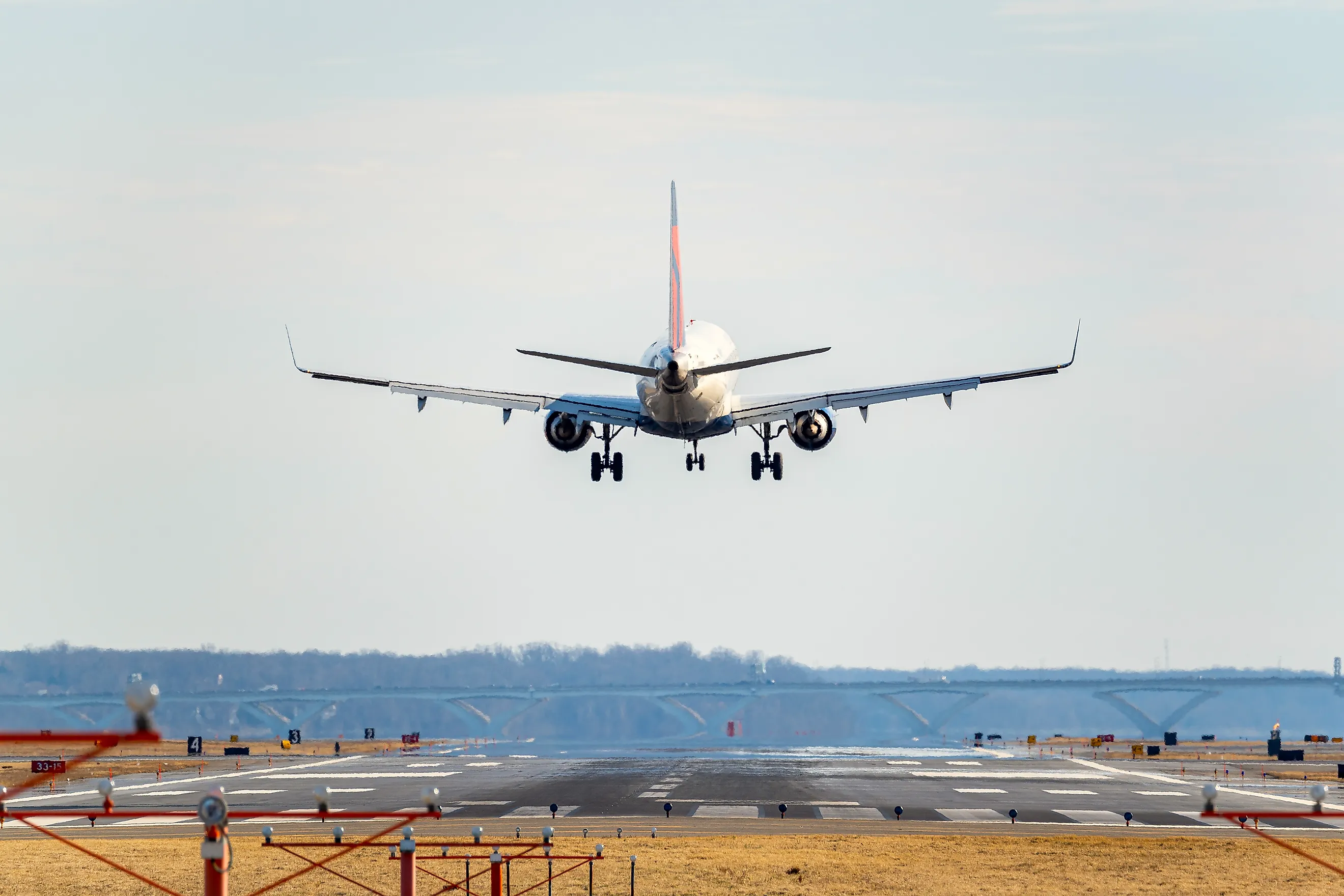
The Ronald Reagan Washington National Airport has a long, congested main runway with many restrictions, but its lesser-used runway measures in at only 5,204 feet long. Because the airport is so close to the Potomac River, the runway is significantly shorter. Often, when the main runway becomes too congested, airlines use the shorter one to alleviate overcrowding and runway-crossing issues that may arise.
Boundary constraints set back in 1966 have been federally mandated at Reagan Airport in order to keep long-haul air traffic away, so airlines are often directed to nearby Dulles Airport. Recently, there have been talks to extend the perimeters, but major airlines have expressed concern over the traffic and delays this might cause. To land safely on the shorter runway, pilots must perform strict weight and stopping calculations and navigate complex low-altitude maneuvers while flying through restricted airspace. They need to hit their target immediately at touchdown or perform a go-around.
John Wayne Airport, California - 5,700 ft

The commercial runway at John Wayne Airport is just 5,700 feet long, only slightly longer than Key West Airport's runway. Named in honor of the legendary actor and resident, the airport is surrounded by densely populated residential neighborhoods like Newport Beach, as well as major roads, highways, and structures. The area's limited physical space prevents any real extension of the existing tarmacs.
John Wayne Airport was initially called the Orange County Airport and built as a private, civilian landing strip long before it grew to allow major airlines. The property boundaries were already set in place, which is why expansion wasn’t possible in such an urbanized city. The runway length, or lack thereof, also limits the size and weight load of most commercial and passenger jets for safety reasons. Pilots landing on this shorter runway use manual braking or auto brakes rather than coasting along, while aiming to touch down immediately at the 1,000 foot markers.
Hollywood Burbank Airport, California - 5,802 ft

Hollywood Burbank Airport has a commercial runway measuring only 5,802 feet (it has another longer runway15/33 at 6,886 ft). Like John Wayne Airport, because it is landlocked by crowded housing and developed land in the San Fernando Valley. It borders main city streets and residential neighborhoods, making it virtually impossible to ever lengthen the runway. The city grew around what was once an airfield back in the 1920s, before modern jet aircraft and safety zones were even required. It officially opened as United Airport in 1930, as the largest and advanced commercial airport in the Los Angeles area, hosting major airlines like TWA, United Airlines and Western Air Express.
Because the main runway is so limited in size, heavy wide-body jets like Boeing 747s or 777s are primarily unable to use it according to safety standards, unlike regional or single-aisle jets such as the Boeing 737s and Airbus A320S that can. Like at Key West International, Burbank Airport has installed EMAS beds on the departure end of the runway 8 (the shorter runway) to mitigate landing and takeoff risks.
Ronald Reagan Washington National Airport, Virginia
The Ronald Reagan Washington National Airport has a long, congested main runway with many restrictions, but its lesser-used runway measures in at only 5,204 feet long. Because the airport is so close to the Potomac River, the runway is significantly shorter. Often, when the main runway becomes too congested, airlines use the shorter one to alleviate overcrowding and runway-crossing issues that may arise.
Boundary constraints set back in 1966 have been federally mandated at Reagan Airport in order to keep long-haul air traffic away, so airlines are often directed to nearby Dulles Airport. Recently, there have been talks to extend the perimeters, but major airlines have expressed concern over the traffic and delays this might cause. To land safely on the shorter runway, pilots must perform strict weight and stopping calculations and navigate complex low-altitude maneuvers while flying through restricted airspace. They need to hit their target immediately at touchdown or perform a go-around.
The End Of The Road
Short runways leave little room for error, but that doesn’t stop commercial and passenger planes from arriving daily. Even though these four islands are boxed in by busy neighborhoods and encompassed by water, they have adapted to their limits with strict planning, weight restrictions, and safety procedures. With no room to extend and build out, pilots and engineers literally have to make every foot count.