The Largest Working Observatory In The United States
High on a Hawaiian volcano sit two of the largest telescopes on Earth, aimed straight up at the night sky. The air is so still and the skies so dark that, for some views of space, these ground telescopes see more sharply than the Hubble Space Telescope does from orbit. Astronomers have used the W.M. Keck Observatory to watch galaxies near the edge of the known universe and to catch planets still being born. Out in the middle of the Pacific, it keeps spotting things no one has seen before.
Location

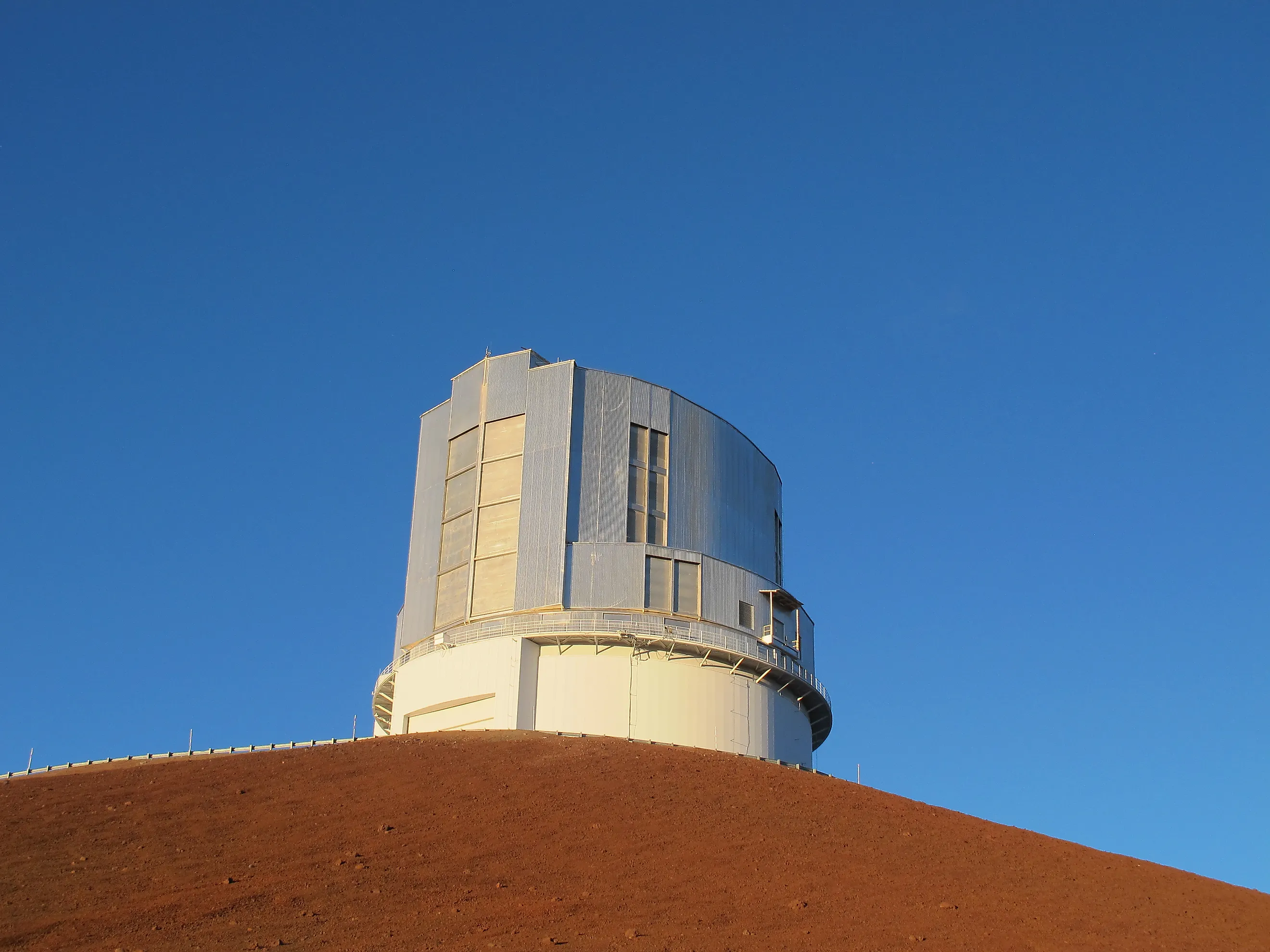
The W.M. Keck Observatory sits on the summit of Maunakea, Hawai'i. The twin Keck Observatory telescopes sit at the top of Maunakea, at an elevation of 13,600 feet (4,145 meters). With few city lights to pollute Hawaiian night skies, it's one of the best places to observe the cosmos.
This is an ideal location for these telescopes because the island sits in the middle of the Pacific Ocean. Hawai'i is surrounded by thousands of miles of thermally stable seas, making the weather fairly predictable. For most of the year, the atmosphere above Maunakea is clear, calm, and dry. No mountain ranges surround the summit to roil the upper atmosphere.
This makes the site ideal for observing the universe. The observatory respects the Native Hawaiian community and thanks them for sharing this significant cultural site for research.
The Giant Telescopes

Two telescopes work together at the W.M. Keck Observatory. The twin telescopes are named Keck I and Keck II, and each measures 32.8 feet (10 meters) across. Each is made of 36 hexagonal segments that work together as a single reflective mirror. The design comes from Jerry Nelson, the "Father of the Keck Observatory Telescopes".
Each segment is so smooth that, if it were the width of the Earth, any imperfections would be only three feet high. To keep the mirrors as precise as possible, a computer controls each segment with sensors and actuators. This keeps each segment's position accurate to about four nanometers. That is roughly 1/25,000 of a human hair's diameter.
The telescopes are housed in insulated domes of 700,000 cubic feet. Each dome has giant air conditioners that keep the temperature at or below freezing to help reduce deformation of the telescope's steel and mirrors.
Each telescope has an adaptive optics (AO) system. This system measures and corrects atmospheric turbulence using a deformable mirror that changes shape 2,000 times per second. The AO system was first introduced in 1999 to Keck II and later Keck I. This technology now produces near-infrared images with greater crispness and detail than the Hubble Space Telescope.
What Scientists Study

Keck supports studies and discoveries about stars, black holes, galaxies, and the universe's formation. Keck has found a galaxy almost entirely made of dark matter. It has tracked activity on Jupiter's volcanic moon and on Neptune. It has uncovered four quasars (galaxies powered by black holes) in a single system.
One major discovery was mapping how stars move in the Andromeda Galaxy. That galaxy is 2.5 million light-years away from Earth. This information helps astronomers understand just how immense the galaxy is.
In 2015, Keck helped track down what was then called the most distant galaxy ever found, EGSY8p7. It is about 13.2 billion light-years from Earth, and its extreme distance means the galaxy dates to just 600 million years after the Big Bang. Studying such galaxies helps scientists understand the universe's history.
Keck is helping examine galaxies dating to the end of the Dark Ages, when the universe was too opaque for light to penetrate. This is just the beginning of what Keck is helping us discover about the universe.
As of 2026, Keck is following a planet known as Elias 2-24 b, which is still actively gathering material from the gas and dust disk surrounding its young host star. This lets scientists study a giant planet that is still growing, and how it does so.
A Look Inside the Observatory

Telescopes aren't the only instruments that help scientists learn more about the universe. There is the MOSFIRE (Multi-Object Spectrometer for Infra-Red Exploration), DEIMOS (Deep Extragalactic Imaging Multi-Object Spectrograph), HIRES (High Resolution Echelle Spectrometer), KCWI (Keck Cosmic Web Imager), LRIS (Low Resolution Imaging Spectrograph), OSIRIS (OH-Suppressing Infrared Imaging Spectrograph), and the newest instrument, KPF (Keck Planet Finder).
Each one helps the telescopes discover and learn about the universe. Visitors can enter the Visitors Gallery, where you can see Keck I. However, visitors are not allowed in the equipment rooms. The observatory also has a gallery with exhibits that showcase its operations.
Before reaching the visitors' gallery, visitors should stay at the Maunakea Visitors Information Station (VIS) for at least 30 minutes to acclimate to the elevation. From there, only 4WD vehicles may take the road to the summit.
The Takeaway
The W. M. Keck Observatory remains not only the largest observatory but also a leader in scientific discovery. These giant telescopes help scientists explore the universe and explain how planets, galaxies, and black matter come to be. Situated in one of the best observation sites in the world, it will continue to help astronomers see the night sky and beyond.