10 Biggest Airports In The United States
Bigger does not mean busier. Atlanta moves more travelers than any airport on Earth, yet it does not even crack this list. At about 19 square kilometers (roughly 4,700 acres), Hartsfield-Jackson is so compact you could fit it inside top-ranked Denver about seven times over, and it comes in just under the smallest airport that did make the cut. This list ranks the ten biggest airports in the United States the other way, by sheer land area, the acreage under all those runways, terminals, and taxiways. Some are traffic monsters. Others are quiet giants sitting on wide-open room to grow. Here they are, largest first.
- Denver International Airport (DEN), Colorado
- Dallas/Fort Worth International Airport (DFW), Texas
- Orlando International Airport (MCO), Florida
- Dulles International Airport (IAD), Virginia
- George Bush Intercontinental (IAH), Texas
- Salt Lake City International (SLC), Utah
- O'Hare International Airport (ORD), Illinois
- San Francisco International Airport (SFO), California
- John F Kennedy Airport (JFK), New York
- Detroit Metropolitan Airport (DTW), Michigan
1. Denver International Airport (DEN), Colorado - 135.7 km2

Denver is not just the biggest airport in America. It is bigger than the second and third on this list combined. DEN covers 135.7 square kilometers, more than twice the size of the island of Manhattan, which makes it the largest airport in North America and the second largest on the planet, trailing only King Fahd International in Saudi Arabia, a facility roughly six times larger still. All that land buys options. Six runways sit far enough apart for simultaneous operations, and one of them, 16R/34L, stretches 16,000 feet, the longest public-use runway anywhere in North America. Here is the twist: the airport that once trailed the pack in traffic now leads it. DEN handled a record 82 million passengers in 2024, making it the third-busiest airport in the country, behind only Atlanta and Dallas/Fort Worth. Not bad for a place that opened in 1995, later than nearly every rival, and still has empty acreage waiting for the next expansion. United, Frontier, and Southwest all run hubs here.
2. Dallas/Fort Worth International Airport (DFW), Texas - 69.63 km2

DFW is so large it has its own ZIP code, 75261, and a footprint bigger than the island of Manhattan. It is American Airlines' fortress hub, feeding more than 250 destinations across some 35 countries, and in 2024 it moved about 88 million passengers, which ranks it the third-busiest airport on the entire planet. The 6,963-hectare field spreads across two counties between Dallas and Fort Worth, yet its five terminals and 191 gates take up only about half of it. Passengers hop between those terminals on Skylink, a fast automated people mover, and here is a detail that surprises even frequent flyers: DFW is the largest carbon-neutral airport in the world.
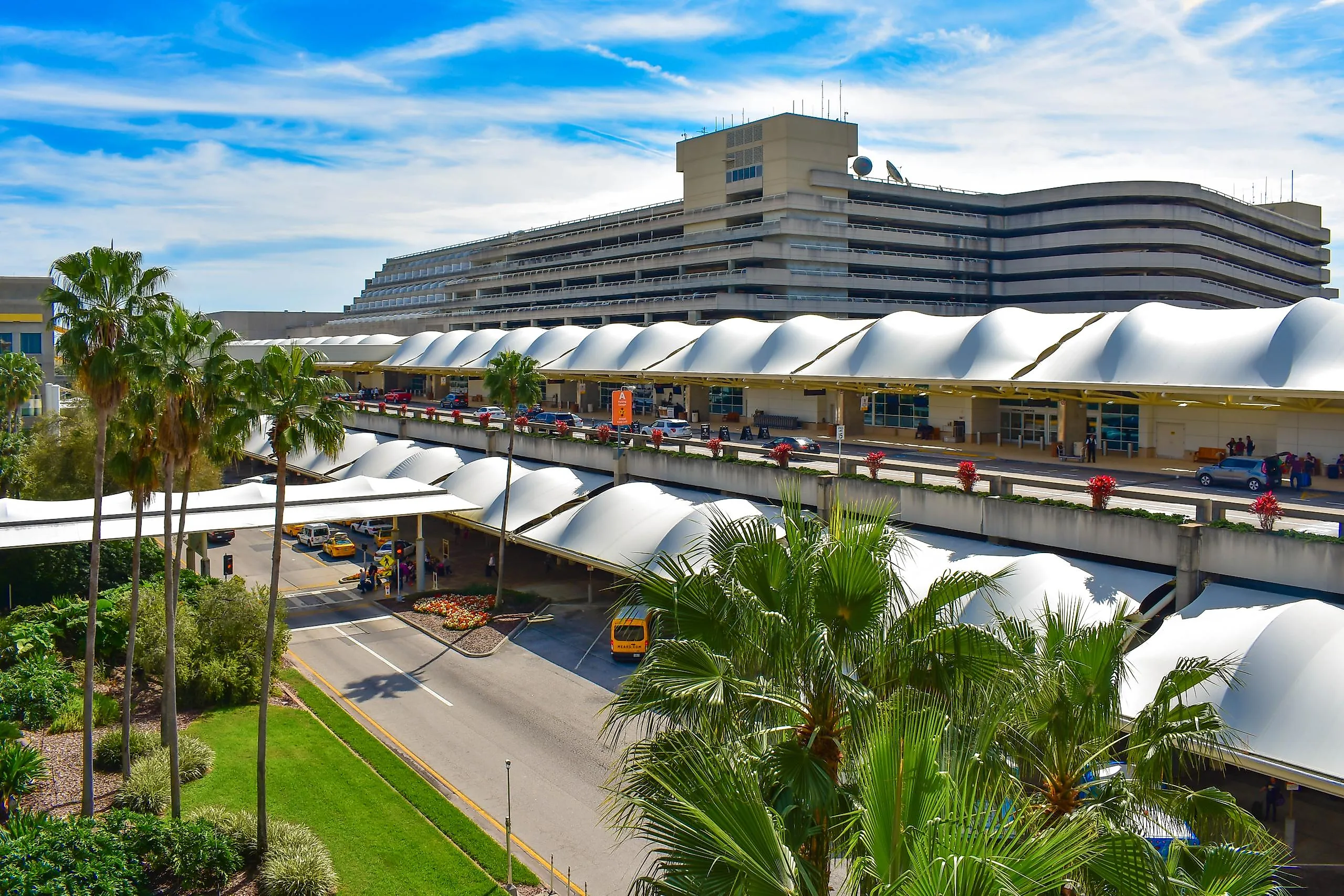
3. Orlando International Airport (MCO), Florida - 54 km2

Before it welcomed families to Mickey Mouse, Orlando's airport dropped bombs. MCO began life as McCoy Air Force Base, a Strategic Air Command installation, and that military past is why its code still reads MCO today. The base closed after the Vietnam War and reopened for civilian flights in the 1970s. Now it is the busiest airport in Florida, funneling roughly 57 million passengers a year toward the theme parks, and it just got bigger: the $2.8 billion Terminal C opened in 2022, pushing the airport to 129 gates across a brand-new concourse. Wetlands and buffer zones eat up much of the 54 square kilometers, giving the place room to keep pace with Florida's relentless tourist tide.
4. Dulles International Airport (IAD), Virginia - 52.6 km2

When Dulles opened in 1962, it sat so far out in the Virginia countryside that critics called it a white elephant. The metro area simply grew out to meet it. Named for John Foster Dulles, the 52nd US Secretary of State under President Eisenhower, the airport now spreads across parts of Fairfax and Loudoun Counties in Virginia, about 25 miles west of the capital, and handles roughly 26 million travelers a year. Getting downtown used to mean a long slog through traffic. Not anymore: the Metro's Silver Line reached the terminal in 2022, so you can now ride the rails straight into the heart of Washington. Its soaring Eero Saarinen main terminal still looks like the future it was built to promise.
5. George Bush Intercontinental (IAH), Texas - 40.5 km2

Here is a size-versus-traffic puzzle: IAH is smaller than Dulles but pushes nearly twice as many people through its gates. Houston's main airport, renamed in 1997 to honor President George H. W. Bush, moves more than 45 million passengers and close to half a million flights a year, and it serves as United Airlines' second-biggest hub. It was also an early adopter of contactless service, letting travelers video-chat a live agent from their phones instead of standing in a line. With plenty of undeveloped land still on the property, Houston's big airport has decades of room to keep expanding.
6. Salt Lake City International (SLC), Utah - 31.1 km2

Salt Lake City did something almost no American city dares to try: it knocked down its aging airport and built an entirely new one on the same ground. The New SLC opened in 2020, the first all-new major hub airport constructed in the United States this century, replacing a facility that dated to 1960. About 28 million passengers a year pass through it, and Delta runs it as a key western hub. Skip the pricey on-site parking and ride in on the Utah Transit Authority's TRAX light rail instead, which drops you right at the doors, six kilometers from downtown.
7. O'Hare International Airport (ORD), Illinois - 30.9 km2

For 35 straight years, from 1963 until Atlanta overtook it in 1998, O'Hare was the busiest airport on Earth. It has not slowed down much. The first major US airport planned after World War II is still a double hub for United and American, running nonstop service to nearly 230 destinations and handling around 80 million passengers a year, nearly three times the traffic of Salt Lake City despite occupying almost the same amount of land. Eight runways now crisscross the field, the last of them finished in 2020 to keep the famous Chicago congestion moving, feeding four terminals and 91 gates.
8. San Francisco International Airport (SFO), California - 21.07 km2

SFO is the Bay Area's front door to the world, the largest of the region's airports and its main launchpad for flights to Asia, Europe, and Australia. About 52 million passengers a year move through its four terminals and 115 gates, perched in San Mateo County some 13 miles south of downtown. In 2019 it opened the revamped Harvey Milk Terminal 1, the first airport terminal anywhere named for the pioneering San Francisco official. The whole operation is owned and run, fittingly, by the City and County of San Francisco.
9. John F Kennedy Airport (JFK), New York - 21 km2

New York City's famous "JFK" packs a lot into 21 square kilometers in the Jamaica neighborhood of Queens, moving more than 60 million travelers a year through a cluster of terminals. Right now it is a construction zone: JFK is in the middle of a $19 billion overhaul, the biggest in its history, with a new Terminal 1 set to open in 2026 and other terminals being torn down and rebuilt around it. When the dust settles, the airport that helped define the jet age should finally match the city it serves.
10. Detroit Metropolitan Airport (DTW), Michigan - 19.6 km2
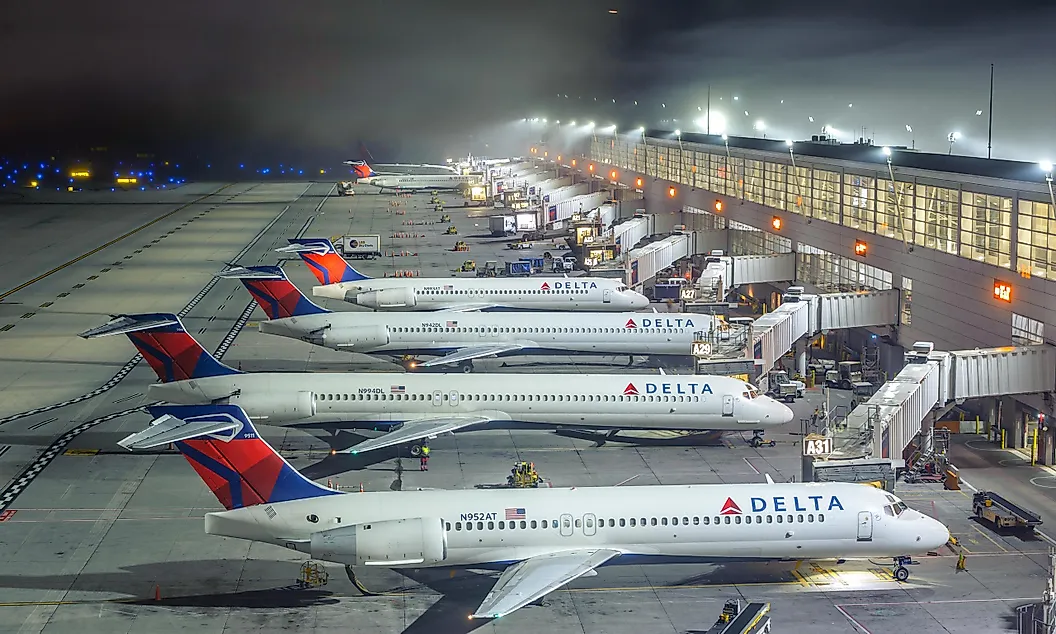
Detroit's airport started small, laid out in 1929 on a 2.6-square-kilometer patch of farmland, and grew nearly eightfold to close out this list at 19.6 square kilometers. Today it is Delta's biggest hub outside Atlanta, moving about 32 million passengers a year across two terminals and six runways just outside Detroit. The showpiece is the McNamara Terminal, shared by Delta and partners Aeromexico and Air France, complete with an underground tunnel lit by a color-shifting light show that has become an oddly beloved layover ritual.
Together these giants show that in American aviation, land is leverage. The busiest of them keep setting records, while the roomiest, led by Denver, still have space to build whatever comes next. Nearly every one is mid-expansion or fresh off a rebuild, betting that the crowds are only going to get bigger.
| Rank | Airport | Location (State) | Area (in km2) |
|---|---|---|---|
| 1 | Denver International Airport (DEN) | Colorado | 135.7 |
| 2 | Dallas/Fort Worth International Airport (DFW) | Texas | 69.63 |
| 3 | Orlando International Airport (MCO) | Florida | 54.0 |
| 4 | Dulles International Airport (IAD) | Virginia | 52.6 |
| 5 | George Bush Intercontinental (IAH) | Texas | 40.5 |
| 6 | Salt Lake City International (SLC) | Utah | 31.1 |
| 7 | O'Hare International Airport (ORD) | Illinois | 30.9 |
| 8 | San Francisco International Airport (SFO) | California | 21.07 |
| 9 | John F. Kennedy Airport (JFK) | New York | 21.0 |
| 10 | Detroit Metropolitan Airport (DTW) | Michigan | 19.6 |