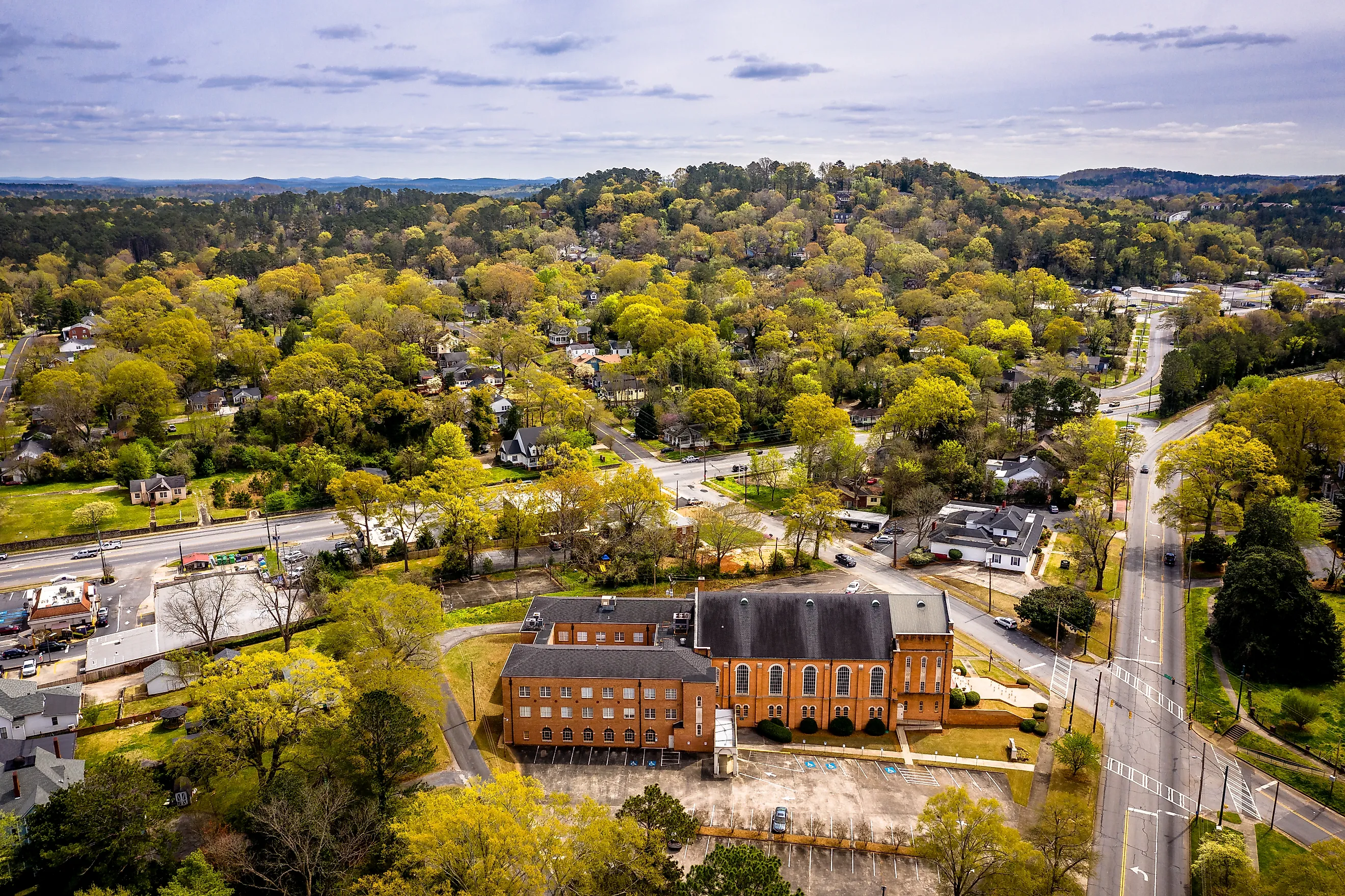
6 of the Oldest Incorporated Towns in Georgia
Georgia was the last of the 13 colonies to be settled, with the founding of Savannah by James Oglethorpe and his colonists in 1733. Although initially envisioned as a border area between the English colonies and Spanish Florida, it would end up serving an important role in the American Revolutionary War and later on during the American Civil War. The oldest incorporated towns in Georgia give off echoes of both of those time periods, whether that be the first town named after George Washington, the hiding place of Confederate gold, or rare plantation homes that avoided destruction during the American Civil War. Other older towns have reinvented themselves, establishing scenic railroad depot parks and the largest college campus grounds in the world. These are just some of the historic and natural sites that rest in 6 of the oldest incorporated towns in Georgia.
St. Marys

St. Marys was established just a few years after the American Revolutionary War in 1787. The land was formerly owned by Jermyn and Charles Wright, brothers of the royal Governor James Wright. They were banished from Georgia due to their royal connections, and the town of St. Marys was officially incorporated in 1802. Today, the town sits on the Atlantic coast as the gateway to Cumberland Island. Across the town are a number of beautiful and mysterious pieces of architecture.
One example is the Gilman Cultural Center, housed in the 1830 Orange Hall, a Greek Revival-style mansion known as the "Grand Dame of St. Marys." Another is the remains of a mansion built by Thomas Carnegie in 1884, which burned down in 1959. Today, visitors who take the ferry from St. Marys can wander through the Dungeness Ruins on Cumberland Island. St. Marys also preserves its history as a shipping port at the Cumberland Island National Seashore Museum, which also features a display on a battle fought here during the War of 1812. One of the best ways to learn about the history of St. Marys is on the St. Marys History Walk, a short walking trail with 24 panels on its various periods of history.
Eatonton

Native American tribes left their mark literally on the earth in Eatonton, with ancient mound effigies dating back 2,000 years. As a settler community, it was established in 1808 as the county seat of Putnam County, and eventually became a prominent farming town and early manufacturing hub. During the American Civil War, women of the town founded the Ladies Aid Society to sew uniforms and patches for Confederate soldiers, but Eatonton lost most of its manufacturing capabilities when General William Tecumseh Sherman's troops burned the cotton factory and manufacturing company.
Today there are two Native American effigies in Putnam County near Eatonton. These are the Rock Hawk Effigy Mound, located near Lake Oconee, and the Rock Eagle Mound, which was built somewhere between 100 and 300 AD and is viewable from an observation tower. The town's history from the Civil War to the 1950s is preserved at the Old School History Museum, housed within an original 1916 schoolhouse, which includes a recreated drugstore and turn-of-the-century recreation of downtown Eatonton.
Rome

Where did the name Rome come from? While some say it was named after the town's seven hills, since it shares that feature with the ancient city of Rome in Italy, others say the name was chosen randomly out of a hat. What is true is that the city is an old community, dating back to 1834. The town was heavily damaged in the American Civil War, but has been rebuilt with some of the largest spaces in Georgia.
For example, it contains the largest contiguous college campus on Earth, the 27,000-acre Berry College. It's more than just a place of higher learning, as it also provides a wide variety of trails around the Berry College Reservoir and the three-mile biking trail. Along the way are many interesting historic monuments, such as the circa-1850 Possum Trot Church and historic school complex or the often-photographed Old Mill Waterwheel, located right before the trail to the reservoir. In the center of the town stands a beautiful 104-foot-tall Rome Clocktower, which was actually built over an existing water tower from 1871 that held 250,000 gallons of water in its heyday.
Washington

Washington was the first town to be chartered under the name of America's first President, George Washington. The town was first settled in the 1770s and would see fighting between patriots and royalists in the later years of the American Revolution.
The town was officially named Washington in 1780, and was incorporated in 1804. During the American Civil War, the town would serve as one of the last hiding spots for the Confederate treasury of more than half a million dollars in gold. Some legends persist of Confederate gold tucked away in Washington.
Today, Washington is filled with historical places such as the Washington Historical Museum, housed within an 1835 mansion. Here, one can see a field desk used by Confederate President Jefferson Davis, an Eli Whitney Cotton Gin, and even a gravy boat used by George Washington. Another historic home is the Greek Revival Robert Toombs House Historic Site, the residence of Robert Toombs, a Confederate secretary of state and brigadier general and one of the authors of the Georgia Constitution of 1877. For older history, one can go hiking through the Kettle Creek Battlefield, where loyalist and patriot forces clashed in 1779.
Hartwell

Hartwell is one of the later incorporated towns on this list, but it harkens back to much earlier days in its name. It was incorporated just before the American Civil War in 1856 and gets its name from Nancy Hart, a woman who served as a spy for the patriots during the American Revolutionary War. For the Cherokee, this land was the Ah-Yeh-Li-A-Lo-Hee, or the Center of the World, as it acted as a central location for gatherings. Today, one of the town's gathering places is Railroad Street Park, home to an 1878 historic depot that now acts as a museum, along with murals and playgrounds. Hartwell provides family nature escapes at the Hartwell Lakeside Park, featuring swimming, fishing, biking trails, and cabins for retreats. Lake Hartwell was created by the Hartwell Dam in the early 1960s. While at the lake, folks can go out on driving tours of the Lake Hartwell Wildlife Safari, home to water buffalo, bison, parakeets, zebras, and many other protected wildlife from across the world.
Darien

Darien is the second-oldest planned European settlement in Georgia, established in 1736, a mere three years after the founding of Savannah. Scottish Highlanders recruited by General James Edward Oglethorpe settled it and named it after the Isthmus of Darien in Panama, where Scotland had attempted to establish a colony in the late 17th century. Beside the town stands Fort King George, built by the British in 1721, which today is the oldest English fort remaining on Georgia's coast and is maintained as the Fort King George State Historic Site.
The town would later be officially incorporated in 1816 and would become a major shipping and commercial fishing center. Today, in addition to the fort, the town is home to a variety of beautiful churches, both large and small. These include the First Presbyterian Church, established in 1736 and currently operating in a Gothic Revival-style structure dating back to 1900. Another, just outside town, is the tiny Christ's Chapel, billed as the Smallest Church in America. Nearby, the Harris Neck National Wildlife Refuge shelters large populations of wood storks and nearly 350 other bird species.
The Treasures Of Georgia Are Here In The Oldest Towns
Georgia's treasure lies not in gold but in the stories of the people who lived here. That includes the often overlooked Native American tribes, who left their mark through the center of the world in Hartwell, and effigies dating back to the times of the Roman Empire in Eatonton. Other stories here are more complicated, such as the violent clashes between loyalists and patriots in the American Revolutionary War and those of Confederates and Union armies in the Civil War. However, history marches on, and these towns have made beautiful new spaces for people to view, both big and small, including America's smallest church and the world's biggest college campus.