Why Baby Copperheads Show Up In Fall
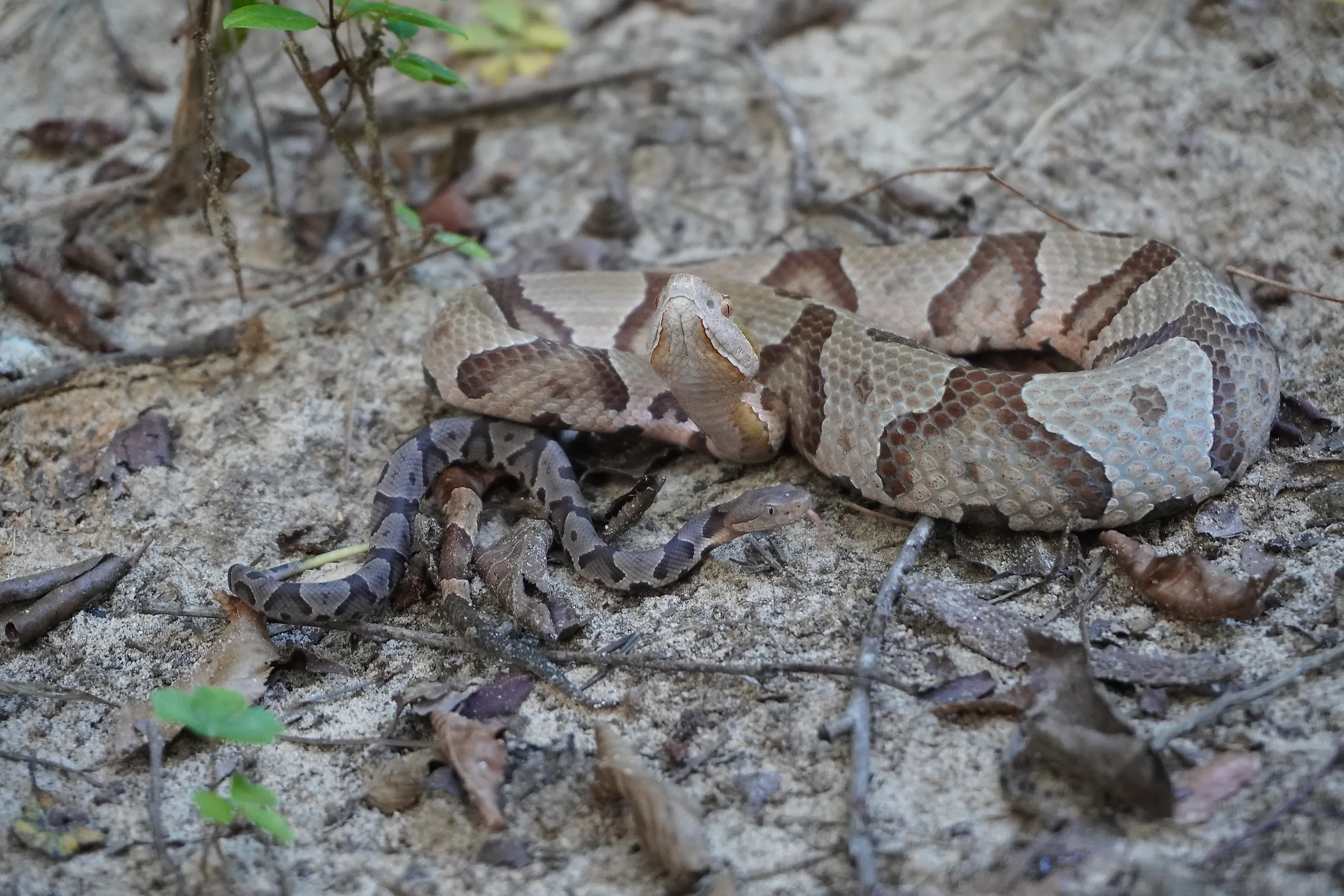
A newborn copperhead is about seven inches long, patterned like a slightly faded adult, and equipped with one piece of hardware its parents no longer have: a bright sulfur-yellow tail tip. That tail is a fishing lure. The snake coils, lifts the tip near the center of its own body and wiggles it, and to a passing lizard or frog it looks exactly like a caterpillar having a bad day. When the prey comes to investigate the caterpillar, the caterpillar eats it. This is why baby copperheads appear in autumn and why they are far more visible than adults, and the answer to the obvious follow-up question is no, they are not more dangerous.
They Show Up Because They Have Just Arrived
The simplest explanation is the one most often skipped. Baby copperheads appear in autumn because autumn is when they are born.
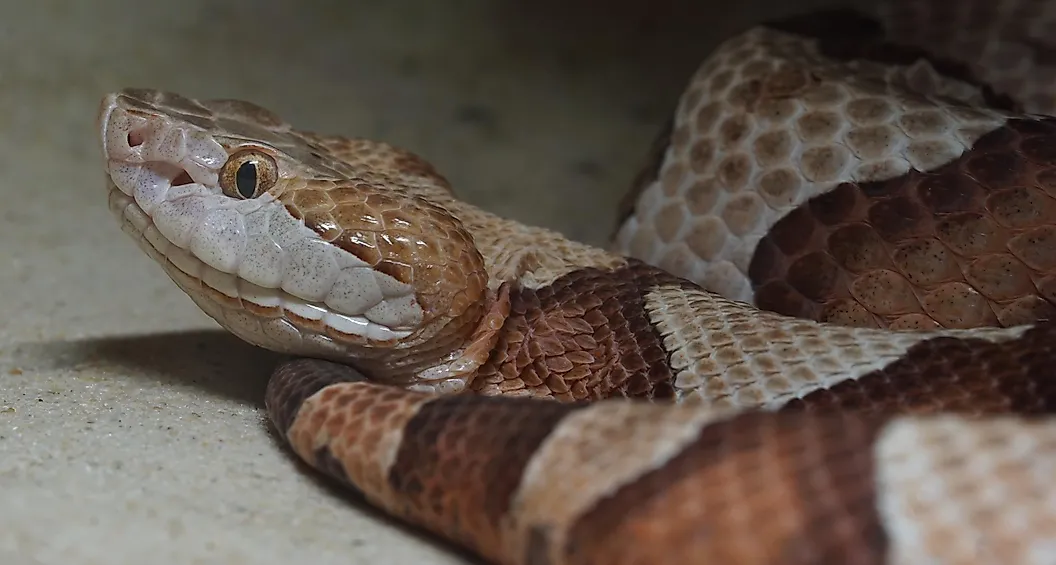
Copperheads do not lay eggs. Females carry their young and give birth to live snakes, typically from late August through September, with some litters arriving into early October. A typical litter runs between two and ten, with six to nine common, though litters of twenty have been documented.
Newborns measure roughly seven to ten inches. They look like miniature adults with a slightly duller, grayer version of the hourglass pattern, which is why they are so easily mistaken for something harmless.
The Tail Is The Whole Story

Everything interesting about a juvenile copperhead comes back to that yellow tip, and the behavior has a proper name.
Caudal luring means tail luring, and the Missouri Department of Conservation describes the sequence precisely. If a small lizard or frog comes within a few feet, the coiled snake moves its tail toward the center of its coil, elevates it slightly, and begins to wiggle it. To a hungry lizard that moving yellow tip looks like a green caterpillar. The lizard pursues the squirming insect, and the copperhead grabs it.
It is ambush hunting with built-in bait, and it exists because a seven-inch snake cannot chase anything down. The prey has to be persuaded to come over.
Why The Color Fades

The yellow tail is temporary, and the reason it disappears explains what it was for. The tip darkens to black, brown or gray over roughly the first year, with the Missouri guidance putting the full transition at around eighteen months to two years. That timeline matches the point at which a copperhead becomes large enough to take bigger prey.
Once a snake can handle mice and small rodents, it does not need to convince a lizard that its tail is a grub. The lure is abandoned because the diet changed, which means the bright tail is a tool for a specific life stage rather than a marking.
It Is Also The Best Identification Feature

For anybody trying to work out what a small snake in the garden actually is, the tail tip beats every other method.
Pattern comparison is unreliable, because several harmless species resemble juvenile copperheads and corn snakes in particular get killed for it. Size tells you nothing either, since harmless and venomous juveniles occupy the same range.
A bright yellow or yellow-green tail on a small snake in the eastern United States narrows it down immediately. Juvenile cottonmouths share the feature, so it indicates a venomous pit viper rather than a copperhead specifically, but either way it is the single most useful thing to photograph from a safe distance.
The Myth, Properly Buried

The belief that baby copperheads are more dangerous than adults is probably the most widely repeated piece of wrong snake information in America, and state wildlife agencies have been correcting it for decades.
Missouri's conservation department states it plainly: there is no biological reason for baby copperheads to have more potent venom than adults, and they have smaller venom glands and tiny fangs. Georgia's wildlife agency addresses the usual justification directly, noting that copperheads of any age can control how much venom they deliver and that dry bites occur frequently in this species.
The venom is chemically the same at any age. What differs is the amount, and the adults have far more of it with larger fangs to deliver it. A juvenile is not a worse bite. It is a smaller one.
Why People Think Otherwise
There is a kernel of something real underneath the myth, and it is worth naming because it explains the persistence.
Juvenile copperheads are genuinely harder to see. They are seven inches of dull brown in deep leaf litter, which means people step closer to them than they would to an adult. A bite from a snake nobody noticed is more likely to be underestimated at the time and treated late, which can make the outcome worse.
That is a visibility problem rather than a venom problem, but it produces enough bad experiences to keep the story alive.
Mothers Stay, Briefly

Parental care is rare among snakes, which makes the copperhead's version worth noting even though it barely lasts. Newborns stay close to their mother for roughly the first week or two. During that window they shed their skin for the first time, and the female may defend them. Then the family breaks up and the juveniles disperse to find their own ground.
That dispersal is the second reason they turn up everywhere in autumn. A litter of nine scatters across the landscape at once, and none of them has any learned sense of where it is safe to be.
Most Of Them Will Not Eat Much
The timing of an autumn birth creates an immediate problem for the newborn, and it is a tight one.
A baby copperhead born in September has a few weeks of warm weather before brumation, the reptile version of winter dormancy. Zoo Atlanta notes that in that window a newborn may eat only a handful of times, and in some cases not at all, before everything shuts down for the winter.
Then it has to find a hibernaculum, often shared with adult copperheads, timber rattlesnakes and rat snakes. A snake born in late summer faces its first winter at a few weeks old, barely fed, in a den it has never seen.
Females Do Not Do This Every Year
One number reframes how many baby copperheads are actually out there in any given autumn.
Reproduction is expensive, and females do not breed annually. Research in Kansas found females might produce litters in two consecutive years and then go several years without reproducing at all. Sexual maturity itself does not arrive until three to five years of age, with females typically slower than males.
So a given autumn's crop of juveniles comes from a fraction of the adult females in an area, not all of them.
What To Do If You Find One

The guidance is the same as for an adult, with one addition about looking harder. Leave it alone and give it room, since the overwhelming majority of bites happen when somebody tries to handle, catch or kill a snake. Photograph the tail from a distance if you want an identification. Watch where you put hands and feet in leaf litter, around log piles and along stone walls through September and October. Keep dogs leashed, since they investigate exactly the places a small snake is hiding.
And do not kill it on suspicion. Harmless species get destroyed constantly on the strength of a vague resemblance, and in most of the copperhead's range the snake you are looking at is not a copperhead.
The Short Version

Baby copperheads show up in autumn because they are born between late August and early October, stay with their mother a fortnight, and then scatter to find territory and a first winter den with no idea where either is.
The yellow tail they arrive with is a lure for catching lizards, it fades once they are big enough for rodents, and it is the clearest identification mark on any small snake in the eastern United States. They are not more venomous than their parents. They are just much harder to see, which turns out to be a different problem with the same ending.