The Oldest Steam Trains In America
Plenty of American towns have an old steam locomotive standing in a local park, often beside the community’s old railway depot. Most of these machines arrived back in the 1950s when railroads switched to diesel and gave their retired engines to the towns they once served.
Left exposed to the elements without any maintenance, most will never move under their own power again.
Fortunately for railway enthusiasts (and who doesn’t like trains!), some were rescued and are still running today. Each of the eight we feature here was built before 1895, and whether they operate from a railway museum, a historic station, a theme park, or a zoo, they all still carry paying passengers.
Ranked by the year each left the workshop for the first time, here’s our take on the oldest steam trains still operating in America.
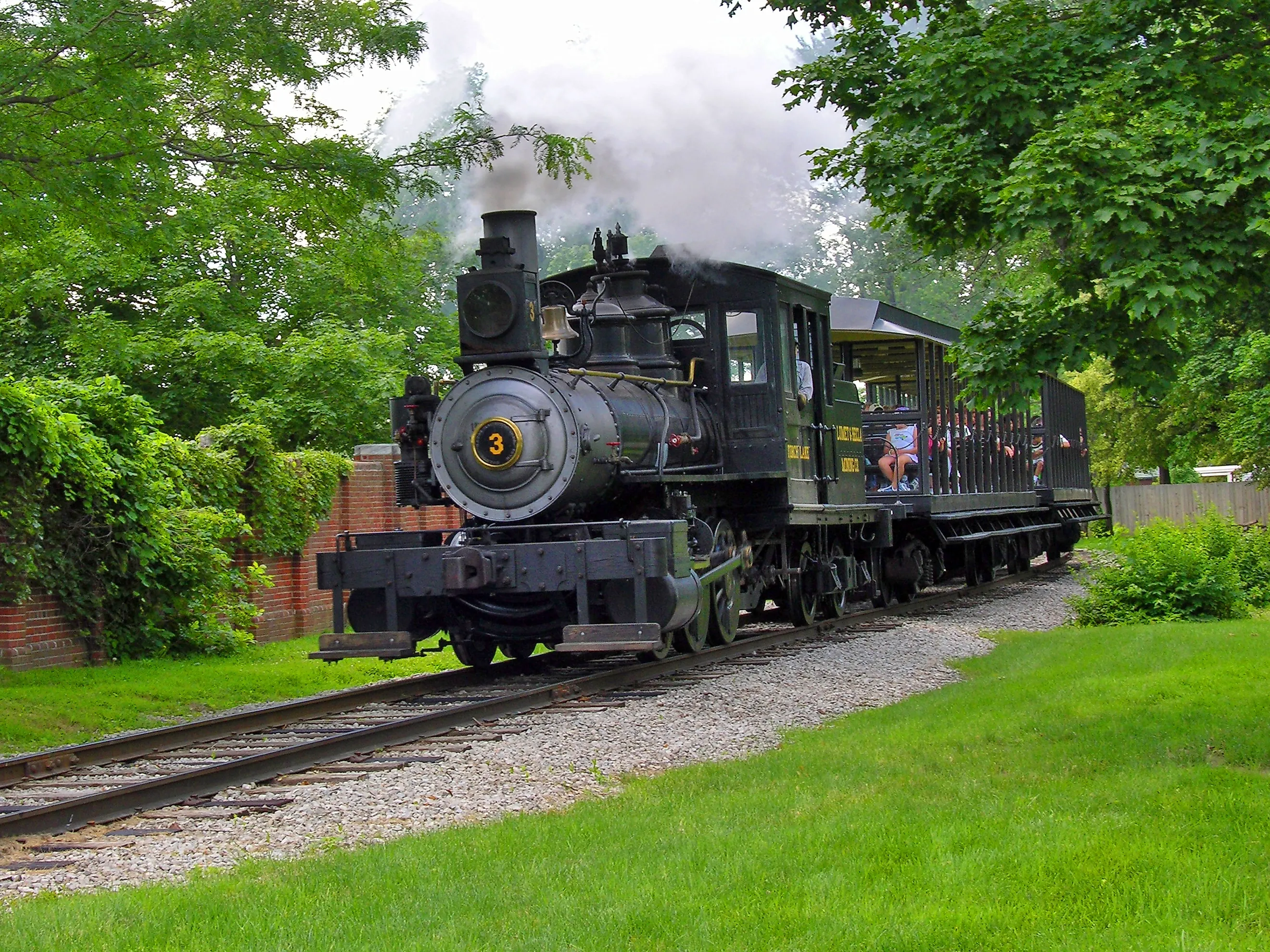
1. Torch Lake, Greenfield Village, Dearborn, Michigan (1873)

It was copper, not passengers, that Torch Lake was built to move. The Mason Machine Works of Taunton, Massachusetts, completed the steam engine in 1873 for the Calumet and Hecla Mining Company, the Boston firm that mined copper on Michigan’s Keweenaw Peninsula.
Torch Lake is a Mason Bogie, with its cylinders and driving wheels mounted on a truck that swivels under the boiler, letting it better handle the sharp curves a mining railroad had to deal with.
Mason built more than 700 of them, and Torch Lake is the last of its kind. Fired for the last time in 1933, it was in storage when Universal Oil Products bought the mining company and gave it to The Henry Ford, the museum complex in Dearborn, in 1969.

The museum rebuilt it, regauged it for the village’s standard-gauge track (the 4-foot-8.5-inch mainline standard), and ran it as the first train of its new perimeter railroad in 1972.
It still operates on the Weiser Railroad, which loops Greenfield Village alongside a Philadelphia-built Baldwin from 1897. The engines are serviced in public view in the Detroit, Toledo & Milwaukee Roundhouse, built in Marshall, Michigan, in 1884.
2. Glenbrook, Nevada State Railroad Museum, Carson City, Nevada (1875)

The wood-burning Glenbrook steam engine left Philadelphia’s Baldwin Locomotive Works in March 1875 for the Carson & Tahoe Lumber & Fluming Company.
It’s a narrow-gauge engine, built for rails three feet apart, and for 23 years it hauled lumber and cordwood from the mill town of Glenbrook up to Spooner Summit, the pass above the lake, where they were sent down a water flume to Carson City.
From 1898 to 1925, it pulled tourist trains between Truckee, California, and Tahoe City. The Bliss family, who had owned the lumber company, bought the engine back in 1943 to keep it from the scrapyard and gave it to the Nevada State Museum, where it stood outside until 1981.
It then moved to the Nevada State Railroad Museum in Carson City, and a 34-year restoration was completed in 2015.

It now pulls passengers on the museum’s loop at the Memorial Day, Fourth of July, and October harvest steam-ups, alongside Virginia & Truckee No. 25, a Baldwin built in 1905. Its yardmate from the same year, the Virginia & Truckee’s Inyo, later stood in for the Central Pacific’s Jupiter at Utah’s Golden Spike site, where the transcontinental railroad was joined in 1869 (it’s now off display for a rebuild).
3. No. 41, Calico Railroad, Knott’s Berry Farm, Buena Park, California (1881)

Two Baldwin locomotives built in 1881 came to Knott’s Berry Farm in Buena Park, California, in 1951, and one of them still circles the park’s Ghost Town. Baldwin built both for the Denver & Rio Grande, the narrow-gauge railroad that pushed into Colorado’s mining country. Both were Consolidations, the name for a 2-8-0 with eight driving wheels.
Walter Knott, the berry farmer whose roadside chicken-dinner restaurant grew into the park, bought the pair as Colorado’s narrow-gauge lines wound down. He put them to use as attractions when the Ghost Town & Calico Railroad opened in 1952.

No. 41 went to the shops of the Durango & Silverton Narrow Gauge Railroad, the Colorado tourist line, in 2022 for a 20-month rebuild and was back hauling park guests in December 2023. Its twin, No. 340, followed it to Durango in 2024 for its own rebuild and ran a short series of Durango & Silverton excursions into the Animas Canyon in 2025.
4. Denver & Rio Grande No. 168, Cumbres & Toltec Scenic Railroad, Antonito, Colorado (1883)

For 77 years, the Denver & Rio Grande No. 168 stood on a pedestal in Antlers Park in downtown Colorado Springs. Baldwin built it in 1883 as a Ten-Wheeler, a 4-6-0 with four guide wheels ahead of six 46-inch drivers, meant for fast passenger work.
It pulled the special train that took President William Howard Taft to open the Gunnison Tunnel irrigation project in 1909, and the railroad presented it to the city on August 1, 1938.

In 2015, the city leased it to the Cumbres & Toltec Scenic Railroad, the 64-mile Rio Grande remnant between Antonito, Colorado, and Chama, New Mexico, that the two states bought in 1970. The railroad’s own shop crew in Antonito spent 27 months and $508,000 on the rebuild, and the engine steamed for the first time since 1938 in October 2019.
The engine still runs on Cumbres & Toltec’s special excursions rather than the daily trains, pulling restored 19th-century Rio Grande coaches. These include dinner trains from Antonito to Osier, the midpoint lunch stop. The daily trains cross Cumbres Pass at 10,015 feet behind Baldwin freight engines built in 1925.
5. Riva, Omaha Zoo Railroad, Henry Doorly Zoo and Aquarium, Omaha, Nebraska (1890)

The one engine on this list built outside the United States, Riva is an Austrian tank locomotive, meaning it keeps its water and fuel on board rather than towing a tender.
The Krauss Works of Linz built it in 1890 for a tramway linking Mori, Arco, and Riva del Garda on Lake Garda, then Austrian territory that’s now in northern Italy.
It finished its European career on the Romanian State Railways, and in 1968 passed to Plasser & Theurer, the Austrian maker of track-maintenance machines.

When the Henry Doorly Zoo and Aquarium went looking for a second steam engine, Plasser & Theurer donated Riva in 1974. Union Pacific, the railroad headquartered in Omaha, rebuilt it in its own shops, and it entered zoo service in 1976.
Union Pacific crews laid the Omaha Zoo Railroad in 1968, and its first engine, No. 119, is a replica, built in 1968, of the UP locomotive at the 1869 Golden Spike ceremony. Riva has nearly twice its pulling power, and on busy weekends both engines run at once, with Riva hauling six open-air coaches and a caboose between the railroad’s two stations.
6. TIE: Sierra Railway No. 3, Railtown 1897 State Historic Park, Jamestown, California (1891) and No. 9, Wiscasset, Waterville & Farmington Railway, Alna, Maine (1891)

Sierra Railway No. 3 has appeared in more than 100 films and TV shows, including High Noon (1952) and Back to the Future Part III (1990). So, it’s for good reason that Railtown calls it the “Movie Star Locomotive.” The Rogers Locomotive and Machine Works of Paterson, New Jersey, completed it in March 1891 for an Arizona line, the Prescott & Arizona Central Railway.
The Sierra Railway in California bought it in June 1897 to help build its route into the Mother Lode gold country. It now belongs to the State of California and is kept in the roundhouse, built in 1897, at Railtown 1897 State Historic Park in Jamestown, the Sierra’s original shops complex. Both the locomotive and the shops are listed on the National Register of Historic Places.
It was taken out of service in 2021 for the Federal Railroad Administration’s 1,472-day inspection, the boiler teardown required of every operating steam locomotive. It was fired up again in April 2025 and returned to excursion duty in July the same year. It pulls the park’s six-mile, 45-minute round trips on scheduled steam days.

The 18-ton Wiscasset, Waterville & Farmington Railway No. 9 is the only engine on this list that runs on two-foot gauge, a cost-saving standard a handful of Maine railroads adopted in the 1880s and 1890s. The Portland Company built it in 1891 as No. 5 of the Sandy River Railroad, and it passed through two more Maine two-footers before the WW&F bought it in 1933.
A Connecticut buyer then kept it on a farm in Thompson for 60 years before the family agreed in 1994 to send it home to Maine. The WW&F Railway Museum in Alna, a volunteer group that re-laid 3.5 miles of the original roadbed, finished a 20-year restoration and ran No. 9 under its own steam in December 2015.
Trains leave the museum’s Sheepscot station and climb to Trout Brook by way of a covered bridge. No. 9 headed the museum’s annual picnic trains in 2025 and 2026, alongside Monson Railroad No. 3, another Maine two-footer.
8. Fred Gurley, Disneyland Railroad, Anaheim, California (1894)

Sugarcane was the first cargo for Disneyland’s No. 3, the Fred Gurley. It was built for the Godchaux Sugar Company in Louisiana by Baldwin in 1894 as a Forney, a tank engine with its water and fuel on a frame behind the cab.
Walt Disney’s designers had it rebuilt in the studio shops rather than build a new engine from scratch, as they had for the park’s two engines built in 1955.
It made its first trip around the park in March 1958 and was named for Fred G. Gurley, president of the Santa Fe Railway, which sponsored the line until 1974. Disney calls it the oldest steam engine operating at any of its parks worldwide.
The Disneyland Railroad opened with the park on July 17, 1955, and its 1.2-mile loop around the Anaheim park stops at Main Street, New Orleans Square, Mickey’s Toontown, and Tomorrowland, passing the Grand Canyon and Primeval World dioramas.
The park’s other engines include the Ward Kimball, a Baldwin built in 1902, the Ernest S. Marsh, built in 1925, and the two engines Disney built for opening day.
Before You Climb Aboard
Every locomotive on this list escaped the fate of the engines rusting in town parks across America. Keeping them that way takes volunteers, machinists, and museum staff, plus the ticket revenue that pays for boiler inspections and replacement parts no factory has made in more than a century.
Many run only on select dates, and schedules can change at short notice when repairs are needed, so check each railway’s website before traveling.
Climb aboard a machine built in the 1800s, knowing your fare helps keep it on the tracks and out of the town park for good.