The Largest Railroad Museums In The United States
Train enthusiast or not, it's hard to deny that little thrill of excitement when the gates come down and the bells start clanging at a railway crossing. It might add a few minutes to your drive, but the ritual of counting freight cars as a train trundles past never grows old (unless, of course, that train were the 500-car, four-mile-long Norfolk & Western Super Train of 1967).
Counting engines and rolling stock is also how we ranked the largest railroad museums in the United States: we simply looked at the number of locos and cars each museum publishes for its collection and took them at their word. Here, then, are the results of our survey of the biggest train museums in America.
1. Illinois Railway Museum, Union, Illinois

When a group of men ponied up $100 each in 1953 to buy a retired interurban car, an electric railcar built to run between towns, they couldn't have known that initial purchase would one day amount to over 500 pieces of railway and transit equipment. Now known as the Illinois Railway Museum, it's the largest such collection in North America and has occupied a 100-acre property near the village of Union northwest of Chicago since 1964.
The collection's star is the Nebraska Zephyr. This stainless-steel streamliner was built in 1936 for the Chicago, Burlington & Quincy Railroad and is the only complete Zephyr train still running. It's hauled by the Silver Pilot, the last surviving E5 streamlined diesel engine. Operating trains ride a five-mile main line, and there's also a streetcar loop.

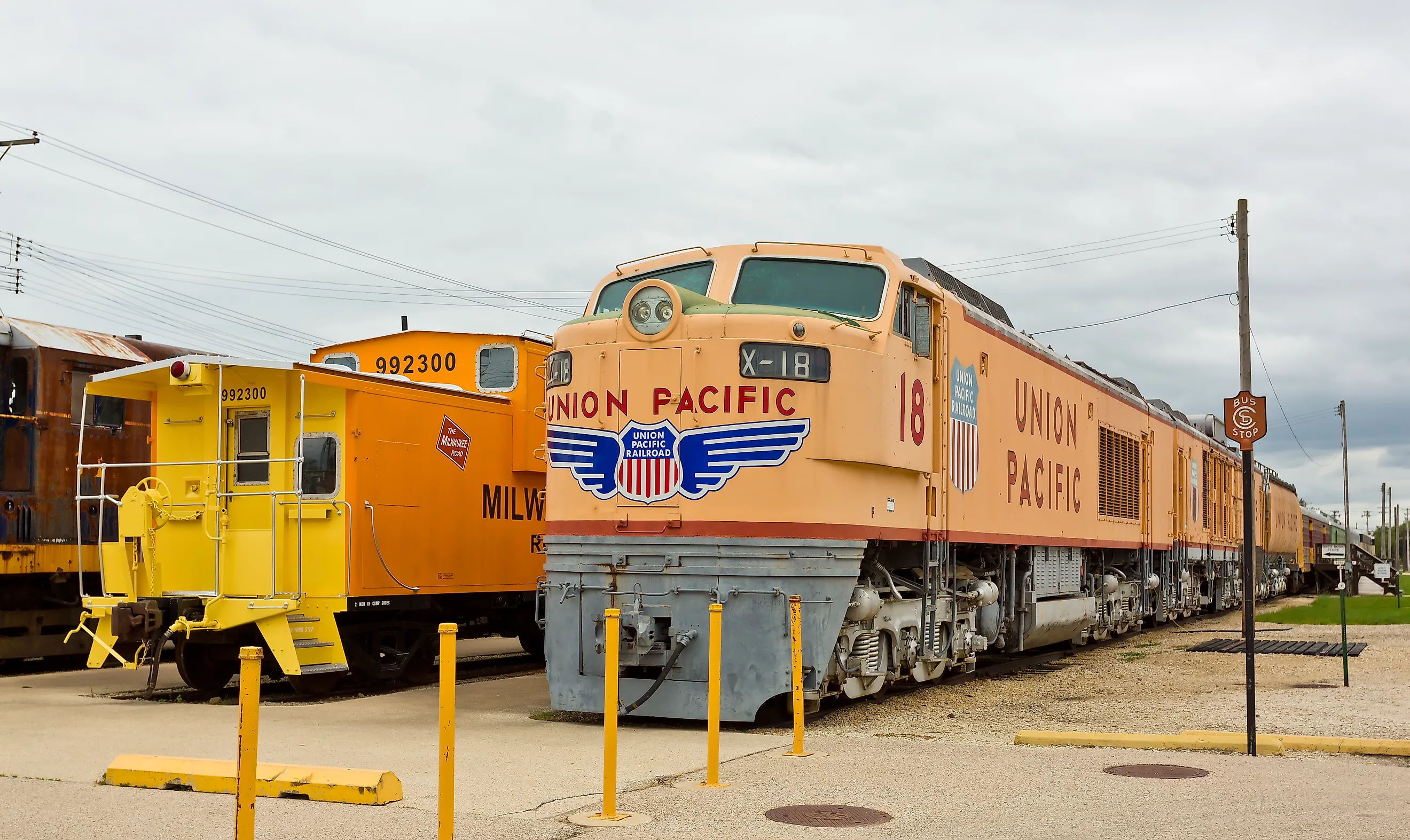
Another classic is the Frisco 1630, a steam locomotive built in 1918 by Baldwin, the Philadelphia locomotive works, for export to Russia and stranded in the United States by the Bolshevik Revolution of 1917. The Union Pacific 6930 is another unique museum piece. A 6,600-horsepower engine built in 1969 for the centennial of the transcontinental railroad, the most powerful single-unit diesel locomotive ever built. Rides are included with admission.
2. Southern California Railway Museum, Perris, California
The largest collection of railway equipment in the western United States, the Southern California Railway Museum covers nearly 100 acres in Perris, a city southeast of Los Angeles. Its core collection includes more than 200 railway vehicles, with a focus on the Pacific Electric Railway, the Los Angeles interurban system that ran more than 1,000 miles of track at its peak.
The service ended in 1961, and the museum is home to more than 35 pieces of equipment, including the Red Cars, the railway's famous red-painted trolleys. The museum is also home to the Grizzly Flats Railroad, the backyard narrow-gauge line that Disney animator Ward Kimball began building in San Gabriel in 1938. One of its locomotives, Emma Nevada, was built in 1881 and named for an opera singer. The property's movie-set Victorian-era depot is worth seeing.
The grounds are free Tuesday through Sunday, train and trolley rides run on weekends, and the Polar Express holiday train starts up mid-November for Christmas.
3. National Museum of Railroad History & Innovation, Baltimore, Maryland (Tie)
The National Museum of Railroad History & Innovation, formerly known as the B&O Railroad Musem, occupies 40 acres of the Baltimore & Ohio Railroad's (B&O) Mount Clare repair shops in Baltimore. The B&O was chartered in 1827 as America's first railroad open to paying freight and passengers, and in 1830 laid its first mile of commercial track here, running west from Mount Clare toward what is now Ellicott City.
Nearly 200 locomotives and pieces of rolling stock are kept here, and the centerpiece of the museum is its roundhouse, a 22-bay circular shop built in 1884 around a turntable. Highlights include the William Mason, a steam locomotive built in 1856, a replica of the Tom Thumb, the B&O's first steam loco from 1830, and American Freedom Train No. 1, the engine that pulled the 1975 Bicentennial exhibition train across the country.
The Mile One Express operates on that first mile of track from April to early November. A $38 million expansion is under way, with an Innovation Hall entrance due to open in January 2027 for the railroad's bicentennial.
4. National Museum of Transportation, St. Louis, Missouri (Tie)
Union Pacific 4006, one of 25 Big Boy steam engines built between 1941 and 1944, headlines the collection at the National Museum of Transportation in Kirkwood, 16 miles southwest of downtown St. Louis. The museum's 42-acre campus houses more than 190 major exhibits in its rail and transit collection, more than 70 of them locomotives. It also has collections of automobiles and aircraft worth seeing.
The museum started off in 1944 when a group of St. Louis residents bought the Bellefontaine, a mule-drawn streetcar. The site includes one of the two Barretts tunnels, the first railroad tunnels built west of the Mississippi River, dug between 1851 and 1853.
Other equipment includes the Daniel Nason, a wood-burning loco built in 1858, and General Motors No. 103, a 1939 demonstrator loaned to railroads as a sales pitch and credited as the first successful diesel-electric freight locomotive. Trolley rides are included with your admission when the cars are running.
5. Railroad Museum of Pennsylvania, Strasburg, Pennsylvania (Tie)

A new six-stall roundhouse is being added to the Railroad Museum of Pennsylvania to house six of the Strasburg attraction's more than 100 locomotives and railroad cars. The museum opened in 1975, and highlights include the 100,000-square-foot Rolling Stock Hall and its core collection of equipment that the Pennsylvania Railroad (PRR) set aside after showing it off at the 1939 New York World's Fair.
Among them are No. 4800, nicknamed Old Rivets and built in 1934 as the first of the PRR's GG1 electric passenger locomotives; and No. 460, the Lindbergh Engine, which in 1927 raced newsreel film of aviator Charles Lindbergh's return from his solo Atlantic flight to New York at speeds up to 115 miles per hour.
Another highlight is engine No. 6755, a 384-ton freight locomotive built in 1930 and believed to be the largest surviving PRR steam engine. The new $15 million roundhouse is due to open by early 2027.
5. Colorado Railroad Museum, Golden, Colorado (Tie)

The Colorado Railroad Museum is built around narrow gauge track, which measures three feet wide instead of the standard four feet eight and a half inches. The collection, which now has over 100 locomotives, passenger cars, and cabooses, concentrates on equipment from Colorado's narrow-gauge mountain lines, which began closing in the 1940s.
Set in a 15-acre railyard beside Clear Creek in Golden, 12 miles west of Denver, the museum opened in 1959 in a replica of an 1880s railway depot, which still serves as the main exhibit building. The stars of the show are three of the seven Galloping Geese, railcars that the Rio Grande Southern Railroad, a narrow-gauge line in southwestern Colorado, built in the 1930s from Pierce-Arrow luxury automobile bodies. All three still run on scheduled days.
Other highlights include the Denver & Rio Grande Western No. 346, built in 1881 and the oldest operating steam engine in Colorado; and No. 491, built in Denver in 1928 and the largest operating narrow-gauge steam locomotive in the Western Hemisphere.
7. Southeastern Railway Museum, Duluth, Georgia

Georgia's official transportation history museum is a 35-acre yard in Duluth, a suburb northeast of Atlanta. The Southeastern Railway Museum was founded in 1970 and features 90-plus railway cars and locomotives, the largest such collection in the state. Its best-known pieces are the Superb, a private railcar built by the Pullman Company in 1911 that was used by President Warren G. Harding, and the Marco Polo, a private car used by President Franklin D. Roosevelt.
Other notable machines in its collection include Savannah & Atlanta No. 750, a passenger steam locomotive that appeared in Biloxi Blues, the 1988 Neil Simon film, and Southern Railway No. 6901, a passenger diesel built in 1951 that pulled the Southern Crescent. Admission includes a caboose ride around the grounds.
8. National Railroad Museum, Green Bay, Wisconsin

Green Bay's National Railroad Museum is home to the only British A4 steam engine in America. One of only six surviving streamlined express locomotives built in the 1930s for the London to Edinburgh service, No. 60008 Dwight D. Eisenhower has been at the museum since Memorial Day 1964. It was loaned to the National Railway Museum in York, England, in 2012 for a two-year period.
The museum occupies 33 acres on the Fox River in Ashwaubenon, next to Green Bay, and has over 70 old railway engines and cars. Local businessmen set it up in 1956, and a joint resolution of Congress two years later made it the only congressionally designated railroad museum in the country.
The Eisenhower locomotive shares the 25,000-square-foot Lenfestey Center with Union Pacific 4017, a 1.1-million-pound Big Boy. A second hall, the Fox River Expansion, features the Merci Train boxcar, one of 49 that France sent to the United States in 1949 as a thank-you for American-supplied food relief after World War II. It also houses the Pullman Joseph Lister, a hospital car that served the Mayo Clinic in Rochester, Minnesota.
Still Counting Train Cars

Between them, these eight museums have more than 1,300 locomotives and rail cars. Lined up, that'd be a train nearly three times longer than the 500-car Super Train of 1967, with more than 10 miles of rolling stock, and enough to keep you counting for the better part of an hour at a crossing. And that number keeps growing: Baltimore opens its Innovation Hall in January 2027, Strasburg's roundhouse follows soon after, and Green Bay has only just filled its new hall. Check back in a few years and count again.