The Oldest Prisons You Can Tour In America
The first prisoner sent to New-Gate Prison in Connecticut arrived in December 1773 and was lowered into an abandoned 67-foot-deep copper mine, which the colony thought was escape-proof. Legend has it he was hauled out less than three weeks later after his sweetheart lowered him a rope. America's oldest prisons have been sharing stories like that ever since, and some of them are now popular attractions that can be toured.
We've ranked the oldest prisons that offer scheduled public tours, using the year each took in its first inmates as its starting point. These include state, territorial, federal, and military prisons that have since closed. County jails, which were built for people awaiting trial rather than serving sentences, are a different institution altogether, and a list for another day.
So, shake your shackles and start banging your tin cup as we take a look at the oldest prisons you can tour in America.
1. Old New-Gate Prison & Copper Mine, East Granby, Connecticut (1773)

Copper mining at the site of Old New-Gate Prison, then part of Simsbury, dates to 1707, when residents formed America's first chartered copper mining company. By 1773, the ore had run out. The Connecticut General Assembly, the colony's legislature, decided that the mine's two shafts, 25 feet deep and 67 feet deep respectively, would make for an inescapable prison. That theory lasted all of 18 days until John Hinson, serving ten years for burglary and the first inmate, was hauled up the deeper shaft on a rope.
Despite the escape, New-Gate Prison remained in use, and during the Revolutionary War, colonists who sided with Britain, alongside counterfeiters and thieves, were held in the caverns. Inmates slept underground and worked above ground making nails, since officials had decided handing convicts mining tools was a bad idea.

The state gave up on the place in 1827 and moved everyone to a new prison in Wethersfield, south of Hartford.
Connecticut now runs Old New-Gate Prison & Copper Mine as a museum, with guided tours into the mine tunnels where the prisoners slept. Above ground, the ruins of the guardhouse, the stone wall built in 1802, and the four-story cell block built in 1824 can be explored. Across the road, Viets Tavern, once run by the prison's first keeper, is being restored with a federal grant.
2. Eastern State Penitentiary, Philadelphia, Pennsylvania (1829)

Established in 1829, Eastern State Penitentiary was designed with individual cells that segregated prisoners in the belief that their solitude would make them penitent. The prison was a project of a reform group founded in 1787 with Benjamin Franklin among its early members. Its cellblocks radiated outward from a central hub like the spokes of a wheel, enabling guards to easily see down its corridors.
Its medieval Gothic exterior on Fairmount Avenue was deliberately designed to instill so much fear in passersby about what lay inside that they'd never commit a crime. English novelist Charles Dickens, who visited the prison in 1842, called the system cruel and wrong.

Built for 250 people, the prison held 1,700 by the mid-1920s and had grown to 15 cellblocks by 1956. Chicago mob boss Al Capone served eight months there in 1929 and 1930 for carrying a concealed weapon, in a cell fitted out with rugs, paintings, and a radio.
Pennsylvania closed the prison in 1971. Hard hat tours began in 1994 and brought in 10,000 visitors that first year. Self-guided audio tours, as well as guided options, are available. Capone's restored cell is on the route, and a new exhibit, Freedom Through Faith, tells the story of the prison synagogue that opened here in 1924, the first in an American prison.
3. Missouri State Penitentiary, Jefferson City, Missouri (1836)

Missouri built its first state penitentiary in Jefferson City to help the town keep its status as capital, and it admitted its first inmate in 1836. Over the next 168 years, the prison on the Missouri River became the oldest continuously operating one west of the Mississippi, and one of the most violent. A riot in September 1954 began when two inmates faked illness, ambushed the guards who came for them, and took their keys. The ensuing violence saw four inmates die, and $5 million in damage inflicted on the facility.
Dubbed the "bloodiest 47 acres in America," its inmates included Charles "Pretty Boy" Floyd, the Depression-era bank robber, and Sonny Liston, who arrived in 1950 for armed robbery, learned to box in the prison gym, and was world heavyweight champion by 1962.

James Earl Ray escaped in 1967 by hiding in a truck hauling bread from the prison bakery and killed civil rights leader Martin Luther King Jr. the following year.
The state moved the last prisoners out in September 2004, and history tours now run from March through November. Highlights include A-Hall, the oldest cellblock, built in 1868; the dungeon cells where inmates were held in darkness; and the gas chamber, which inmates built and where 40 people were put to death between 1938 and 1989, the last by lethal injection. Ghost tours are available, and the separate Missouri State Penitentiary Museum, two blocks away, has a replica cell and historic photos.
4. Michigan's First State Prison, Jackson, Michigan (1839)

Jackson beat several other cities for the right to host Michigan's first prison in 1838, and the following year, 35 inmates moved into a wooden stockade fenced with tamarack poles, a rot-resistant native larch. Within a year, it was packed well past capacity, and ten prisoners escaped in 1840. The stone cellblock that replaced the stockade was built in 1842 behind walls 25 feet high, and by 1882, more than 2,000 prisoners were locked inside what the city claims was the largest walled prison in the world at the time.
When the State Prison of Southern Michigan opened on the north side of Jackson in 1934, the old building became a National Guard armory.

The building reopened in 2008 as Armory Arts Village, a complex of 62 apartments and 12 artists' studios inside the former cell block. The original painted cell numbers are still visible on the brick, and the curved bars outside the windows are still in place.
Jackson Historic Prison Tours has taken groups through the building since the apartments opened. Guides lead visitors into the gallery that once held four tiers of cells, down to the solitary confinement cells in the basement, and through the tunnels beneath the yard, sharing stories of escapes and the plate-throwing riots that overcrowding set off along the way.
5. Old Joliet Prison, Joliet, Illinois (1858)

Visitors enter Old Joliet Prison through the same east gate actor John Belushi walked out of in the opening scene of The Blues Brothers, the 1980 film that gave his character the name Joliet Jake. The prison opened in May 1858, when 53 convicts arrived at a small stone building that still stands and were put to work quarrying limestone a few hundred feet away to build the walls around themselves. It replaced Illinois's first penitentiary at Alton, which the prison reformer Dorothea Dix had inspected in 1847 and condemned.
By 1878, close to 2,000 inmates were locked up inside. Its inmates included Nathan Leopold and Richard Loeb, the Chicago students who murdered 14-year-old Bobby Franks in 1924 and began serving life sentences here that September.

George "Baby Face" Nelson, the bank robber who ran with John Dillinger, served time here too. The state of Illinois closed the prison in 2002, and the Joliet Area Historical Museum began tours in August 2018.
Ninety-minute guided history tours, self-guided walks, and hard-hat tours of the administration building are available. The inscription, "It's Never Too Late to Mend," is still set into the floor of the entrance, a detail that also appears in The Blues Brothers. The complex also doubled as Fox River State Penitentiary for the first season of the television series Prison Break, shot here in 2005.
6. Alcatraz Island, San Francisco, California (1859)

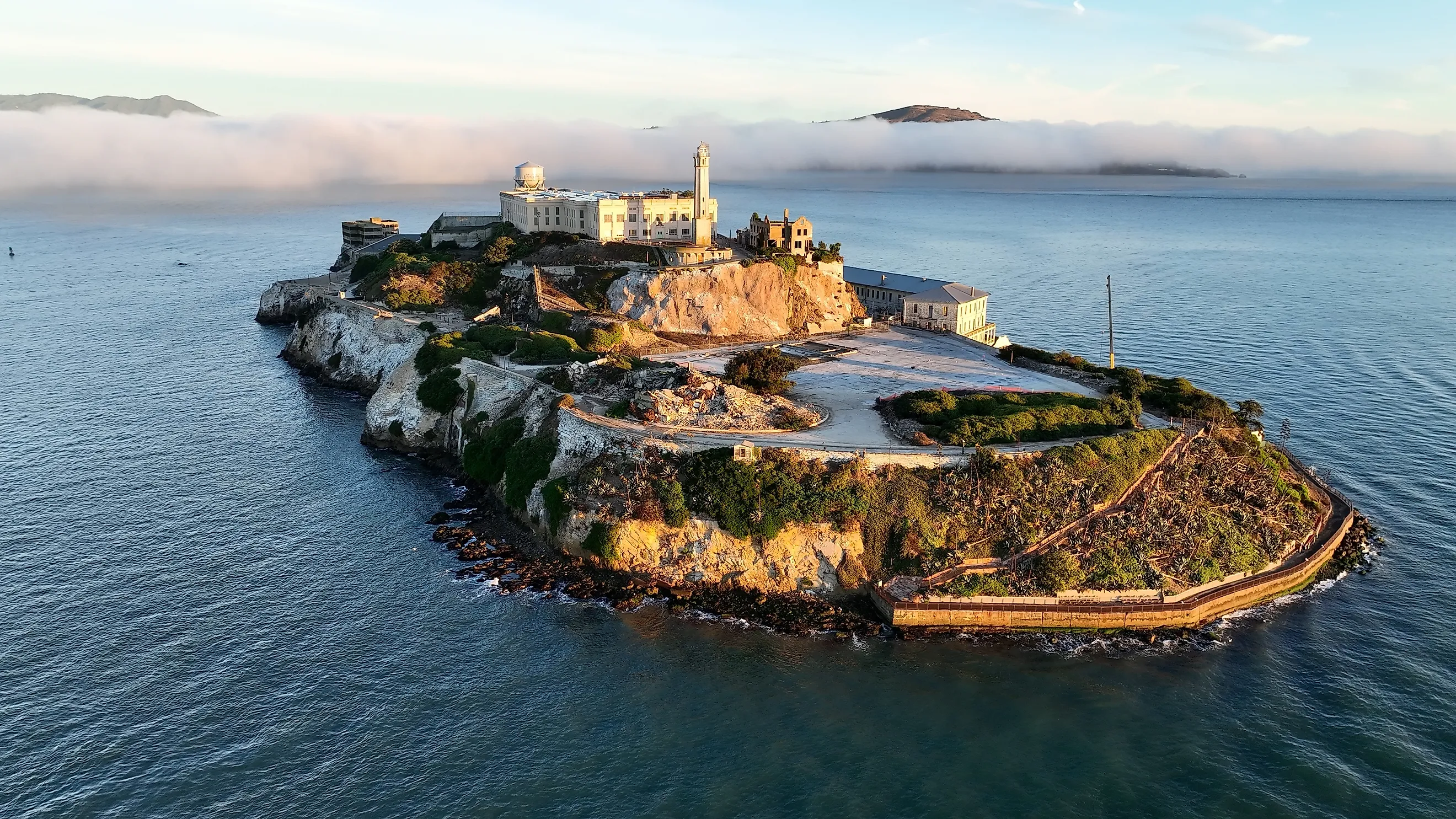
Alcatraz in San Francisco started out as a military base, with the island's first permanent garrison arriving in 1859. Almost immediately, 11 of those soldiers were confined in the basement of the Sally Port, the fortified gateway on the road up from the dock, for breaking Army rules. The Army soon realized that cold water and fast currents made a better wall than anything it could build, and in 1861 designated the island the military prison for the Department of the Pacific.
Civil War prisoners followed, among them the crew of a Confederate privateer and civilians accused of treason. In 1895, 19 Hopi members of a Native American nation from Arizona were held here for refusing to send their children to government schools.

Military prisoners built the concrete cellhouse between 1909 and 1912, with 600 single cells. The Army left in 1934, handing over 32 of its toughest inmates, who became the first residents of the now federal penitentiary. Notable crooks held here included Al Capone, George "Machine Gun" Kelly (the Prohibition-era kidnapper), and Robert Stroud, aka the Birdman of Alcatraz.
The prison closed in 1963, and the entire island is now run by the National Park Service as part of the Golden Gate National Recreation Area. Alcatraz City Cruises is the only ferry that lands there, and it's a 15-minute crossing from Pier 33 on the San Francisco Embarcadero. Admission includes the Doing Time cellhouse audio tour, narrated by former guards and inmates.
7. Nevada State Prison, Carson City, Nevada (1862)
Nevada's first territorial legislature met in 1861 at the Warm Springs Hotel, built around a hot spring east of Carson City. The following year, the territory bought the hotel and turned it into the Nevada State Prison. The sandstone quarry on the grounds supplied the stone for the Nevada State Capitol, and prisoners cutting that stone uncovered fossilized footprints of mammoths, sloths, and dire wolves.
The prison carried out the country's first-ever execution by lethal gas in February 1924. The condemned man, a Chinese immigrant called Gee Jon, was convicted of a gang murder.
When Nevada legalized gambling in 1932, the warden let inmates open a casino called the Bull Pen, which offered blackjack, craps, poker, and sports betting, with brass tokens as chips (it ran until 1967). The last inmates left in January 2012, 150 years after the first arrivals.
The prison opened to the public as an attraction in 2016, and 90-minute guided day tours include the cellhouses, the quarry, and the death chamber. Advance booking is required, and ghost walks run on fall evenings.
8. Old Montana Prison, Deer Lodge, Montana (1871)

On July 2, 1871, US Marshal William Wheeler delivered the first nine prisoners to the new Montana Territorial Prison at Deer Lodge. It was overcrowded within a month, and Montana, finding it too costly to run, contracted it out in 1890 to Thomas McTague and Frank Conley, a former guard, for 70 cents per prisoner per day. Conley, warden until 1921, put the inmates to work.
In 1893, they replaced the wooden fence with the sandstone wall that still surrounds the site, four and a half feet thick and 24 feet high. They also hand-made 1.2 million bricks for a cell house finished in 1896, and a larger one built in 1912. In April 1959, inmates Jerry Myles and Lee Smart seized a rifle from a catwalk guard, shot Deputy Warden Ted Rothe dead, and held the prison for 36 hours with 19 employees and five inmates as hostages until the National Guard went in. Myles shot Smart and then himself.

The state closed the prison in 1979 and moved everyone to a new one west of town. The Powell County Museum and Arts Foundation now leases the prison from the state and runs it as the centerpiece of five museums, including the Montana Auto Museum, all covered by one admission. Guided and self-guided tours include the cell house from 1912, the maximum-security block with its windowless black box cells, and the yard. They also include the galloping gallows, a portable scaffold, on display in the Clark Theater, the prison's own playhouse.
Bazooka scars from the 1959 siege are still visible on the tower where the ringleaders made their stand. Cell No. 1 is on the route too. It housed Paul "Turkey Pete" Eitner, a lifer who believed he had bought the prison. Eitner died in it in 1967 after 49 years inside, and his was the only funeral ever held within the prison's walls.
These Days, Everyone Gets Out
Between them, these eight prisons cover more than 250 years of American crime and punishment. They once held a man who went on to become heavyweight champion, Martin Luther King Jr.'s assassin, Al Capone (twice), and even a convict who thought he owned the prison. Several were built by the people locked inside them, and most were condemned as overcrowded or inhumane decades before anyone got around to closing them.
But the difference between you and John Hinson, the man sent down that old mine at New-Gate in 1773, is that you get to leave by the front gate.