The National Forests Where Copperheads Den For The Winter
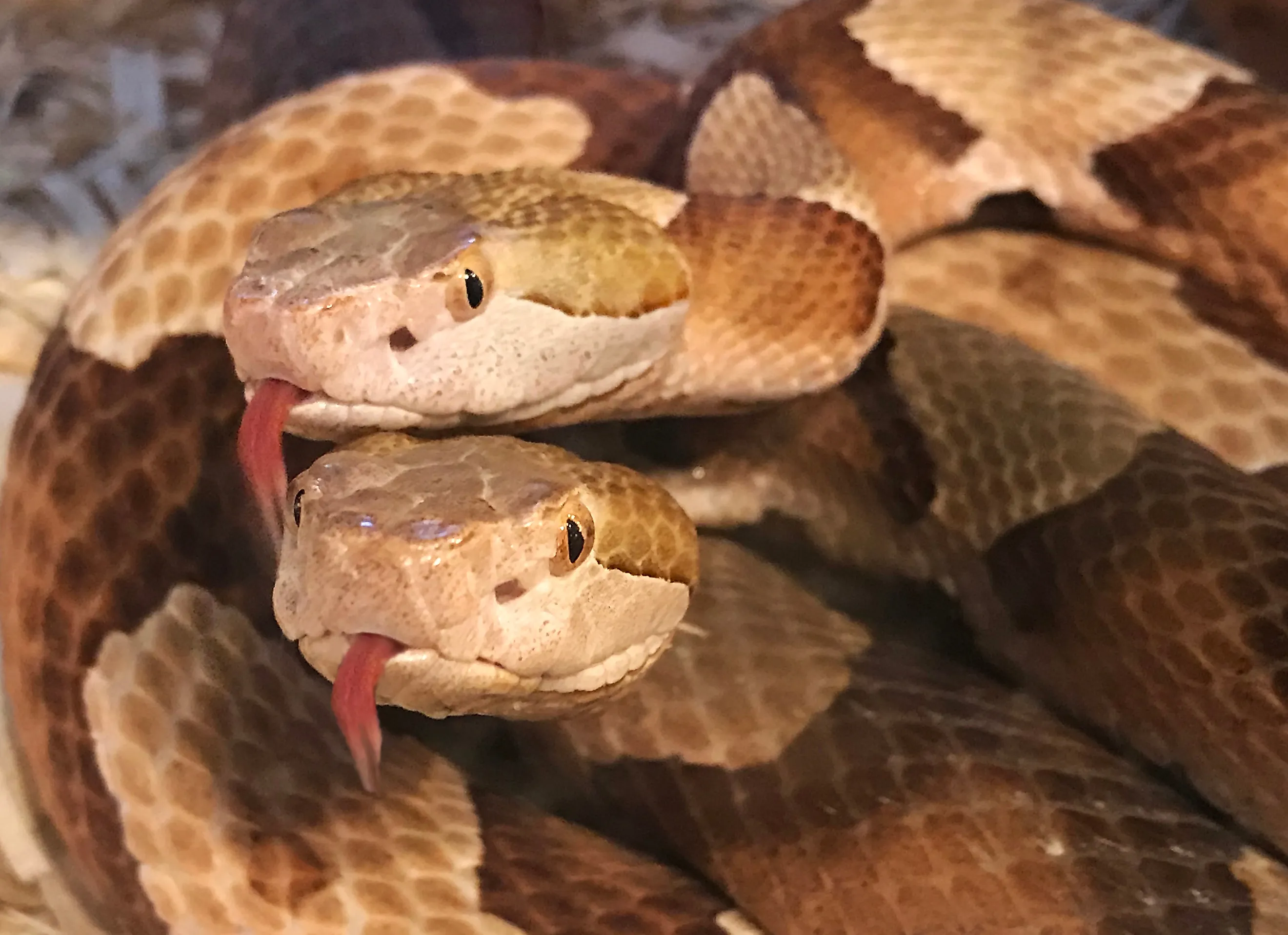
As many as 100 snakes have been reported from a single winter den, and copperheads sometimes share that rock with timber rattlesnakes and black rat snakes. In southern Illinois, so many snakes head into one limestone bluff each fall that the Forest Service shuts the road at its foot to cars for two months. By mid-November that crossing is over, and most of the copperheads in the national forests of the Ozarks and the eastern mountains are underground. Some lie alone in a stump hole below the frost line. Others crowd onto a south-facing ledge, and they often return to the same spot year after year.
Mark Twain National Forest, Missouri

Missouri's copperheads move into their winter sites from mid-to-late October. Some spend the season alone, and others gather at favorite overwintering sites, which the state's conservation department describes as typically south-facing rocky ledges. Caves, animal burrows, hollow logs and stumps, abandoned rock quarries, and rocky lake spillways also serve.
In the Mark Twain National Forest, that kind of rocky, open ground runs through the Hercules-Glades Wilderness in southwest Missouri, which takes its name partly from the limestone glades spread across it. The Forest Service warns hikers on the wilderness's 32 miles of trail that copperheads and rattlesnakes may be encountered there. The glades themselves are openings of native tall prairie grass, with eastern red cedar and oak scattered between them.
Shawnee National Forest, Illinois

East of the Mississippi, the fall move into the rock is big enough that the Forest Service closes a road for it. Snake Road, a 2.5-mile road in the Shawnee National Forest of southern Illinois, runs along the base of the Pine Hills bluffs beside LaRue Swamp, and from September 1 to October 30 it is closed to vehicles to protect thousands of reptiles and amphibians during their migration. They feed in the swamp through the summer and hibernate in the bluffs through the winter, and ground temperature is the main trigger for the move between the two. People can still walk the road during the closure.
Around 35 kinds of snakes make the crossing, among them three venomous species, the cottonmouth, the copperhead, and the timber rattlesnake. The cliffs of the Pine Hills are siliceous limestone, and in Illinois, timber rattlesnakes den in steep limestone outcrops facing south to southwest near large forests. They may share those winter quarters with black rat snakes, garter snakes, copperheads, and racers.
The bluffs and the swamp below them make up the LaRue-Pine Hills research natural area, and collecting, handling, or removing any snake there is prohibited.
Daniel Boone National Forest, Kentucky

In Kentucky's Red River Gorge, Eastern Kentucky University researchers led by biologist Stephen Richter were running an ongoing study of copperheads by 2018, with help from the Forest Service, the state's wildlife agency, and the Louisville Zoo. That year eight copperheads fitted with radio transmitters went back into the gorge so the team could follow them and learn, among other things, where they hibernate, feed, and breed. Richter tied the gorge's copperheads to its rock crevices and the underground retreats they provide.
That rock is sandstone. Inside the Daniel Boone National Forest, 29,000 acres of the gorge are designated a National Natural Landmark and National Geological Area, with more than 100 sandstone arches and other rock features, and nearly 70 miles of system trails run through it. University of Kentucky biologist Steven Price has pointed to a south-facing slope in the Red River Gorge as an example of an ideal overwintering site for snakes.
George Washington And Jefferson National Forests, Virginia

In Virginia, whether a copperhead spends the winter in a crowd depends on elevation. In the mountains, the state's copperheads often overwinter in groups in dens, sometimes shared with timber rattlesnakes. In the low valleys of the Ridge and Valley region, as in the Piedmont and on the Coastal Plain, they winter singly or in small numbers. The George Washington and Jefferson National Forests spread across the Blue Ridge and the Ridge and Valley of western Virginia, with small parts in West Virginia and Kentucky, and rise to 5,729 feet on Mount Rogers, the state's highest point.
Timber rattlesnake dens in Virginia are on steep ground, at roughly 650 to 3,950 feet of elevation on slopes of 30 to 45 degrees, in fissures in ledges or in talus and scree. The rattlesnakes go in between September 26 and October 18 and come out in a general mass emergence between April 18 and May 12, depending on the weather. Virginia museum records of copperheads run from April 9 to October 30.
Pisgah National Forest, North Carolina

Farther south along the Blue Ridge, the Linville Gorge Wilderness in North Carolina's Pisgah National Forest is steep, rugged ground with numerous rock formations, and the Linville River runs about 1,400 feet below the ridge. Copperheads and timber rattlesnakes both live in the gorge. Along Jonas Ridge stand three massive rock formations, Hawksbill, Table Rock, and the Chimneys, and climbers use Table Rock and Hawksbill along with Shortoff Mountain.
Across North Carolina, copperheads spend the winter in stump holes, rock fissures, or other sheltered spots below the frost line, and those sites may be shared with other snakes of the same or different species. A biologist with the state's Wildlife Resources Commission says snakes start moving toward their hibernation sites when temperatures are in the 60s and stay in the ground once readings fall into the 50s and below, though even in fall and winter they will periodically come out in the daytime when temperatures are higher.
Chattahoochee National Forest, Georgia

At the southern end of the Blue Ridge, in north Georgia, a copperhead may use the same winter den for many years, either alone or with other copperheads and rattlesnakes, according to University of Georgia Extension. On sunny days in the cooler months, copperheads bask near those dens before retreating underground for the winter. In Georgia, the northern copperhead lives in the mountain counties of the north, in rocky areas and on wooded hillsides, and those mountains hold the Chattahoochee National Forest, where the Forest Service tells visitors to look out for the rattlesnake and the copperhead.
In spring, the crossing at the Pine Hills runs the other way. From March 15 to May 15, the Forest Service closes Snake Road to vehicles again while reptiles and amphibians come down out of the limestone bluffs and cross back to LaRue Swamp to feed. Ground temperature sets off that move too. In Missouri, snakes typically start to emerge from mid-to-late March into mid-April, once the soil reaches about 50 to 55 degrees, and Virginia's timber rattlesnakes leave their dens in the talus and ledges between mid-April and mid-May.
Many copperheads go back to the same rock. In Kentucky, they tend to return to the same shelter each year, so a snake that leaves a south-facing sandstone slope in the Red River Gorge in spring may well be back under it the following fall.