The Longest Covered Bridges In The United States
Covered bridges once numbered in the thousands across the United States, and the handful of long survivors have become the ones people drive out of their way to see. Length is the measure that separates the famous spans from the ordinary ones, whether the timber went up in the 1860s or the 2000s. The ranking below uses total structural length, abutment to abutment, as recorded in official engineering inventories. Some entries still carry highway traffic, while others now carry only walkers. Every one of them is a working lesson in how far wood and trusswork can reach.
Smolen-Gulf Bridge, Ohio

The Smolen-Gulf Bridge in Ashtabula County, Ohio, took the title of longest covered bridge in the U.S. from the Cornish-Windsor Covered Bridge, and it currently ranks as the fourth longest covered bridge in the world. It carries State Road across the Ashtabula River, and a steel bridge occupied the site before it. The Smolen-Gulf Bridge opened in 2008, and a visitors' pavilion went up nearby in 2010. In 2016, a smaller pedestrian crossing called the Riverview Covered Bridge opened below the main bridge. Those who visit will find a 613-foot (187-meter) Pratt truss configuration across the river. The bridge can handle heavy tractor-trailers, cars, and pedestrians, since the builders used around half a million pounds of steel and 613,000 board feet of timber. It clears the riverbed by 93 feet (28.3 meters) and remains fully operational and open to traffic.
Medora Covered Bridge, Indiana

The Medora Covered Bridge crosses the East Fork of the White River near Medora, Indiana, and it is the longest historic timber covered bridge in the country, measuring 460 feet (140 meters) in total length. Builders finished it in 1875, and it has been preserved since without structural changes. The bridge rests on poplar arches, which had to be assembled in eight sections over a period of nine months. Designer J.J. Daniels used three 140-foot spans and attached the counterbracing to the oak king posts. The total cost of construction came to $18,142. Cars have not driven over the bridge since 1972, but it stays open to pedestrians as part of a public county park. A full restoration followed in 2010, after the structure survived at least seven floods.
Cornish-Windsor Covered Bridge, New Hampshire and Vermont

Known as the 'kissing bridge,' the Cornish-Windsor Covered Bridge connects Vermont to New Hampshire, and it held the title of longest covered bridge in the U.S. until 2008. Crews completed it in 1866, and it stands as a leading example of the wooden bridges that were popular during the 19th century. It uses load-bearing joints and a lattice truss pattern, and it extends 449 feet (137 meters) across the Connecticut River. The bridge began as a toll structure that cost $9,000, and it replaced several earlier bridges that floods had destroyed on the same site. A walk across into New Hampshire cost two cents, while the return trip to Vermont cost three. After New Hampshire purchased the bridge in 1936, crossings became free seven years later. It was named a National Civil Engineering Landmark in 1970 and added to the National Register of Historic Places in 1976. A restoration in 1989 returned it to service, and it stays open to pedestrians and cars.
Philippi Covered Bridge, West Virginia

The Philippi Covered Bridge in West Virginia was nearly destroyed by fire in 1989, then restored and returned to duty as a working part of the federal highway system. The two-lane bridge is known for its American Civil War history, especially the Battle of Philippi in 1861. It is the oldest and longest covered bridge in the state, at around 285 feet (87 meters) long and 26 feet (8 meters) wide. Lemuel Chenoweth built it in 1852 on large stone piers, at a cost of about $12,180, using a modified Burr arch truss to carry the Beverly-Fairmont Turnpike. It stays open today, carrying two lanes of U.S. Route 250 traffic under West Virginia Division of Highways oversight.
Roseville-Coxville Covered Bridge, Indiana

The Roseville-Coxville Covered Bridge crosses Big Raccoon Creek in Parke County, Indiana, and measures 281 feet (86 meters) in total length. J.J. Daniels, the same builder responsible for the Medora Covered Bridge, constructed it in 1910, so two of the longest historic spans in the country share one designer. The structure carries a 263-foot two-span deck with a nine-foot overhang at each end. It sits in the county that calls itself the covered bridge capital of the country, home to more than 30 such crossings. Parke County rebuilt the bridge in 1977, and it appears on the National Register of Historic Places. It remains a fixture of the county's annual covered bridge festival, which draws visitors each October.
Academia Pomeroy Covered Bridge, Pennsylvania

The Academia Pomeroy Covered Bridge is the longest covered bridge remaining in Pennsylvania, a state that holds more covered bridges than any other. It stretches 278 feet (85 meters) portal to portal across Tuscarora Creek near Port Royal, in Juniata County. James N. Groninger built the double-span Burr arch structure in 1902, on the site of an earlier bridge that ice and floodwater had destroyed the year before. The Juniata County Historical Society has owned it since 1962, and an eight-year restoration wrapped up in 2009 at a cost of about $1.4 million. The bridge no longer carries vehicles, but visitors can walk its full length, and it appears on the National Register of Historic Places.
Bridgeport Covered Bridge, California

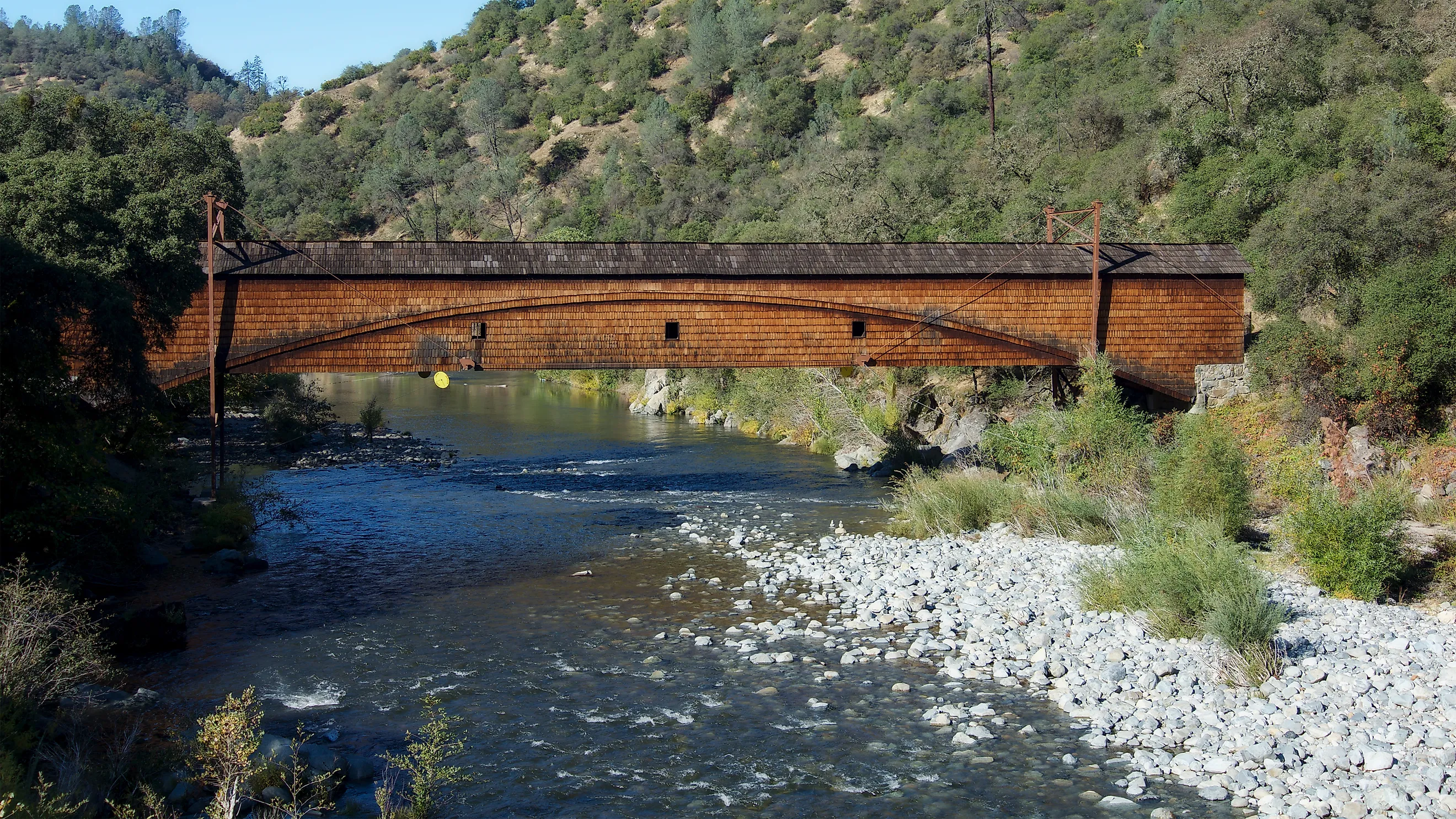
California's Bridgeport Covered Bridge, in South Yuba River State Park, went up in 1862 to replace a crossing that floodwater had swept away. It measures about 230 feet (70 meters) along the ridge line and carries a single clear span of 208 feet (63 meters) over the South Yuba River, which makes it the longest single-span wooden covered bridge in the world by most measures. David Wood designed it with a Howe truss reinforced by a Burr arch, working from an eastern U.S. pattern because neither a truss nor an arch alone could reach across the river. Automobile traffic was routed off it in 1972, and timber rot set in over the following decades. The bridge closed to all access in 2011, and a full restoration reopened it to pedestrians in 2021, restoring the centerpiece of South Yuba River State Park.
Watson Mill Covered Bridge, Georgia

The Watson Mill Covered Bridge is the longest covered bridge in Georgia, spanning 229 feet (70 meters) across the South Fork of the Broad River near Comer. Washington W. King built it in 1885, and his father was Horace King, a formerly enslaved man who became one of the most respected covered bridge builders in the South. The four-span structure uses a Town lattice truss held together with wooden pins rather than metal fasteners. Georgia once had more than 200 covered bridges, and fewer than 20 now remain, which makes this one a rare survivor. It anchors Watson Mill Bridge State Park, where the shoals below the bridge draw waders in summer.
Old Blenheim Covered Bridge, New York

The Old Blenheim Covered Bridge crosses Schoharie Creek in North Blenheim, New York, at about 228 feet (69 meters) in total length. Nicholas Montgomery Powers built the original in 1855, and its 210-foot clear span was long celebrated as the longest single-span wooden covered bridge in the world. Floodwaters from Hurricane Irene swept that historic structure away in 2011. Schoharie County pushed for a faithful replacement, and 3G Construction completed a replica in 2018, set on abutments about 12 feet higher than the originals to guard against future floods. The double-barreled design, with a central arch dividing two lanes, matches the bridge that stood on the creek for more than 150 years.
Pine Grove Covered Bridge, Pennsylvania

The Pine Grove Covered Bridge crosses the East Branch of Octoraro Creek at 195 feet (59 meters), and it straddles the line between Lancaster and Chester counties in southern Pennsylvania. Elias McMellen built the two-span structure in 1884, using a double Burr arch reinforced with king posts. It is the longest covered bridge in each of the two counties it touches, and one of the longest that drivers can still cross in the state. The creek below draws anglers and paddlers, and the bridge sits among the southernmost of Pennsylvania's surviving covered spans.
Preserving Covered Bridges For The Future
Maintaining these historic covered bridges relies on a mix of public investment and civil engineering. The timber structures remain vulnerable to rot, pests, fire, and moisture, so inspectors and maintenance crews work under Federal Highway Administration standards. Preservation depends on fire-retardant treatment, security monitoring, and steel reinforcement set beneath the wooden cladding. State departments of transportation and local historical societies secure the funding, often through grants such as the National Historic Covered Bridge Preservation Program.
Lasting Craftsmanship And Engineering
America's longest covered bridges pair 19th-century timber craftsmanship with modern engineering that keeps them standing. Some still carry vehicles while others carry only walkers, and many have become the signature landmark of their county or town. Visitors who cross them see more than a covered bridge. They see the reach of a building tradition that ran from single-lane creek crossings to a 613-foot span across an Ohio river, and that people are still willing to rebuild plank by plank.