Top 10 Most Famous Bridges In The United States
On May 17, 1884, P.T. Barnum marched 21 elephants across the Brooklyn Bridge. Jumbo was in the line. The bridge had been open a year and New Yorkers still did not trust it, so Barnum sold tickets to the doubt and the engineers got their proof. Most of the bridges below have some version of that story attached to them. The record gets broken, the ranking goes stale, and what survives is the detail nobody planned.
Bixby Creek Bridge - California

The whole bridge cost $199,861 and came in roughly $3,400 under budget, which is the least Californian thing about it. The 1996 seismic retrofit cost about a hundred times the original build. Opened in November 1932, the open-spandrel arch runs 714 feet with a 360-foot main span and sits some 260 feet above the creek, and it went up as the longest concrete arch span on the California State Highway System.
Before it existed, Big Sur residents were effectively cut off for stretches of the year. The bridge takes its name from Charles Henry Bixby, who ran a sawmill and lime kilns on the creek in the 1800s. Death Cab for Cutie put it on record in 2008 with "Bixby Canyon Bridge," the opening track of the album Narrow Stairs, which Ben Gibbard wrote after going to Big Sur to chase Jack Kerouac's ghost around and coming home without it.
Brooklyn Bridge - New York City, New York

John A. Roebling designed the Brooklyn Bridge and never saw a stone of it laid. He crushed his foot while surveying the site in 1869, refused conventional treatment, and died of tetanus weeks later. Construction started in January 1870 under his son Washington, who then got decompression sickness in the caissons and directed the rest of the job by telescope from a Brooklyn window while his wife Emily Warren Roebling ran the site and dealt with the contractors. An estimated 27 workers died building it, though no one kept a list, which is its own comment on the era.
It opened on May 24, 1883 as the first steel-wire suspension bridge in the world and the longest suspension bridge of any kind, with a main span of 1,595 feet and towers reaching 276 feet above the water. Four cables of 5,434 wires each still carry the load. The day after the opening, about 150,300 people and 1,800 horse-drawn vehicles crossed. A week later a stampede on the promenade killed 12, which is what set up Barnum's elephants the following spring. Brooklyn was a separate city until 1898, so for its first 15 years the bridge connected two rival municipalities that had spent decades arguing about whether to build it.
George Washington Bridge - Fort Lee, New Jersey

Othmar Ammann's towers were supposed to be dressed in granite and concrete. The Depression killed the cladding budget, the bare steel latticework stayed exposed, and critics decided they liked it better that way. Le Corbusier called it the most beautiful bridge in the world. It remains the only accidental masterpiece on this list.
The bridge opened on October 25, 1931 carrying one deck. The lower level, nicknamed Martha, opened on August 29, 1962 to feed the growing interstate system, and the finished structure carries 14 vehicle lanes of Interstate 95 over the Hudson. That makes it the busiest motor vehicle bridge on the planet, with 103.9 million crossings counted in 2019. On selected holidays, and every September 11 since 2006, the Port Authority hangs a 90-foot by 60-foot American flag from the New Jersey tower. It weighs about 450 pounds and is billed as the largest free-flying version of the flag anywhere.
Golden Gate Bridge - San Francisco, California

The Navy wanted it painted in black and yellow stripes so ships would notice it. The Army Air Corps lobbied for red and white. Consulting architect Irving Morrow looked at the reddish primer the steel arrived in, decided it read well against the fog and the headlands, and fought to keep it. That primer is now called International Orange and it is the single most recognizable color decision in American infrastructure.
The Golden Gate Bridge opened on May 27, 1937, foot traffic first and cars the following day. Its towers stand 746 feet above the water, the main span measures 4,200 feet, and the whole crossing runs about 1.7 miles. It cost around $35 million, finishing under budget and ahead of schedule, against Joseph Strauss's early $17 million estimate and a rival projection near $100 million. Roughly 10 million people visit each year. Only southbound drivers pay a toll, northbound has been free since 1968, and walkers and cyclists cross for nothing.
The bridge is also not repainted end to end, whatever you have heard. A permanent crew of about 45 painters works the structure in patches year-round, chasing corrosion rather than completing laps, and they applied 4,193 gallons of paint and primer in 2022.
Lake Pontchartrain Causeway - Metairie to Mandeville, Louisiana

For roughly eight miles in the middle of the Lake Pontchartrain Causeway, there is no land visible in any direction. Drivers report it as either meditative or deeply unpleasant, with little middle ground. The longer of the two parallel spans runs 23.83 miles, linking Metairie on the south shore with Mandeville on the north, and shaves a long drive around the lake down to about half an hour.
The first span opened on August 30, 1956. The second opened on May 10, 1969 at a cost of roughly $30 million. Building it meant inventing a production line: a plant near the north shore poured and cured precast, prestressed concrete segments, barges floated them out, and crews set them in sequence over 2,246 spans on the southbound bridge alone. In 2011, when China's Jiaozhou Bay Bridge appeared to take the length record, Guinness declined to pick a winner and split the category in two instead. The Causeway kept the title for longest continuous bridge over water. Qingdao got the aggregate one.
Mackinac Bridge - Mackinaw City, Michigan

The Mackinac Bridge Authority will send an employee to drive your car across for you. This is a real, published service with a fee schedule, currently $15 on top of the toll, and 2,559 people used it in 2019. The reason is the two center lanes, which are open steel grating. You can see the Straits of Mackinac moving 200 feet below your tires, and a meaningful number of drivers get partway out and decide they would rather not.
Michiganders floated the idea in the 1880s and got the bridge on November 1, 1957. It runs 26,372 feet end to end with a 3,800-foot main span, carries four lanes of Interstate 75, and measures 8,614 feet between anchorages, which is still the longest suspended span between anchorages in the Western Hemisphere. Locals call it the Mighty Mac. The name is spelled with a c and pronounced with a w, a trap the state has never bothered to fix. Every Labor Day the bridge closes to traffic for the Bridge Walk, which drew about 33,000 people in 2025.
New River Gorge Bridge - Fayetteville, West Virginia

The New River is somewhere between 260 and 325 million years old, making it one of the oldest rivers on Earth and the worst-named waterway in the country. The bridge over it opened on October 22, 1977 and turned a 40-minute crawl down one side of the gorge and up the other into a crossing of under a minute. Its steel arch spans 1,700 feet, the deck sits 876 feet above the water, and the full structure measures 3,030 feet. When it opened it was the longest single-span arch bridge in the world, a record it held 26 years. It is still the longest in the Western Hemisphere.
One Saturday a year, the third in October, the state closes the bridge and lets people jump off it. Bridge Day is the only day BASE jumping is legal here and the only day of the year anyone can legally walk across. It is also the sole site in the National Park System where the activity is permitted at all. The 2025 event drew more than 120,000 spectators and 315 jumpers who logged 752 jumps. The rest of the year the bridge just carries traffic over New River Gorge National Park and Preserve, redesignated as a national park in December 2020. West Virginia put the bridge on its state quarter in 2005.
Seven Mile Bridge - Florida Keys, Florida

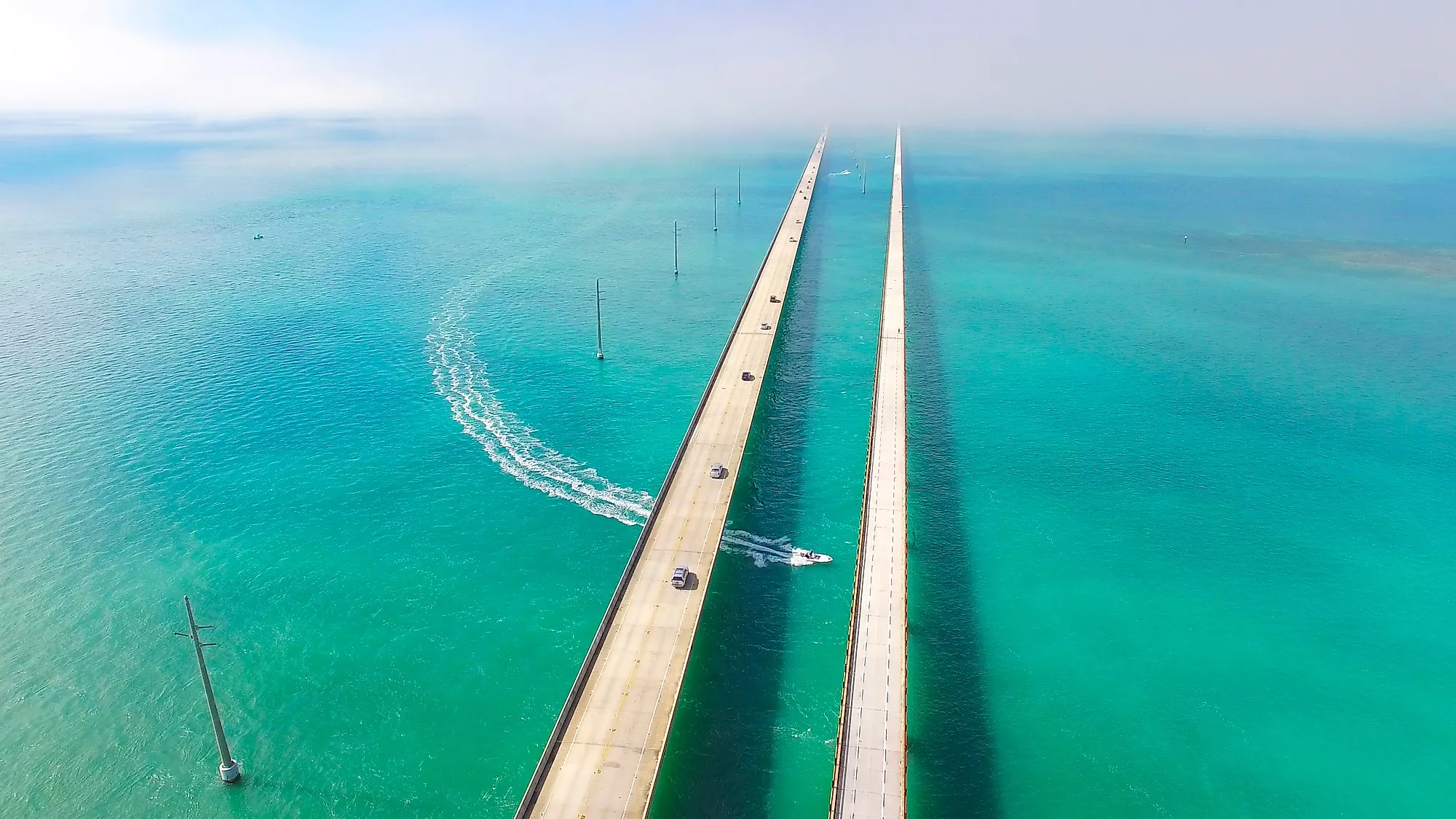
The Seven Mile Bridge is not seven miles. It measures about 6.79 miles, or 35,862 feet, and nobody has ever proposed renaming it. Two lanes of U.S. 1 run across it, connecting Knight's Key in the Middle Keys to Little Duck Key in the Lower Keys, all of it in Monroe County.
There have been two of them. Henry Flagler's crews built the original between 1909 and 1912 to carry the Over-Sea Railroad, the 1935 Labor Day hurricane ended the railroad, and the state converted the surviving structure for automobiles in 1938. The current bridge went up between 1978 and 1982. The old one is still standing beside it, and a 2.2-mile stretch running out to Pigeon Key reopened in January 2022 after a restoration costing about $44 million, so walkers, cyclists, and anglers now have the better view. Every April the Seven Mile Bridge Run closes the crossing and raises money for community programs in Marathon, Florida. Hollywood has blown the bridge up more than once on film, in Licence to Kill, True Lies, and 2 Fast 2 Furious. It also runs through the Conch Republic, the mock nation the Keys declared on April 23, 1982 in protest of a Border Patrol roadblock that had turned the only road out into a traffic jam.
Sunshine Skyway Bridge - Tampa Bay, Florida

On the morning of May 9, 1980, in a squall, the freighter Summit Venture struck a support column of the old Skyway and brought down more than 1,200 feet of roadway. Thirty-five people died, 26 of them aboard a Greyhound bus that went into the bay. The replacement had to be a different kind of structure, with its piers set far from the shipping channel and protected by concrete islands built to absorb a strike.
Governor Bob Graham had seen the Brotonne Bridge in Normandy and wanted that cable-stayed silhouette for Tampa Bay, and he got it. The bridge opened in April 1987 running 4.1 miles across the mouth of the bay, with a 1,200-foot main span carrying Interstate 275 and U.S. 19 between Terra Ceia in Manatee County and St. Petersburg in Pinellas County. The stay cables are painted bright yellow. The state renamed the crossing the Bob Graham Sunshine Skyway Bridge in 2005. Walking or cycling it is prohibited and enforced by the Highway Patrol, so the only way to stand over the water is the Skyway Fishing Pier State Park, built out of the approaches to the bridge the Summit Venture destroyed.
Chesapeake Bay Bridge - Annapolis, Maryland

There is a business on Kent Island whose entire model is driving other people's cars over this bridge. Kent Island Express has operated for more than 15 years, charges around $40, and moves a few dozen customers a day in season. Its clientele has gephyrophobia, the fear of crossing bridges, and Maryland has produced enough of them to sustain a small industry. The state runs no equivalent service of its own.
The complaints are specific and reasonable. The deck climbs 186 feet over the shipping channel with narrow lanes, low railings, and no shoulder to pull onto. The 1952 span has open steel grating. Fog rolls in off the water and takes the far shore with it, and when eastbound traffic backs up the authority reverses a westbound lane, which means oncoming cars with nothing between you and them. Officially the Gov. William Preston Lane Jr. Memorial Bridge, named for the governor who pushed it through in the late 1940s, the crossing carries U.S. 50 and U.S. 301 over Chesapeake Bay in two structures totalling five lanes. At 4.3 miles, the 1952 original was the longest continuous over-water steel structure in the world. Pedestrians got their turn at the annual Bay Bridge Walk until the state discontinued it after 2006. The November Across the Bay 10K replaced it in 2014.
What the Records Do Not Explain
Almost every superlative on this list has an expiration date. Bixby Creek lost its concrete-span record, the Brooklyn Bridge was outstripped within a generation, New River Gorge held the arch title 26 years, and Mackinac now ranks somewhere in the twenties worldwide by main span. What lasts is stranger and harder to engineer. A paint color chosen over the Navy's objection. A record kept by subdividing the category. A published fee for having a stranger drive your car. These bridges got famous for solving a problem, and then stayed famous for everything that accumulated on top afterward.