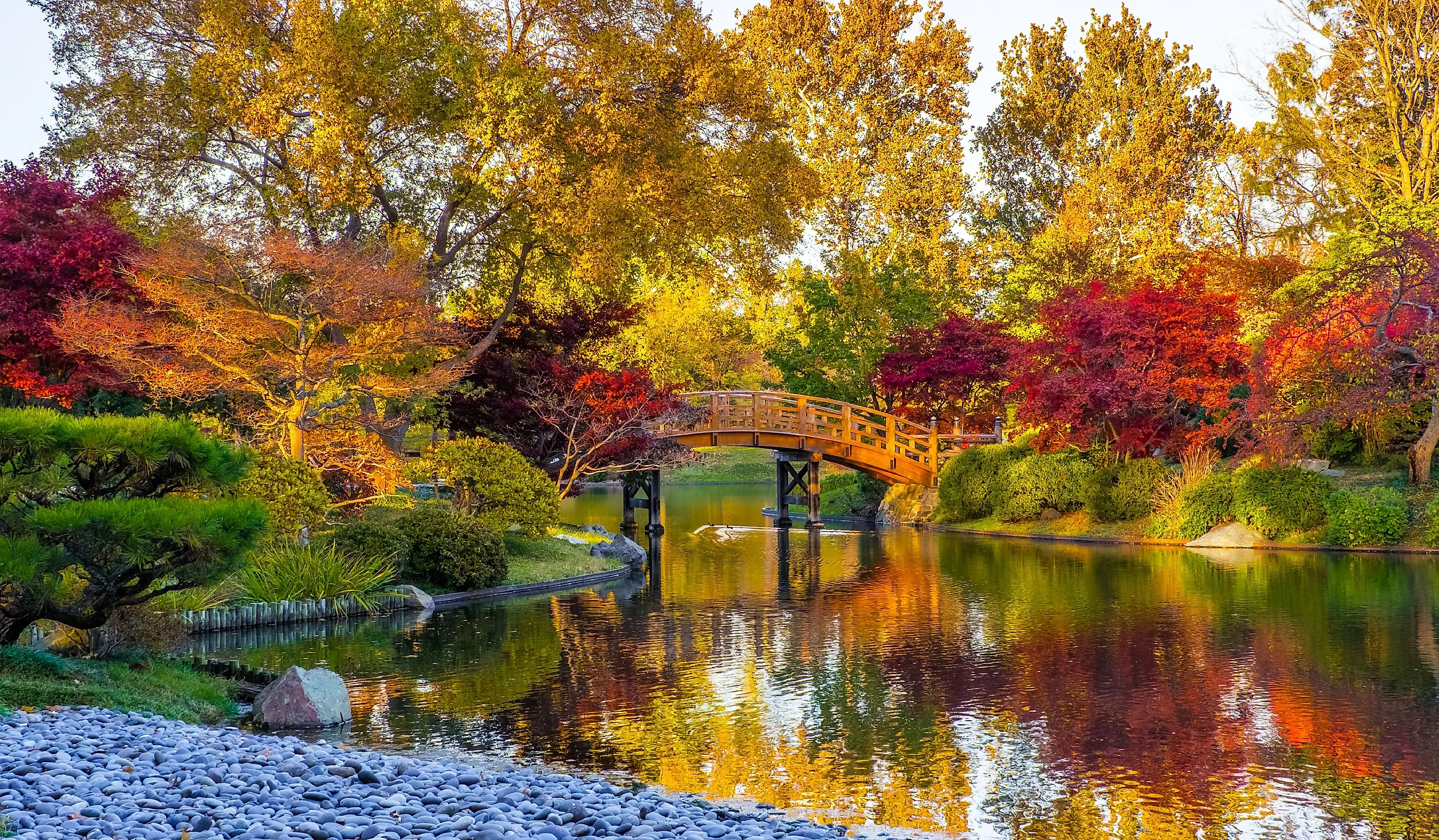
The Largest Japanese Gardens In The United States
Many Americans have likely visited modest traditional Japanese gardens. Usually tucked into the corner of a local botanical garden, they most likely have one stone latern, maybe a red maple or two, and a pond full of koi carp. But the reality is that the United States has some pretty big Japanese gardens.
The good news is we've done the homework for you, and are pleased to report that, in some cases, the largest Japanese gardens in America include lakes, hillsides, and acres of green space. Here they are, ranked by acreage using figures published by each garden's owner or operator for the Japanese garden alone. And they all are worth planning a day trip around.
1. Gibbs Gardens, Ball Ground, Georgia (40 Acres)

The largest Japanese garden in the country is the work of an Atlanta landscaper. Jim Gibbs, the retired founder of Gibbs Landscape Company, began building the Japanese Gardens at Gibbs Gardens in Ball Ground, Georgia, in the 1980s after traveling in Japan. He opened his estate to the public in March 2012.
Gibbs named the garden Tsukiyama, after the Japanese style of hill-and-pond garden designed to be walked through, and it covers more than 40 acres of the 376-acre property.

Visitors enter through a torii gate, the post-and-beam gateway that marks the entrance to a Shinto shrine in Japan, and follow a path around seven spring-fed ponds, past 40 hand-carved stone lanterns, across a zigzag bridge with three turns. Thousands of Japanese maples turn red, orange, and amber in fall, the season the garden is best known for.
Gibbs Gardens bills Tsukiyama as the largest Japanese garden in the nation, a claim that Atlanta Magazine and Clemson University's Home & Garden Information Center in South Carolina have repeated. The estate is an hour north of Atlanta and is open Tuesday to Sunday from March into December, closing for the winter.
2. Liliʻuokalani Gardens, Hilo, Hawaii (24.67 Acres)

No ticket is needed for Liliʻuokalani Gardens, a county park on Banyan Drive in Hilo, on the island of Hawaii, and it's open all year. The park is named for Queen Liliʻuokalani, the last monarch of the Hawaiian Kingdom, and tradition has it that she gave the five-acre Waihonu fishpond to the people of Hilo in 1907 for use as a Japanese tea garden.
In April 1917, territorial governor Lucius Pinkham signed an act setting aside 17 acres as a public park in her name. Construction began that November, and the garden opened in 1919. Tsunamis in 1946 and 1960 wrecked the garden, and it was rebuilt both times.

In 1968, the governors of Japan's prefectures, the country's equivalent of states, sent 13 stone lanterns and two stone lion gates to mark 100 years since the first Japanese immigrants reached Hawaii.
With the small island of Moku Ola (aka Coconut Island) and other shoreline parcels added over the years, the park now covers 24.67 acres. Guidebooks often refer to it as the largest Edo-style garden outside Japan, a reference to the stroll gardens, built to be walked around, of the Edo period from 1603 to 1868.
3. Kubota Garden, Seattle, Washington (20 Acres)

In 1927, a self-taught gardener named Fujitaro Kubota bought five acres of swamp in the Rainier Beach neighborhood of Seattle, Washington, that loggers had stripped of trees. There, he planted what is now Kubota Garden. Kubota had emigrated from the Japanese island of Shikoku in 1907, and because the law barred Japanese immigrants from owning land, the deed was in a friend's name.
The garden doubled as the display grounds for his landscaping business and grew to 20 acres by 1940. Two years later, the family was sent to Minidoka, an internment camp in Idaho where the US government held Japanese Americans during World War II, and returned in 1945 to restore the garden.

Kubota's best-known addition, a hillside of waterfalls and ponds called the Mountainside, was created during the Seattle World's Fair of 1962.
The city designated the garden's 4.5-acre core as a landmark in 1981 and bought the whole property in 1987. Seattle Parks and Recreation runs it as a free public park with 11 ponds, two red bridges, and 140 varieties of maple, and describes it as a blend of Japanese garden concepts and native Northwest plants. The nonprofit Kubota Garden Foundation leads free tours, and the garden will be celebrating its centennial in 2027.
4. Hakone Estate and Gardens, Saratoga, California (18 Acres)

A world's fair is to thank for Hakone Estate and Gardens in Saratoga, California. Oliver and Isabel Stine, arts patrons from San Francisco, saw the Japanese exhibits at the Panama-Pacific International Exposition, the world's fair held in the city in 1915, and bought land in the Saratoga hills that year for a summer retreat.
Isabel Stine then toured gardens in Japan, named the property after the Fuji-Hakone region west of Tokyo, and hired two Japanese specialists: architect Tsunematsu Shintani for the buildings and Naoharu Aihara, who came from a family of imperial gardeners, for the grounds. The Upper House was built in 1918.

The City of Saratoga bought Hakone in 1966 to keep it from being subdivided, and the nonprofit Hakone Foundation has run it since 2000.
Its 18 acres include woodland and chaparral, the dense scrub of the California hills, as well as four gardens: the Hill and Pond Garden, the Tea Garden, the Zen Garden, and a bamboo garden added in 1987. Scenes for Memoirs of a Geisha, the 2005 film, were shot here.
5. Elizabeth Hubert Malott Japanese Garden, Glencoe, Illinois (17 Acres, Tied)

One of the three islands in the Elizabeth Hubert Malott Japanese Garden at the Chicago Botanic Garden in Glencoe, Illinois, can't be visited. Horaijima, the Island of Everlasting Happiness, represents paradise and is meant to be seen from across the water. The other two, Seifuto and Keiunto, are open, and the garden has both an arched bridge and a zigzag bridge.
The garden covers 17 acres of the 385-acre botanic garden north of Chicago, and its original name, Sansho-en, means Garden of Three Islands. It was designed in 1975 by Koichi Kawana, a Japanese-born professor at the University of California, Los Angeles, who designed more than a dozen Japanese gardens in the United States. The garden was dedicated in 1982.
Shoin House, a traditional Japanese residence, was built in Japan without nails, shipped in pieces, and reassembled on site by the same craftsmen. Many of the garden's pines are pruned and trained to look older than they are. Each August, gardeners rake a peace pattern into the dry garden, where gravel stands in for water, using a design by Toshiko Tanaka, an artist who survived the atomic bombing of Hiroshima.
5. Japanese Garden, The Dawes Arboretum, Newark, Ohio (17 Acres, Tied)

The raked gravel in the Japanese Garden at The Dawes Arboretum, south of Newark, Ohio, doubles as a weather forecast. Staff rake the dry garden, a bed of gravel that stands in for water, to match the week ahead, with high, flowing lines before storms, and a few smooth ones when mild weather is expected. The large rocks around its edge represent the coastline of Japan.
Japanese landscape architect Makoto Nakamura designed the garden in 1963, and it opened in 1965. According to the arboretum, it's the only garden Nakamura designed outside Japan, and was one of the first of its kind in Ohio.
He worked the native woods into a design that combines a hill-and-pond garden, a dry garden, and a stroll garden.
Press coverage of the garden's reopening in 2015, after a two-year restoration of its walkway, bridges, resting house (a small shelter), and stonework, gave its size as 17 acres. That's a small part of the nearly 2,000 acres of the Dawes Arboretum, which also appears on our list of the largest arboretums in the country.
7. Roji-en, Morikami Museum and Japanese Gardens, Delray Beach, Florida (16 Acres)

George Morikami spent a decade trying to give away the land where the Morikami Museum and Japanese Gardens now stands. He had arrived from Japan as a young man to join the Yamato Colony, a Japanese farming settlement established in 1905 in what is now northern Boca Raton. Palm Beach County accepted his gift in 1973, and the museum opened in 1977.
The present garden came later. Roji-en, which means Garden of the Drops of Dew, was designed by Hoichi Kurisu, the garden designer who also created Anderson Japanese Gardens in Illinois, and was completed in 2001.

It covers 16 acres around a lake and is made up of six gardens, each modeled on a period of Japanese garden design from the eighth to the 20th centuries. They include the island gardens of early nobles, the rock gardens of Zen temples, and a modern stroll garden, and are inspired by well-known gardens in Japan.
A bonsai collection, miniature trees grown in containers, is displayed along the route, and the gardens are part of the 200-acre Morikami Park. The museum and gardens are open Tuesday to Sunday, the Cornell Café serves lunch on terraces beside the lake, and tea ceremonies are held monthly from October through May.
8. Seiwa-en, Missouri Botanical Garden, St. Louis, Missouri (14 Acres)

Seiwa-en at the Missouri Botanical Garden in St. Louis, Missouri, covers 14 acres, about 4.5 of them a lake, and its name means "garden of pure, clear harmony and peace." It was proposed in 1972 by the Japanese American Citizens League, a national civil rights group, and was designed by Koichi Kawana, the Los Angeles professor behind the Chicago Botanic Garden's Japanese garden. It opened in 1977.
Kawana based it on the strolling gardens that wealthy landowners built around ponds in 19th-century Japan. The lake has four islands. Two of them, the tortoise and crane islands, are symbols of long life and can't be reached, and another has a tea house. Visitors can feed the koi from the bridges, and each year the botanical garden hosts a three-day Japanese Festival, which it bills as one of the country's largest.
America's Biggest Japanese Gardens
Several of these gardens evolved over time, growing a few acres at a time before reaching their current sizes. And as traditional Japanese gardens, they typically feature lakes, woods, and manicured hillsides. They're also delightful to look at and wander through, with their stone lanterns, red maples, koi ponds, and bridges providing a pretty backdrop in which to enjoy some peace and quiet.