10 Stunning Arch Bridges from Around the World
An arch bridge works by converting downward weight into compression, which travels along the curve of the arch and into the supports at each end. The geometry means that the heavier the load on the bridge, the more tightly the stones press against each other, which is why well-built stone arches stay standing for thousands of years with almost no maintenance. The Romans understood the principle better than anyone, and most of the oldest surviving bridges in the world are Roman aqueducts. The ten arch bridges below span almost two thousand years of construction, from a first-century Roman water supply still standing in Spain to a 21st-century Calatrava design in Venice.
Aqueduct of Segovia (Segovia, Spain)

The Aqueduct of Segovia is one of the best-preserved Roman engineering works anywhere in the world. Built in the late first or early second century AD, it carried water from the Sierra de Fuenfría roughly 17 kilometers (10.5 miles) into the city. The most photographed section, in the Plaza del Azoguejo, rises 28.5 meters (93.5 feet) at its tallest point and is supported by two tiers of stacked arches. The aqueduct was built without mortar; its 167 arches are held together by precise stone-cutting and the geometry of the arch itself.

The aqueduct continued to deliver water into the 20th century, when modern pipes replaced it. The structure remains in place because Roman engineers chose unusually large granite blocks (some over a ton) and laid them so that water erosion never undermined the foundations. Segovia's old town and aqueduct were jointly inscribed as a UNESCO World Heritage Site in 1985.
Charles Bridge (Prague, Czech Republic)

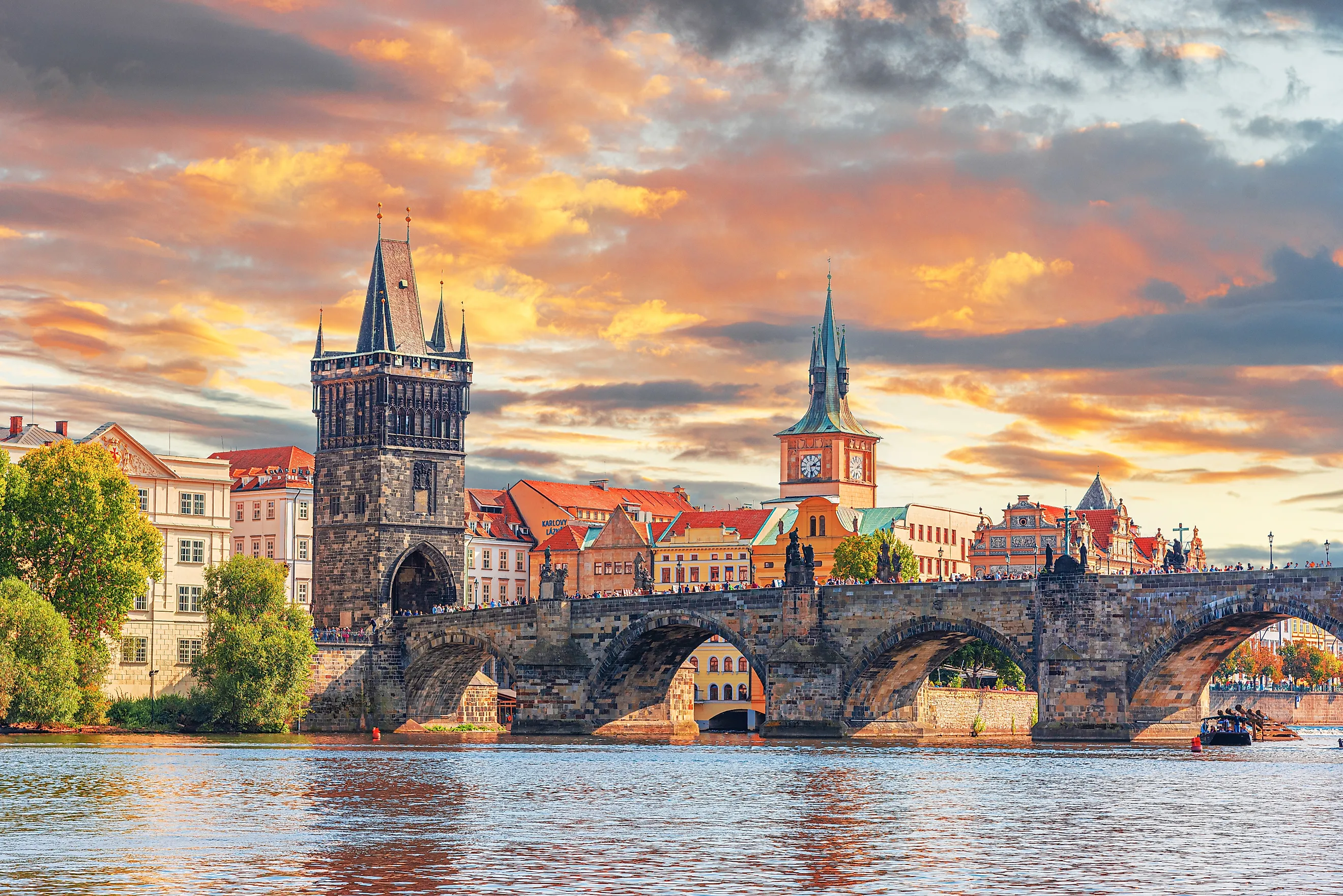
Charles Bridge crosses the Vltava River in Prague and connects the Old Town to the Lesser Town below Prague Castle. Construction began in 1357 under King Charles IV, who according to local legend laid the foundation stone himself at 5:31 a.m. on July 9 (a numerologically auspicious palindrome: 1357-9-7-5-31). The architect was Petr Parléř, also responsible for St. Vitus Cathedral. Construction took 45 years and the bridge was completed in 1402.

The bridge is 516 meters (1,693 feet) long and 9.5 meters (31 feet) wide, with 16 sandstone arches resting on 15 piers. Originally called the Stone Bridge, it was renamed for Charles IV in 1870. The 30 baroque statues that line the balustrade were added in stages between 1683 and 1714 and are now mostly replicas; the originals are housed in the National Museum's Lapidarium. Charles Bridge was the only crossing over the Vltava in Prague until 1841, and it has carried pedestrians only since 1965.
Confederation Bridge (Borden-Carleton, Canada)

The Confederation Bridge connects Prince Edward Island to New Brunswick across the Northumberland Strait, replacing the year-round ferry service that had previously linked the island to mainland Canada. It opened on May 31, 1997, after four years of construction, and at 12.9 kilometers (8 miles) long, it is the longest bridge in the world over ice-covered water.

The bridge is a precast concrete box girder structure with 62 piers, designed to resist sea ice that forms on the strait every winter. The piers are sheathed in conical ice shields that force passing ice floes to ride up and break under their own weight rather than push horizontally against the bridge. The deck sits 40 meters (131 feet) above the water at the navigation channel, leaving clearance for shipping traffic. Tolls are collected only from drivers leaving the island, not from those arriving.
Constitution Bridge (Venice, Italy)

The Ponte della Costituzione (Constitution Bridge) is the newest of the four bridges across Venice's Grand Canal, completed in 2008. It was designed by Spanish architect Santiago Calatrava and connects the Piazzale Roma bus terminal to the Santa Lucia railway station. The bridge has a low-arched profile with a steel structural frame, glass panels, and Istrian stone treads, and is the only one of the canal's bridges built without supporting piers in the water.

The Constitution Bridge has been controversial since its planning. The construction budget more than doubled, and the bridge's stepped design proved inaccessible to wheelchairs and luggage; an external pod-on-cable system was installed in 2010 to provide accessibility, but it was decommissioned in 2020 due to mechanical problems. In 2019, an Italian court ordered Calatrava to pay damages over design flaws related to the marble surfaces, which had cracked and become slippery.
Ponte Vecchio (Florence, Italy)

The Ponte Vecchio is a closed-spandrel segmental arch bridge across the Arno River in Florence. The current bridge was completed in 1345 after a flood destroyed the previous Roman-era and medieval crossings on the same site. Its three segmental arches were unusually flat for the period (a rise of less than half their span), which made the bridge easier to use for carts and foot traffic.

The Ponte Vecchio is best known for the shops built directly onto it. Originally occupied by butchers, tanners, and farmers, the shops were ordered cleared in 1593 by Grand Duke Ferdinand I, who replaced them with goldsmiths and jewelers (a profession the bridge has retained ever since). The Vasari Corridor, a covered passageway built above the eastern row of shops in 1565, allowed the Medici family to walk between the Pitti Palace and the Palazzo Vecchio without entering the streets below. The Ponte Vecchio was the only bridge in Florence the retreating German army did not destroy in World War II; the buildings at either end were demolished instead to block access.
Pont del Diable (Tarragona, Spain)

The Pont del Diable, formally the Aqüeducte de les Ferreres, is a Roman aqueduct bridge built in the first century AD to supply the colonial capital of Tarraco (modern Tarragona). It carried water from the Francolí River roughly 25 kilometers to the city, crossing a deep valley about four kilometers north of the urban center. The bridge survives today as a fragment of the original aqueduct system, the rest of which was dismantled or fell into ruin after the western Roman Empire collapsed.

The structure is 217 meters (712 feet) long and 27 meters (89 feet) tall at its highest point. It has two tiers of arches: 11 on the lower level and 25 on the upper. Like most early Roman aqueducts, it was built without mortar from precisely cut limestone blocks. The local nickname Pont del Diable ("Devil's Bridge") comes from a folk legend that explains the bridge's improbable size by attributing it to the Devil. The site is part of the Archaeological Ensemble of Tarraco, inscribed by UNESCO in 2000.
Pont du Gard (Vers-Pont-du-Gard, France)

The Pont du Gard carried water across the Gardon River as part of a 50-kilometer Roman aqueduct supplying the colony of Nemausus (modern Nîmes). It was built in the mid-first century AD, most likely during the reign of Emperor Claudius, and at 48.8 meters (160 feet) high it is the tallest of all surviving Roman aqueducts. The bridge consists of three tiers of stacked arches: six in the lower tier (including the 24.5-meter span over the river itself), 11 in the middle, and 35 in the upper tier (which carried the water channel). The upper tier originally had 47 arches; 12 were lost in the medieval period.

The aqueduct was a precision instrument. Its average gradient over the entire 50-kilometer length is just 1 in 18,241 (about 24 cm per km), which Roman surveyors achieved using simple sighting tools. The bridge itself drops only 2.5 cm across its 275-meter length. The structure was built without mortar from limestone quarried locally; some blocks weigh six tons and were lifted into place using treadmill-driven cranes. UNESCO inscribed the bridge in 1985.
Rialto Bridge (Venice, Italy)

The Rialto is the oldest of the four bridges across Venice's Grand Canal. The current stone version, built between 1588 and 1591, replaced a series of earlier wooden bridges (and one pontoon bridge) that had stood on the site since the 12th century. The bridge takes its name from the Rialto market district at its eastern end, the historic commercial heart of the Venetian Republic. Several of the most famous Renaissance architects submitted designs in the city's competition (Jacopo Sansovino, Andrea Palladio, and Vincenzo Scamozzi among them), but the commission went to Antonio da Ponte, whose design used a single 28-meter masonry arch.

Da Ponte's design was bold for its time. A single broad arch was unusual on so wide a span, and many engineers predicted the bridge would collapse. To allow ships to pass beneath, da Ponte raised the arch to 7.5 meters (24.6 feet) above the canal at high tide. The bridge has two ramped walkways with shops along their lengths, separated by a central elevated walkway under arcades. The shops were originally meant to defray the cost of the bridge through rents collected by the city.
Stari Most (Mostar, Bosnia and Herzegovina)

Stari Most ("Old Bridge") was completed in 1566 across the Neretva River, commissioned by Ottoman Sultan Suleiman the Magnificent and designed by the architect Mimar Hayruddin, a student of Sinan, the empire's most celebrated builder. The single-arch limestone bridge has a span of about 29 meters and rises about 24 meters above the river at low water. It connected the Christian and Muslim quarters of Mostar and stood for 427 years.

On November 9, 1993, during the Croat-Bosniak War, the bridge was destroyed by Croatian artillery shelling. Reconstruction began in 2001 using the original techniques and limestone from the same quarry, and the rebuilt bridge opened on July 23, 2004. The two halves of Mostar are again physically connected. Local divers continue a centuries-old tradition of jumping from the bridge into the Neretva, formalized each summer in an international diving competition. UNESCO inscribed the bridge and the surrounding old town as a World Heritage Site in 2005.
Sydney Harbour Bridge (Sydney, Australia)

The Sydney Harbour Bridge connects the central business district of Sydney to the North Shore across Port Jackson. It opened on March 19, 1932, after eight years of construction by British firm Dorman Long under chief engineer John Bradfield. The structure carries eight lanes of traffic, two railroad tracks, a bicycle path, and a pedestrian walkway, and used over 52,000 tonnes of steel and approximately six million hand-driven rivets in its construction.

The bridge is 1,149 meters (3,769 feet) long with a single arch span of 503 meters and rises 134 meters (440 feet) from water level to the top of the arch. It remains the tallest steel arch bridge in the world. Its 49-meter (160-foot) deck width was the widest of any long-span bridge for 80 years, surpassed only when Vancouver's Port Mann Bridge opened in 2012. Locally the bridge is nicknamed "the Coathanger" for the shape of its arch.
Arch bridges are one of the oldest forms of structural engineering still in active service. The Romans built theirs by precision stone-cutting and gravity, with no mortar; Italian and Bohemian masons in the medieval period perfected the technique with masonry; modern engineers have moved to steel and reinforced concrete, but the underlying principle (compression carried along a curve into abutments at each end) has not changed in two thousand years. The world's oldest functioning arch bridge, the stone Caravan Bridge across the Meles River in Izmir, Turkey, has been in continuous use since around 850 BC. Anything that lasts that long deserves a closer look.