Where People Are Moving To In The Prairies In 2026
Winnipeg grew by 8,438 people in 2024/25, but its residents were leaving. The Winnipeg economic region, which comprises the city and the RM of Headingley, lost a net of 1,704 people to the rest of Manitoba and 3,628 to other provinces. The 13,949 immigrants who arrived more than covered the loss. That split explains much of the Prairies right now. Newcomers from abroad and other provinces tend to land in the big cities first, which drives up housing prices there. Residents who can then trade out of the city move to towns where new subdivisions are still going up. Alberta economists expected this spillover, and the seven places below show where it has landed so far.
Airdrie, Alberta

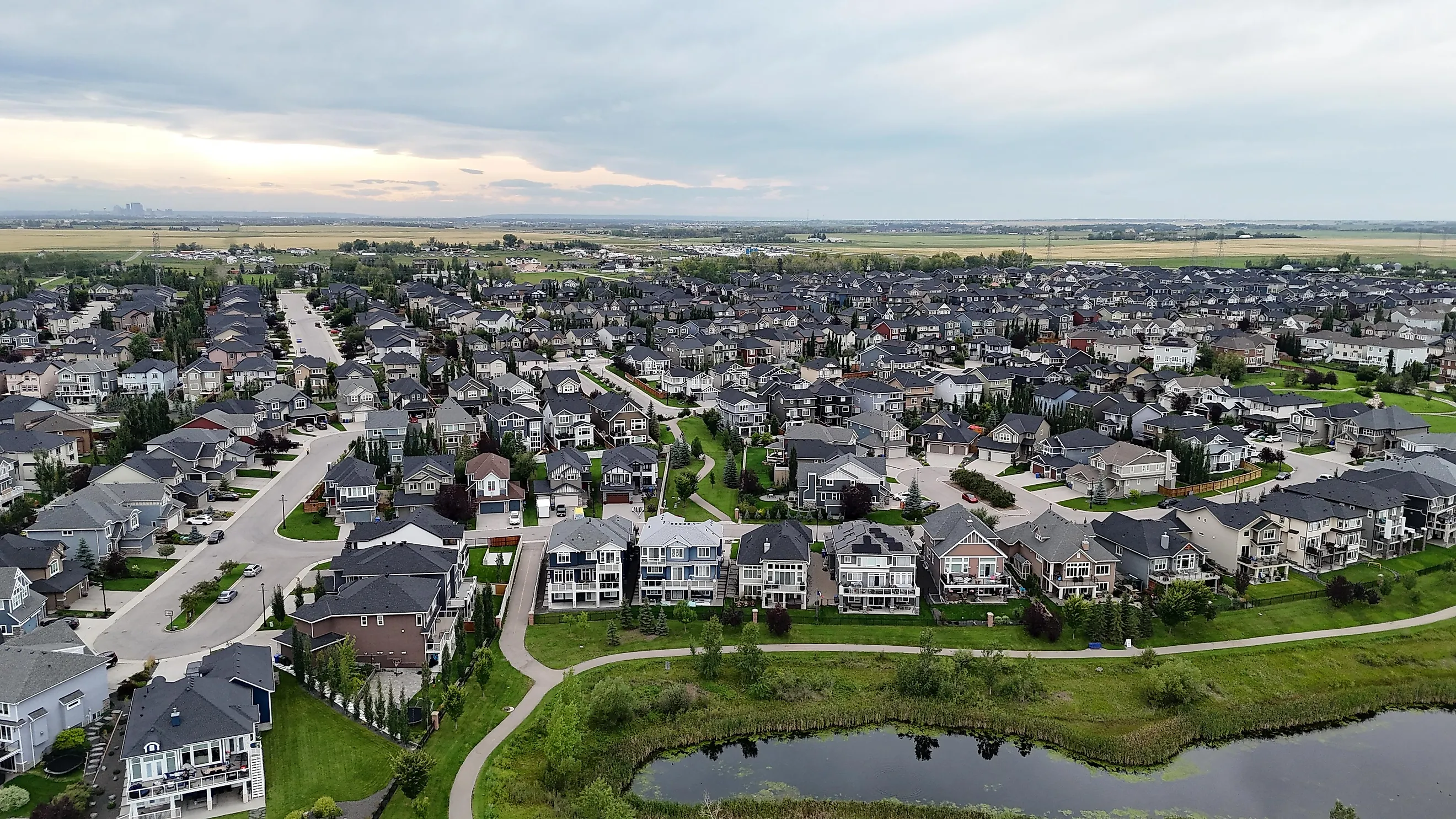
Airdrie is the lower-priced entry point to the Calgary metro area. In March 2026, its detached-home benchmark was $605,400, 18% below Calgary's $741,300. That gap explains the demand, but the supply side explains the pace.
The city's own census counted 1,574 more homes in 2026 than in 2025, and 3,913 more residents, about 2.5 people for every home added. It issued 1,623 housing permits in 2025, with Lanark, Cobblestone Creek, Midtown and South Point among the fastest-growing communities. Airdrie grows about as fast as it builds.
Statistics Canada puts the city at 92,544 in July 2025, up 20% since 2021. Calgary grew by 19%, so Airdrie is taking a proportional share of that inflow, not draining the city. The pace is already easing. The 2026 census showed 4.35% growth, down from about 4.9% a year earlier, which echoes the Calgary metro area's drop from 5.8% to 2.9%.
The price of the discount is the drive. Airdrie sits on Highway 2, about 32 km north of Calgary's city centre, and the Canadian Encyclopedia reports that most of its workforce commutes south.
Chestermere, Alberta

Chestermere complicates the price story. Its detached benchmark was $783,200 in March 2026, $41,900 above Calgary's. Even so, it added 8,666 people between 2021 and July 2025, growing roughly 38% from a base near 23,000. That is about twice the rate of Airdrie or Cochrane.
Buyers here are not hunting for a bargain. They get a lakeside setting and the shortest hop to Calgary of any commuter town, since Chestermere borders the city's eastern edge along Highway 1. Builders have kept up. A regional data summary reports that the city added 1,159 dwellings between 2024 and 2025, a 14.2% increase in its housing stock in one year. A town that expands its homes that quickly will grow quickly almost regardless of price.
Cochrane shows the other side. It lies 36 km west of Calgary's city centre on Highway 1A, with detached homes at $649,200, 12% below Calgary's. It grew 18.3%, from 33,295 to 39,397. Price alone does not predict growth in this part of Alberta.
Spruce Grove, Alberta

Edmonton's suburbs grew less than Edmonton itself, which is the first thing to understand about Spruce Grove. The seven largest suburban municipalities added about 26,900 residents between 2021 and 2025. The city proper added 187,350, so the suburbs took roughly one in eight of the region's gains. Land is one likely reason. Edmonton annexed 8,260 hectares from Leduc County and Beaumont in 2019, giving it room to build within its limits. The Edmonton metro area recorded a record 21,337 housing starts in 2025, up 16.1%.
Edmonton is also the cheaper big city. A CBC report found that at one point in 2024, Calgary's average house price was $190,000 higher. That helps explain why Edmonton's metro area gained slightly more interprovincial migrants than Calgary's in 2024/25 (11,742 against 11,195).
Spruce Grove led the suburbs, adding 5,507 residents to reach a population of 44,575. It lies west of Edmonton on Highways 16 and 16A, roughly 30 km from downtown, with Stony Plain beside it. Avison Young credits housing affordability and new infrastructure. Provincial projections assume Spruce Grove and Stony Plain will slow to about 2.0% a year, well below the 4.2% rate Spruce Grove grew at in 2025.
Warman, Saskatchewan

Warman grew when Saskatchewan grew, which is the clearest clue to what drives it. From 2017 to 2022, the city grew 9.4% while the province grew 2.7%. From 2022 to 2025, Warman grew by 8.2%, compared with the province's 7.5%. Its lead nearly vanished because the province caught up.
The province's growth is led by immigration. The Saskatchewan Immigrant Nominee Program accounted for three-quarters of newcomers in 2023, and its annual allocation rose from 7,350 that year to 8,000 in 2024. Saskatoon's own trends report names net international migration as the main driver of the metro area's growth.
Those newcomers land in Saskatoon, where there is little to buy. Realtors reported inventory about 50% below its 10-year average in 2025. Developers plan to service land for 3,737 units over three years, enough for 2% growth, while the city has grown about 3.9% a year recently. That shortfall plausibly sends buyers 14 km north to Warman, where the city credits younger families for much of the growth. The data cannot confirm who moved from where. Martensville, also north of Saskatoon, has grown only 5.4% since 2022, so not every commuter town has grown equally. After 2022, Warman added about 360 residents a year, up from about 225 before.
White City, Saskatchewan

White City grows like a satellite. It is 10 km east of Regina on the Trans-Canada Highway, and its residents are mostly young families and professionals who work in the capital. After surging by about 8.7% per year from 2012 to 2017, it settled at about 3.2% per year, reaching 4,379 in 2025. That is only about 130 new residents a year, and White City's 4,379 residents equal under 2% of Regina's 263,419.
The more useful comparison is Regina's own forecast. City officials expect the population to approach 370,000 by 2051, implying growth of roughly 1.3% per year. White City is running at more than double that pace, a common commuter-town pattern, likely because the ring is where lots are available. Regina's housing needs assessment calls for 52,300 new units over 25 years, with apartments and townhouses taking a growing share. The commuter belt around White City, Pilot Butte and Balgonie is where larger family lots remain.
Highway 48 leaves the Trans-Canada here, at exit 217.
West St. Paul, Manitoba

West St. Paul shows what happens when a municipality decides to grow. Its population went from 6,682 in the 2021 census to 10,796 in Statistics Canada's 2025 estimate, a 62% jump. The mayor predicted over 50% growth in the next census period in 2022, and her explanation was practical. The RM works with developers and charges fees on each new residential lot to pay for parks, fire equipment, and snow removal. She also said more people moved in during the pandemic than ever.
The municipality lies adjacent to Winnipeg's north side, directly west of the Red River. East St. Paul, across the river, grew only 2.3% from 2022 to 2025. Distance to Winnipeg is the same, so development policy and available land are the more likely differences.
It matters for how Winnipeg's numbers read. The Winnipeg region lost a net 1,704 residents to the rest of Manitoba in 2024/25, and West St. Paul sits outside that region's boundary. The costs are visible: the province is building a school for 600 students in the Meadowlands development, after spending $1.5 million on modular classrooms in 2024 to ease overcrowding.
Prairie Growth Means A Big City is Nearby
People are moving to commuter towns, from White City at 10 km to Niverville at about 32, because that is where homes are still going up at lower prices while the cities fill. The cities still take most of the growth, and the towns grow at the pace their builders set: Airdrie by permits, Chestermere by new dwellings and West St. Paul by its developers. For residents of these towns, school and road pressure arrives with the growth, and the price benefit varies. Airdrie's detached homes cost 18% less than Calgary's, while Chestermere's cost 5.7% more. All of it rests on immigration policy. A report on Saskatoon's population noted that the boom seems likely to have ended with federal cuts, and Airdrie's 2026 census already shows a slowdown, with 3,913 new residents compared with 4,239 a year earlier.