Ancient Bridges Still Carrying Traffic
In the early hours of March 26, 2024, a cargo ship lost power. The vessel was not out at sea but in the Patapsco River. Footage from that morning shows it crashing into the Francis Scott Key Bridge, the gateway to the port of Baltimore. In an instant the bridge that had stood for 47 years was gone. It is a fate shared by many bridges throughout history. Others have lasted for centuries and are still used today. The following are ancient bridges that are still carrying us to our destinations.
Arkadiko Bridge

Located in Greece, the Arkadiko Bridge, also known as the Kazarma Bridge, is dated to have been built by the Mycenaeans around 1300 to 1190 BC. The bridge is about 72 feet long, 13 feet high, and 8 feet across. While not the largest bridge, it was built to last using Cyclopean masonry, where the limestone rocks and tiles were fit together without mortar.
The Mycenaeans built the bridge as a route for traders, chariots, and soldiers to move safely between cities. Archaeologists even found evidence that, to make the bridge more conducive for horse-drawn chariots, curbs were created to help guide them. Not only was it built for the chariots, but the Arkadiko bridge was designed to divert and drain water from the road.
The Mycenaean civilization lasted around 1700-1100 BC and spanned most of mainland Greece and several islands. While the empire did not last forever, the Arkadiko Bridge managed to stay in use. To this day, visitors can walk on this sturdy limestone bridge, following the same path as soldiers of the Greek Bronze Age.
Caravan Bridge

Across the Aegean Sea from Greece and standing in Izmir, Turkey, is another ancient bridge. The Caravan Bridge is made of slab stone and has been witnessed by thousands of people. This single arch bridge was built in 850 BC and has stood the test of time. This bridge is so old that there are many stories of famous people having visited the bridge. It is said that Homer, creator of the Iliad and Odyssey, was born near the Caravan Bridge and mentioned it in his poetry. Even Hans Christian Andersen, a famed novelist, believed that Homer was buried on the banks of the Meles, the river which is near the Caravan Bridge. Despite the age of the bridge, it was consistently in use as the years marched on. The bridge was widened in the 1950s to allow for more traffic and is still in use today.
Pons Fabricius

Built in 62 BC in Italy is the Pons Fabricius. It is known as the oldest Roman bridge in Rome still standing in its original state, and it links the mainland and Tiber Island. This bridge was most likely engineered by Lucius Fabricius, and it was built to replace a wooden bridge that had stood prior. The bridge is about 200 feet long and 18 feet wide and consists of two arches and was considered to be built for the public, unlike other bridges that were built for private use. It was built as a connector from Tiber Island to the Forum Boarium, which at the time was considered the hub of commerce. The bridge was also a route for pilgrims to take to and from the island for travel. Tiber Island was also home to an ancient hospital, furthering people's need for the bridge. Pons Fabricius is also known as the "Bridge of Four Heads", referring to the stone head sculptures placed on the bridge's barriers. The sculptures were supposed to depict the heads of Janus, the god of beginnings and transitions. Pons Fabricius faced several repairs throughout the ages, especially after a major flood in 23 BC, but it can still be traversed today by pedestrians.
Alcántara Bridge

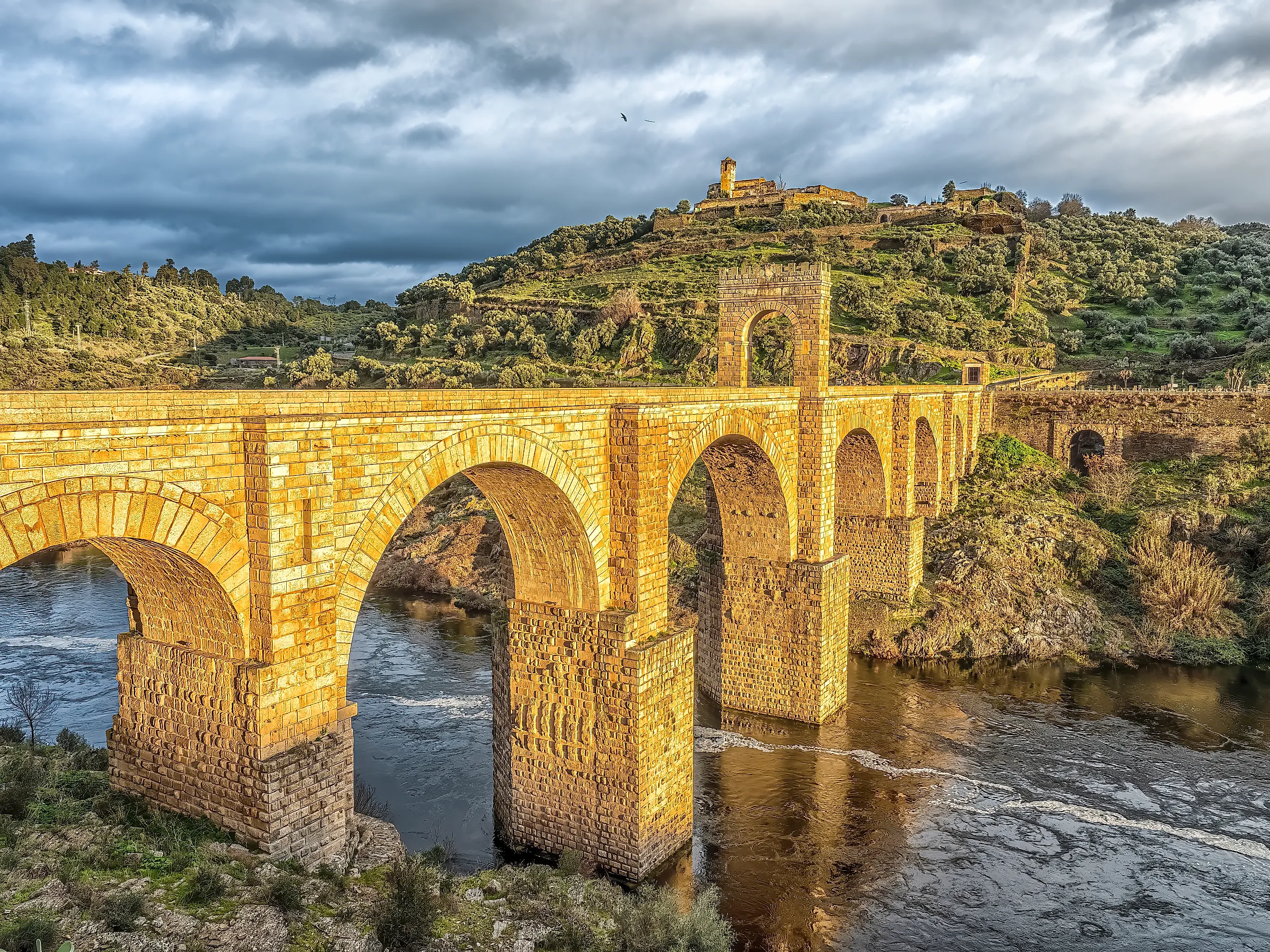
The Alcántara Bridge was built in Spain around 105 to 106 AD and dedicated to the Roman Emperor Trajan. This dedication is not surprising considering that Emperor Trajan had initiated extensive public works projects during his rule. It was thought to be built to continue a road connecting cities and to offer safe passage over the Tagus River. While it stood strong, it was destroyed in 1214 by the Moors, but was rebuilt in 1543 and had to be rebuilt several times afterwards. The bridge is made with six granite arches that are 616 feet long and 40 feet high. While it once carried vehicular traffic, now it is preserved as a monument. However, it is still in use for pedestrians to walk on and enjoy. Of course, since this bridge is so old, it does carry its own legend.
The legend is that King Rodrigo fought the Moors, but then was killed at Alcántara. The sword that the king had wielded was left on the bridge at the highest point, where no one could reach it. However, some others say that there is a golden sword buried on the bridge. Whether it is due to whispers of a king's sword or a golden sword, when the Arabs came to Alcántara, they called the bridge Kantara As-Saif, the bridge of the sword.
Pont Julien

Just a country over from Spain, in the Liberto's valley of Provence, France, is Pont Julien. This bridge was built in 3 BC and is part of the first Roman road in Gaul that connected Italy to Spain. This road, known as the Via Domitia, was most likely used as a route for troops and trade. Pont Julien is made out of limestone and spans 262 feet over the Calavon River. An interesting marvel about this bridge is that the masons built it from precisely cut limestone blocks fitted together without mortar, relying on the stones to interlock for strength. On the supports of the bridge, there are multiple holes that can be seen, but these were not placed there to be decorative or by mistake. These semicircular holes were put into the supports to be able to help drain water when the river rose.
To this day, Pont Julien is a scenic bridge to behold and is considered one of the 15 top things to do in the area. It was even classified as a historical monument in 1914. In 2005, Pont Julien was closed to car traffic, but pedestrians and cyclists are still free to enjoy this ancient bridge.
Severan Bridge

The Severan Bridge, also known as the Cendere Bridge, in Turkey, was built between 193 and 211 AD. At one point in history, it was referred to as the Septimius Severus bridge, the name of the Roman Emperor who ruled at the time. The bridge crosses Cendere Creek and is located in present-day Adıyaman Province, within Mount Nemrut National Park. The park surrounds Nemrut Dağ, the mountaintop tomb-sanctuary of King Antiochus I of Commagene, which was inscribed as a UNESCO World Heritage Site in 1987. Now the only traffic allowed on the bridge is from pedestrians.
Bridging New Worlds
While the Francis Scott Key Bridge in Baltimore fell, it is currently being rebuilt with an estimated time of reopening around late 2030. Even the ancient bridges mentioned needed maintenance as war, weather, and time have ravaged these structures. People will always be traveling, and bridges will always be in use due to our nature to roam. They are structures of where we have been and where we intend to go. In the far future, it will be interesting to see what bridges will still be standing.