The First Suspension Bridge Built In The United States
The Jacob's Creek Bridge was the first suspension bridge built in the United States. It was completed in 1801 near Mount Pleasant, Pennsylvania. Local magistrate James Finley designed the bridge. The final product was a 70-foot iron-chain structure. It withstood horse and wagon traffic across a creek that separated Fayette and Westmoreland counties.
What Is a Suspension Bridge?

A suspension bridge refers to a bridge that features suspension cables between towers. From the cables, hangers extend to hold the deck. The cables are anchored at the ends of the bridge and are designed to carry the weight of the traffic that crosses it. James Finley's bridge design contained all of the elements required for a modern suspension bridge. As such, it is considered the earliest documented example of a suspension bridge built on American soil. When looking at different definitions, there are other contenders to consider. For example, the Spider Bridge at the Falls of Schuylkill was the first wire-cable suspension bridge built. The Fairmount Wire Bridge was the first permanent wire-cable vehicular span. The Wheeling Suspension Bridge is still the oldest surviving long-span suspension bridge.
Construction and History of the Jacob's Creek Bridge

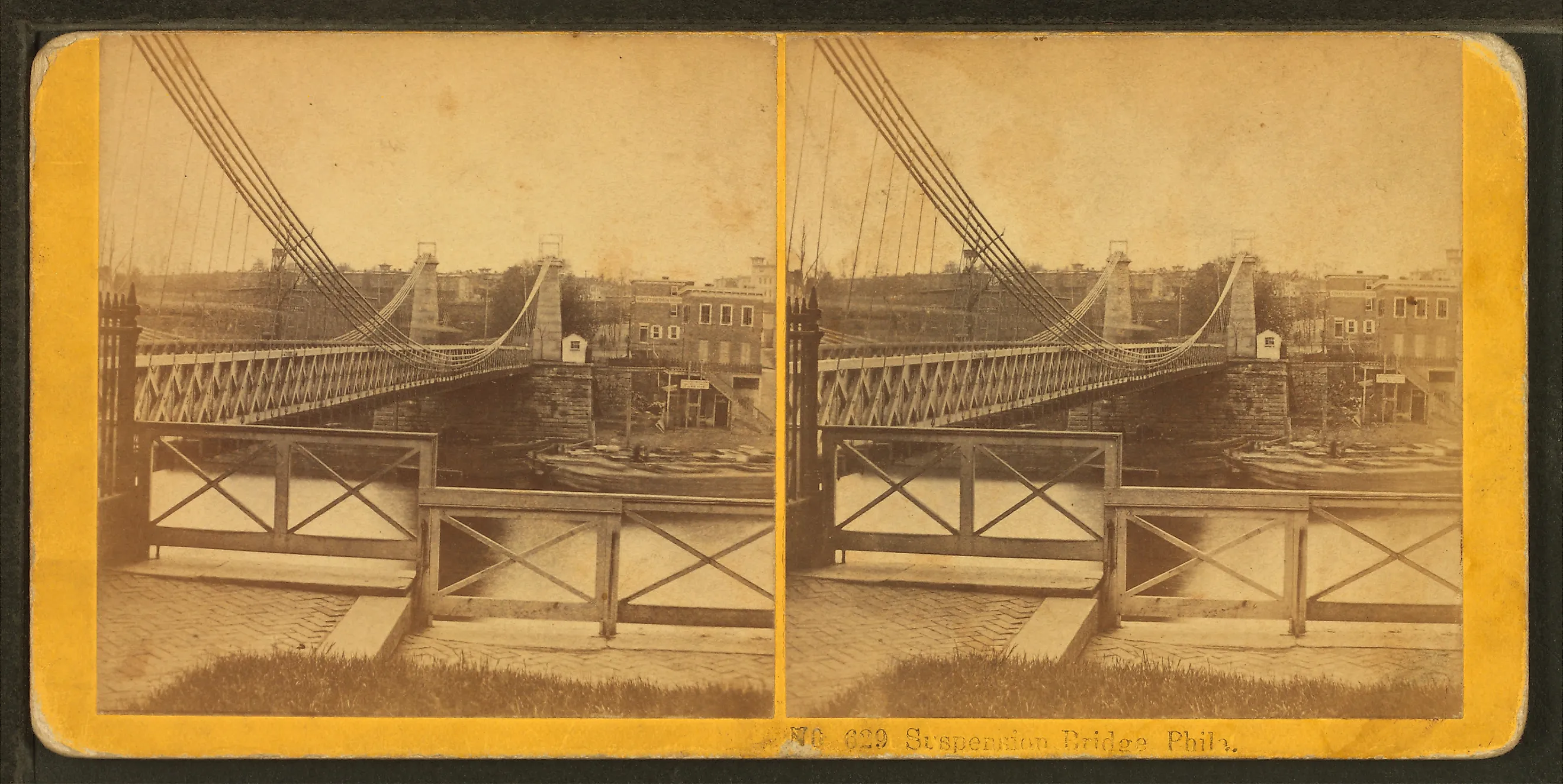
Chain Bridge at Falls of Schuylkill, Philadelphia, Pennsylvania (1808), Jacob's Creek Bridge was of similar design, but only a single span.
The same technology used to build the famous Golden Gate Bridge can be traced to Finley, who built the bridge over Jacob's Creek in Westmoreland County. Finley became a politician on the local and state level, and because of the influence he had, he became inundated with calls to improve local communities. Some of these requested improvements included building roads and bridges. One of the most conspicuous requests was to build a state turnpike that would decrease the time spent traveling between Pittsburgh and Philadelphia. During his work on the turnpike, Finley started designing bridges. He landed on an idea that would make a bridge economically viable as well as easy to construct. Finley also wanted the design of his first bridge to be easy to emulate across the state.
He worked hard on his bridge idea after he completed his term as state senator. When he found a formula he believed could work, he proposed the building of the Jacob's Creek Bridge. He explained that his bridge would be supported by two iron chains, of which the ends would be 'cemented' into the ground. The chains would be raised over piers, create a curve, and allow the middle joists of the lower tier to rest on the chains. When the bridge was completed in 1801, it was 13 feet wide (4 meters) and 70 feet (21 meters) long. It only cost $600 to construct. Finley's original design patent was unfortunately lost in a fire, but there were several published accounts of how the bridge was built. This allowed Finley and others to build more bridges in the same vein, including the Chain Bridge at the Falls of Schuylkill.
What Happened to the Jacob's Creek Bridge?

The original Jacob's Creek Bridge no longer exists, just like all of Finley's other bridges. It was dismantled in 1833 after 32 years of continuous operation to make room for a wider stone arch. The new structure allows more traffic along the turnpike. Visitors traveling along Pennsylvania Route 819 (Mount Pleasant Road), south of Mount Pleasant, can cross Jacob's Creek at the location of James Finley's original 1801 span. The current crossing is a two-lane concrete highway bridge that stretches between Fayette and Westmoreland counties. The rural settlement along the crossing in Westmoreland County still bears the historic place name 'Iron Bridge.' Along Route 819 near the creek bank, visitors will find a blue-and-gold Pennsylvania Historical and Museum Commission roadside marker, dedicated in 1952. The marker identifies the location of the site of the first iron suspension bridge in the U.S.
More Suspension Bridge Contenders

Some of the other suspension bridges built more than a hundred years ago also deserve a couple of accolades. The Spider Bridge at the Falls of Schuylkill in Philadelphia was built by Josiah White and Erskine Hazard. This footbridge was designed to span 408 feet (124 meters) across the Schuylkill River, and cost only $125 to build. The bridge used drawn iron wire instead of forged chains and was the first wire-cable suspension bridge in the world. However, it had a very narrow 18-inch (0.45 meter) wooden deck. The deck could only hold one pedestrian at a time, which meant the bridge did not fit the criteria of a permanent vehicular roadway. It eventually collapsed during heavy ice and snow in 1817.
The Fairmount Wire Bridge was opened in 1842 in Philadelphia. Designed by engineer Charles Ellet Jr, the bridge was the first permanent wire-cable suspension bridge constructed for vehicular traffic in the U.S. It spanned 358 feet (109 meters) across the Schuylkill River, replacing a wooden covered bridge that had been destroyed in a fire. Ellet used parallel iron wire strands that were wrapped into cable bundles. This allowed the wire cable to carry ongoing carriage traffic. It also inspired the fabrication methods that were later refined during the building of the Brooklyn Bridge.
Ellet also designed the Wheeling Suspension Bridge, which was completed in 1849. This bridge carried the National Road over the main channel of the Ohio River, featuring a 1,010-foot (308-meter) span. A massive 1854 storm damaged the bridge's timber deck, but it was repaired quickly. It is still in service today, boasting the title of being the oldest surviving long-span suspension bridge still open to pedestrians in the U.S.
America's First Suspension Bridge Still Inspires
James Finley's Jacob's Creek Bridge changed how engineers looked at American transportation. He proved that heavy roads could be suspended above rivers without needing stone supports inside the water. Builders across the country copied his design, and renowned engineering journals brought the same designs to Europe. It also directly inspired Thomas Telford's 1826 Menai Suspension Bridge in Wales, while kicking suspension bridge design into a higher gear.
A Lasting Impact on Modern Bridge Design
The original iron chains across Jacob's Creek may be long gone, but Finley's designs live on in every major suspension bridge today. Finley's 'experiment' of hanging a flat, rigid roadway beneath overhead support cables fixed the problem of swaying and sagging posed by earlier rope and cable bridges. This allowed engineers to put in place a scalable system for building road networks in the U.S. and across the world. All modern suspension bridges, whether big or small, still use the basic setup first tested at Jacob's Creek in 1801.