The Scariest Bridges To Drive In The United States
American drivers find the Chesapeake Bay Bridge in Maryland so scary to drive that they pay other people to do it for them, according to a Washingtonian article published in July 2026. The Bay Bridge even has a private bridge-over service called the Kent Island Express. Most drivers' fear stems from the incline, the lack of shoulders, and thin guard rails. This is not the only bridge giving drivers nightmares, with the Mackinac Bridge in Michigan and the Sunshine Skyway Bridge in Florida also causing extreme jitters.
Chesapeake Bay Bridge

The Gov. William Preston Lane Jr. Memorial Bridge, better known as the Chesapeake Bay Bridge, is located in Maryland, connecting Anne Arundel County with Queen Anne's County. It was originally designed as a wire suspension, two-lane bridge with a regular cantilever design and was constructed between 1949 and 1952. The bridge officially opened in 1952. Twenty-one years later, a three-lane span with deck suspension was added. The second crossing opened in 1973 to westbound traffic, and the bridge was rehabilitated in 1988.
These details are not what drivers think about when they drive across it, however. The 4.3-mile (6.9 km) bridge rises to 186 feet (56.7 m) above the Chesapeake Bay at its highest point, a dizzying height, especially for those who already have gephyrophobia or acrophobia. With a main suspension span of 1,600 feet (487.7 m), the entire 4.3-mile (6.9 km) bridge has no shoulders or emergency lanes, which means drivers have to keep going, no matter how scared they are. Sometimes, there is two-way traffic on the bridge, causing drivers to become extra nervous. And, during rain and fog, it becomes an almost impossible journey for those who are terrified to begin with. It does not help that there have been several accidents where cars have been pushed over the side of the bridge into the water. Considering all the above, it is no wonder the Bay Bridge is considered the scariest bridge to drive in America.
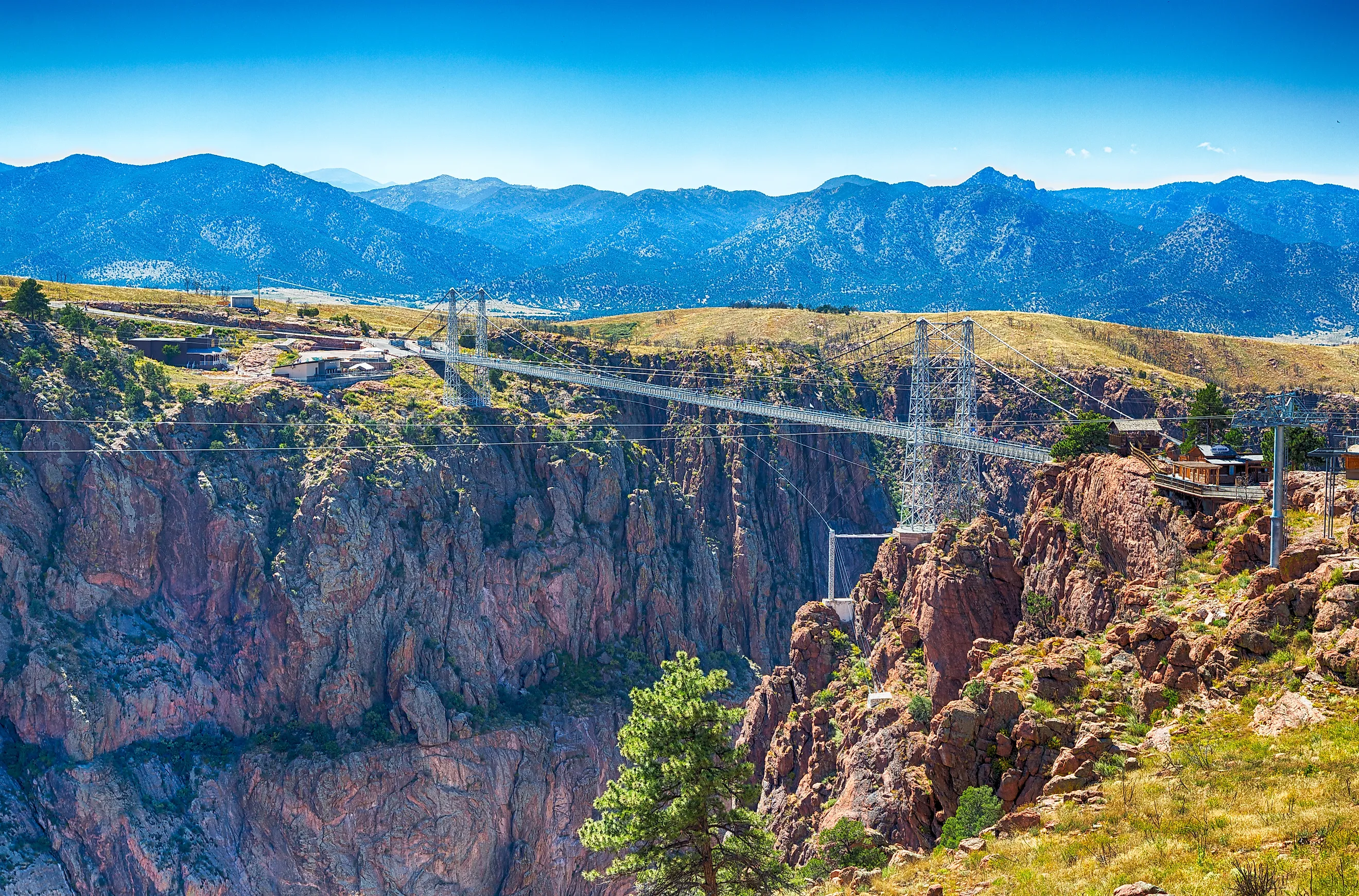
Royal Gorge Bridge

Colorado's version of a terrifying wire suspension bridge is the Royal Gorge Bridgethat spans the Arkansas River. The bridge was built for the Royal Gorge Bridge and Amusement Company and was rehabilitated between 1982 and 1983. The bridge spans 938 feet (285.9 m) and has a total length of 1260 feet (384 m). It is suspended 956 feet above the river, making it one of the highest suspension bridges in the world. It took only seven months to build the Royal Gorge Bridge, and it can hold more than 2,000,000 pounds thanks to its 1,000 tons (907 metric tons) of steel that reinforce its deck. The bridge received new anchor cables and a wind cable system in 1982 to withstand winds of up to 125 mph (201.2 km/h), and worn wooden planks are replaced every year.
Does knowing these facts make it less scary to drive over this bridge? For most drivers, the answer is no, especially considering the wooden planks. Pedestrians mainly use it, and personal vehicles are no longer allowed except for prescheduled car clubs or special events. However, some drivers quickly become nervous when they hear the planks shaking and jiggling as their wheels go over them. The bridge is held in place by granite rock walls and is not open to heavy vehicles. For most, whether driving or walking, the sheer height of this bridge is enough to cause sweaty palms and some dizziness. After all, crossing this bridge is like walking or driving at a height greater than that of a 100-story skyscraper.
Mackinac Bridge

While the Royal Gorge Bridge is only open to drivers on special occasions, the Mackinac Bridge in Michigan is open every day, scaring drivers who see nothing but a narrow lane ahead of them and the vast expanse of the Straits of Mackinac below. As with the Chesapeake Bay Bridge, drivers can also pay someone to drive them across, in this instance, the Mackinac Bridge Authority staff. The bridge's main span is 3800 feet (1,158.2 m) and has a total length of 26,372 feet (8,038.2 m). It was built and opened in 1957 and carries I-75 between Michigan's Upper and Lower Peninsulas along a road that is 54 feet (16.5 m) wide.
For most, the bridge's height of 200 feet (61 m) above water is not the main concern. It is the winds that sweep it, sometimes with a strength of more than 30 miles per hour (48.3 km/h). On the ground, this is not an issue, but for drivers on a narrow bridge feeling their car sway to the side, it can quickly become a very scary situation. Then, some start thinking about how deep the water is below them, up to 250 feet (76.2 m) deep at the center, and this can lead to hyperventilation or panicking. It does not help that the inner lanes have an open steel grate deck that produces a humming noise while allowing drivers to look directly down into the water. Fortunately, the bridge was designed to withstand winds, weight, and temperature changes. The deck can move as much as 35 feet (10.7 m) left or right at the center span under extreme wind loads. And, while there have been two vehicles that fell off the side of the bridge, in 1989 and 1997 respectively, neither incident involved wind.
Sunshine Skyway Bridge

The Bob Graham Sunshine Skyway Bridge carries I-275 across the Tampa Bay mouth and connects St. Petersburg to Terra Ceia. This 4.14-mile (6.7 km) cable-stayed bridge features two 431-foot (131.4 m) towers, but originally opened as a steel cantilever bridge in 1954. In 1971, a parallel span was added to create a four-lane crossing. Disaster struck on May 9, 1980, when the MV Summit Venture struck the bridge's southbound span's support pier. The collision saw a section of the deck drop into the water and take a bus and several other vehicles with it. The disaster killed 35 people.
A new Skyway was built, with construction starting in 1982. The towers were added, and the clearance is now 175 feet (53.3 m). The bridge also has dolphin fenders to deflect ship strikes. But today the fear that drivers have of the Sunshine Skyway is not that they will be on the bridge if a ship hits. It is that feeling of being untethered when climbing the steep ascent with cables that top out at 431 feet (131.4 m) and seeing nothing beyond it but water when finally at the top. The sides feel too exposed, and the guardrails seem inadequate. This makes even experienced drivers grip the steering wheel just a little tighter and hope for the best.
Golden Gate Bridge

San Francisco's Golden Gate Bridge is arguably the most famous bridge on this list. It features in several movies as a gorgeous backdrop and was constructed during the Great Depression. Construction started in 1933 to much fanfare, and the roadway was completed in 1937. The bridge was already terrifying during construction, with currents, heights, and high winds complicating things. Eleven men died during construction, adding to the fear of those building the iconic bridge. Today, the 4,200-foot-long (1,280.2 m) main span suspension bridge still scares people, mainly because the bridge receives strong winds and because San Francisco is known for earthquakes.
The bridge has been designed to withstand said earthquakes and up to 100-mile-per-hour (160.9 km/h) winds, but drivers making their way over it during a storm still became terrified at the screaming sounds it makes. Engineers have stated that a retrofitted handrail added to the bridge in 2020 was to blame for the sounds. Much of the sound was eliminated after an engineering fix, but the bridge still hums during high winds. Even more disconcerting is the feeling of the car being pushed to the side of the bridge or across lanes during wind because the deck is designed to sway up to 27 feet (8.2 m) laterally. Some drivers can handle this sensation but cannot deal with driving in fog that obscures the bridge's 746-foot (227.4 m) towers, making it seem as though they are driving into a space high above the waters of the San Francisco Bay.
The Blueprint of a Nightmarish Drive

None of America's bridges were constructed for the sole purpose of terrifying drivers (and pedestrians). They are meant to connect places and, in many instances, to create a tourist attraction. But while each of these bridges mentioned above has its own personality and aesthetics and draws people from all over the world, they all share the same blueprint when it comes to triggering anxiety. The core of people's fear sits in imagining being stuck in the air hundreds of feet over deep water with no shoulder to pull over on. So does the idea of being pushed into the side of the bridge and plunging into the water below. Throw in strong winds that shake cars, decks that move, and steel grates that hum and scream beneath the tires, and it is very easy to see why some drivers start to panic. Even though millions of drivers take these bridges every day without any problems, for some it is a sheer test of courage. And those who fail the test have no choice but to either pay someone to drive their car across or try to avoid the bridge altogether.
Crossing the Span
You may view a bridge as an engineering marvel or a terrifying obstacle. Either way, crossing them is a rite of passage for hard-core American road-trippers. You may find your heart beating a little faster at the sight of huge suspension towers in the distance, but keep your hands on the wheel, look straight ahead, and remember that millions of drivers make it across safely every day.