The Longest Floating Bridges In The World
Most bridges stand on legs driven into the riverbed. Floating bridges skip the legs entirely and ride on the water, which sounds like a stunt until you learn why anyone builds them. They go up where the water is too deep or the mud too soft to plant a pier, and where a towering suspension span would cost a fortune nobody wants to spend. Here are the ten longest ever built, ranked by the length of the floating section that actually rests on the water, and four of the top five sit in one corner of Washington State.
1. Evergreen Point Floating Bridge, Washington, United States

This is the record holder, and it earns the title by a nose that happens to be several hundred feet long. The floating part of the Governor Albert D. Rosellini-Evergreen Point Bridge runs 2,349.55 meters, about 7,708 feet, which makes it the longest floating bridge on Earth. It carries State Route 520 across Lake Washington between Seattle and Medina, and it opened to traffic in the spring of 2016. The bridge it replaced had done the same job since 1963 along almost the identical line.
The reason it floats comes down to what is under the water. Lake Washington drops to roughly 214 feet, and below that lies a couple hundred more feet of soft mud before you ever reach solid rock. You cannot sink a pier through that, and a suspension bridge tall enough to span the lake would need towers close to the height of the Space Needle. So engineers went the other way and built the road on 77 hollow concrete pontoons, chained together into one long floating foundation and held against the wind by anchor cables running to the lakebed. The deck up top has room for six lanes, transit, and a separate path for people on bikes and on foot.
2. Lacey V. Murrow Memorial Bridge, Washington, United States

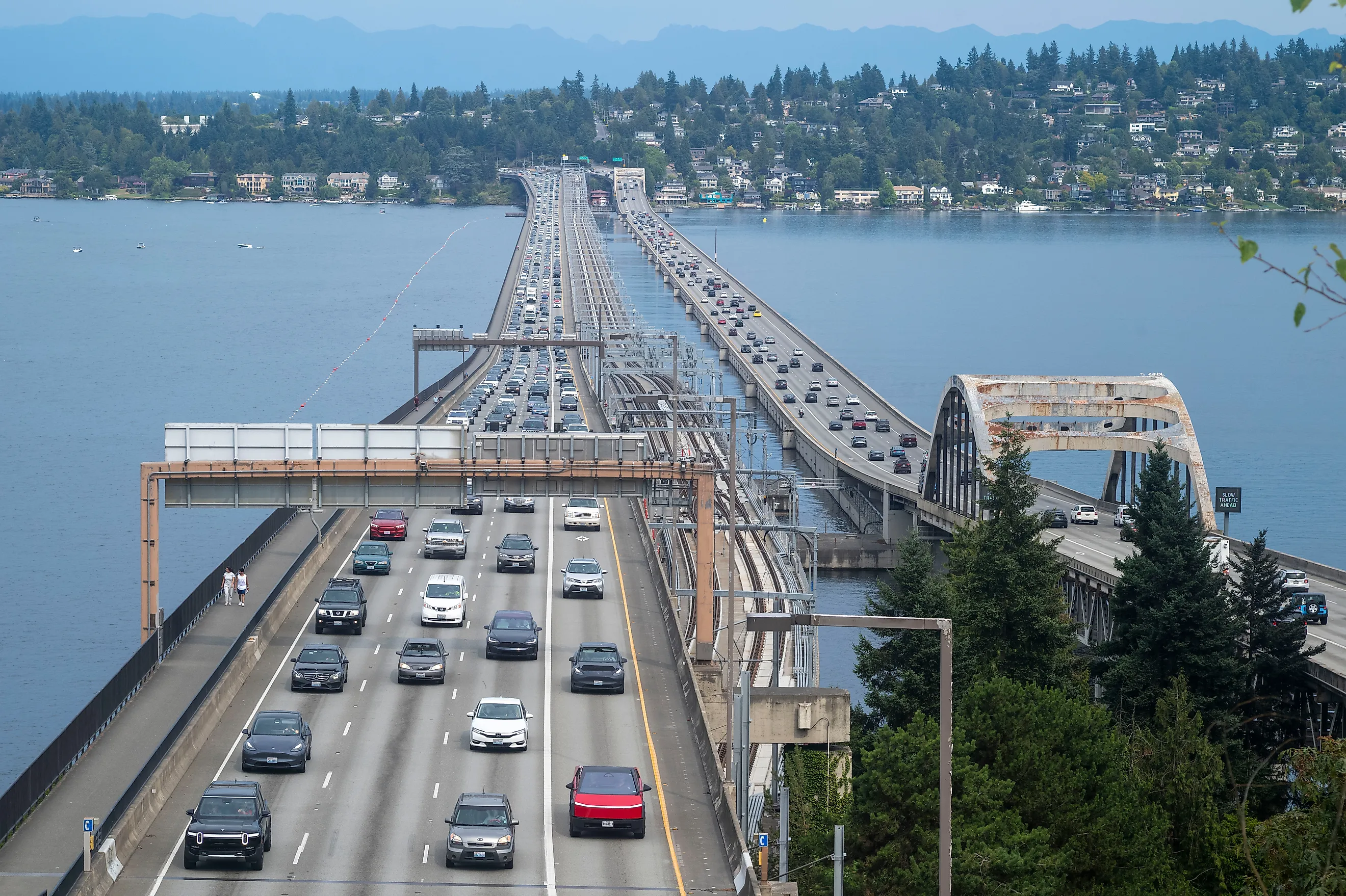
A few miles south, Interstate 90 crosses the same lake, and its eastbound traffic rides the Lacey V. Murrow Memorial Bridge. The floating span runs about 2,020 meters, or 6,620 feet, on a line of concrete pontoons that sits right beside a twin bridge carrying the other direction. Seeing two floating interstates run side by side is one of the odder sights on the whole highway system.
This spot has real history, some of it dramatic. The first bridge here opened in 1940 and was the first big permanent floating bridge to use hollow concrete pontoons at this scale, a genuinely new idea at the time. It sank in November 1990, and the story of how is a lesson every engineer since has taken to heart. Crews had removed the watertight doors inside the pontoons during a renovation, a storm blew in, water poured into compartments that should have stayed sealed, and a long stretch of the bridge went to the bottom. An almost entirely new bridge opened in 1993. It keeps the old name, but the structure floating there today is not the one from 1940.
3. Hood Canal Bridge, Washington, United States

The Hood Canal Bridge stretches almost 2,398 meters end to end, but only its floating section counts for this list, and that measures 1,988 meters, or about 6,521 feet. It carries State Route 104 between the Kitsap and Olympic peninsulas, across a deep saltwater fjord that feeds into Puget Sound. Here is the part that makes it stand out: the roadway can move. When a big ship needs through, hydraulic machinery pulls sections of the bridge aside to open a gap.
Saltwater makes this one a handful to keep up, and storms here have wrecked it before. The original opened in 1961, and in February 1979 a fierce storm overwhelmed the western half. Pontoons flooded, and a large stretch sank. Crews rebuilt the west side by 1982, and the state replaced the tired eastern floating section in 2009. Between the corrosion and the moving parts, the maintenance crews here never really get a quiet year, and it is worth the drive to watch the span open if you ever catch it.
4. Old Demerara Harbour Bridge, Guyana

For more than four decades, the old Demerara Harbour Bridge was how you crossed the Demerara River in Guyana, running about 1,851 meters between Peter's Hall and Meer Zorgen on 114 floating pontoons under 61 spans. A retractable section swung open for oceangoing ships, and a separate raised span let smaller boats slip underneath without stopping the road. It opened in July 1978.
The planners figured it would last about ten years. It lasted forty-seven. The narrow roadway and the scheduled openings meant traffic backed up often, and Guyana finally replaced it with the high-level Bharat Jagdeo Demerara River Bridge, which opened on October 5, 2025. The old floating crossing then went quiet, left retracted for ship traffic while crews began taking it apart to reuse the pieces elsewhere. It is on this list precisely because it was one of the longest floating bridges ever built, even though it no longer carries a car.
5. Homer M. Hadley Memorial Bridge, Washington, United States

The Homer M. Hadley Memorial Bridge runs 1,772 meters, or 5,811 feet, and it floats on 21 concrete pontoons right alongside the Lacey V. Murrow bridge. It opened in 1989 carrying westbound Interstate 90 and a set of reversible express lanes down the middle. Those center lanes went on to do something no bridge had done before.
On March 28, 2026, light rail trains began carrying passengers across it, when Sound Transit's 2 Line opened its Crosslake Connection between Seattle and the Eastside. That made it the first place in the world where a passenger train runs across a floating bridge, full stop. You cannot just lay ordinary track over the seam where solid ground meets a moving pontoon, because the two are always shifting against each other. Engineers solved it with special track bridges and curved rail supports that let the rails bend and settle as the whole structure rises, dips, and twists with the lake. Sixty years of people saying it could not be done, and now the train just runs.
6. Berbice Bridge, Guyana

Guyana's second entry crosses the Berbice River near New Amsterdam and measures 1,570 meters of floating roadway, resting on 39 pontoons under 37 spans. Suction anchors dug into the soft riverbed hold it in place. A four-span retractable section opens a channel about 70 meters wide for ships, a process that takes roughly eight minutes, and a fixed raised span handles the smaller boats.
It opened in December 2008, and for the people on either bank it changed daily life in a concrete way. Before the bridge, crossing meant a ferry and sometimes a long wait; afterward it took a few minutes. The two-lane roadway wears an anti-skid surface, which you appreciate in a place that sees real rain. There is a happy footnote here too. On August 1, 2025, the government scrapped the tolls, and a crossing that had been the priciest routine drive in the country became free.
7. Nordhordland Bridge, Norway

Norway does its floating bridges differently, and the Nordhordland Bridge shows how. It runs about 1,614 meters overall, of which 1,246 meters float, and it crosses Salhusfjorden between the island of Flatøy and the mainland near Bergen. The reason it floats is straightforward once you hear the number: the fjord drops to around 500 meters deep, far too deep to anchor anything to the bottom in the usual way. It opened in 1994 and carries cars, cyclists, and walkers.
The clever part is what it does without. The floating stretch is a steel box girder riding on ten concrete pontoons, and unlike most long pontoon bridges, it has no anchor cables reaching down to the seabed at all. Instead the whole thing is held firmly at its ends, and it curves gently on purpose, so that the push of wind and water gets carried sideways into solid abutments on land. A cable-stayed section lifts the road over the shipping lane at the deep end. The design stays put on its own, and no anchor ever has to reach the floor of the fjord.
8. Bergsøysund Bridge, Norway

The Bergsøysund Bridge uses the same end-supported idea and came first, opening in 1992 as part of the Krifast road project in western Norway. It runs roughly 932 meters, give or take, between the islands of Aspøya and Bergsøya, with a steel truss carrying the road above seven lightweight concrete pontoons. Published figures wobble between 931 and 933 meters, which tells you how these things get measured and re-measured.
Like its northern cousin, it holds itself up at the ends with no cables sunk into the seabed, and for good reason, since the strait beneath it runs about 320 meters deep. It follows a broad curve with a radius near 1,300 meters, and that shape is doing a job, not decorating one. The bend is what lets the structure ride out waves, currents, and wind, because the curve steers all that force back toward the end supports. Engineers have since wired it with sensors and turned it into a kind of living laboratory for how floating bridges actually move.
9. William R. Bennett Bridge, British Columbia, Canada

Across Okanagan Lake in British Columbia, the William R. Bennett Bridge stretches about 1,060 meters, though only 690 of those float, which is the number that lands it here. It ties downtown Kelowna to West Kelowna on Highway 97, opened in May 2008, and carries five lanes plus a separated walking path. A raised section lets boats pass without ever stopping the cars.
Nine concrete pontoons hold up the floating stretch, not ten as you will sometimes read, joined by steel connectors and pinned down by 24 weighted anchors. It took the place of the narrow Okanagan Lake Bridge, which had opened in 1958 as Canada's first floating bridge and had a lift span that stopped traffic every time a vessel came through. By the time it retired, that old crossing had become the bottleneck everyone in town complained about, and the new one carried more cars and quit interrupting them.
10. Yumemai Bridge, Osaka, Japan

Osaka closes out the list with the strangest design of the bunch. The Yumemai Bridge measures about 876.6 meters overall, of which the central floating section runs 410 meters, and it connects the artificial islands of Maishima and Yumeshima in the Port of Osaka. Two big steel pontoons hold up a double-rib arch above the water, and the whole thing opened in 2001.
What makes it special is that it rotates. Yumemai was the world's first arch-shaped floating swing bridge, built so its center could turn and open an emergency shipping route if the port's main channel ever got blocked. Tugboats push the floating structure around a pivot near one end, while fixed posts, reaction walls, and enormous rubber fenders keep the movement under control. When it swings, it opens a channel far wider than any ordinary drawbridge could manage. The rest of the time it just sits there being a road between two islands, which is the quiet genius of it.
How a Road Floats and Stays Put
The whole thing rests on one idea you already know from dropping a boat in the water. Each sealed pontoon pushes aside a volume of water that weighs exactly what the pontoon and its load weigh, and that displaced water holds everything up. Engineers count every ounce that will sit on top, the roadway, the cars, the rails, the machinery, and the pontoons themselves, then build in watertight compartments so a single puncture cannot flood the whole float. They can even add or drain ballast to keep the deck sitting at the right height. That is the good news.
The catch is that a floating bridge never holds still. It answers to waves, wind, water levels, and even the sun warming one side, so every joint has to give a little without tearing up the road or the rails above it. Anchor cables and connectors need constant inspection, and the saltwater crossings fight corrosion for their entire lives. People have floated bridges across water since the days of marching armies, but the ten here show how far that simple idea will stretch, all the way to a six-lane highway, and now to a train gliding over a lake that never stops moving under it.