Which City Has The Highest Number Of Bridges In The World?
The city most often credited with having the most bridges in the world is Pittsburgh, Pennsylvania, which calls itself the City of Bridges and counts 446 of them. That answer is a popular misconception. By the measure Guinness World Records uses, the city with the most bridges is Hamburg, Germany, with an estimated 2,300 to 2,500. Pittsburgh's claim holds up in a narrower sense: it has more bridges than Venice and is the most celebrated bridge city in the United States. The full answer depends on what counts as a bridge and where a city's limits are drawn, so both contenders are worth a look.
The Record Holder: Hamburg, Germany
Guinness World Records lists Hamburg as the city with the most bridges, with an estimated 2,300 to 2,500 inside its city limits. That is more than Amsterdam, London, and Venice combined. The reason is water. Hamburg sits on the Elbe River and is threaded with canals, tributaries, and one of Europe's largest ports, and crossing all of that takes an enormous number of spans of every size, including small pedestrian crossings and large structures carrying road and rail. The oldest of them, the Zollenbrücke, dates to 1663. Because most of these are ordinary working crossings rather than landmark structures, Hamburg's lead rarely comes up in casual conversation, which is part of why other cities get named instead.
Pittsburgh, America's City of Bridges

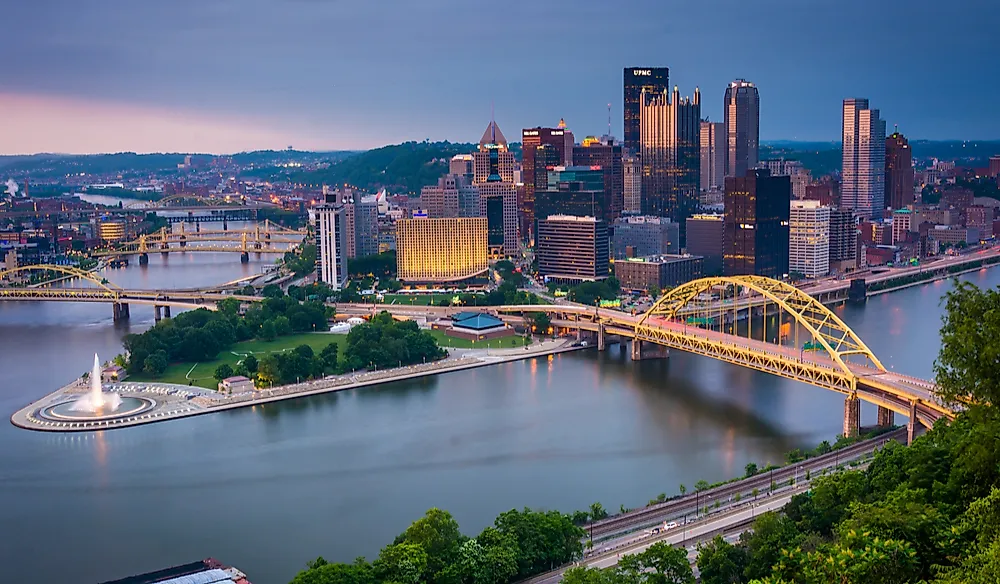
Pittsburgh has carried the City of Bridges nickname for generations, and it counts 446 bridges within its limits, more than any other city in the United States by the figure its boosters use. That total famously exceeds Venice, Italy, which has roughly 400, and that comparison is most likely the origin of the broader "most in the world" claim. Even at home the count is debated: New York City's transportation department oversees several hundred bridges across its boroughs, and the true total for any city turns on whether overpasses, ramps, and pedestrian spans are included or only, as one Pittsburgh engineer put it, carefully designed bridges of significance. What is not in dispute is the density. Pittsburgh concentrates its bridges into a small, hilly area cut by three rivers, which gives it a tighter and more visible collection of crossings than almost anywhere else.
Geography of Pittsburgh
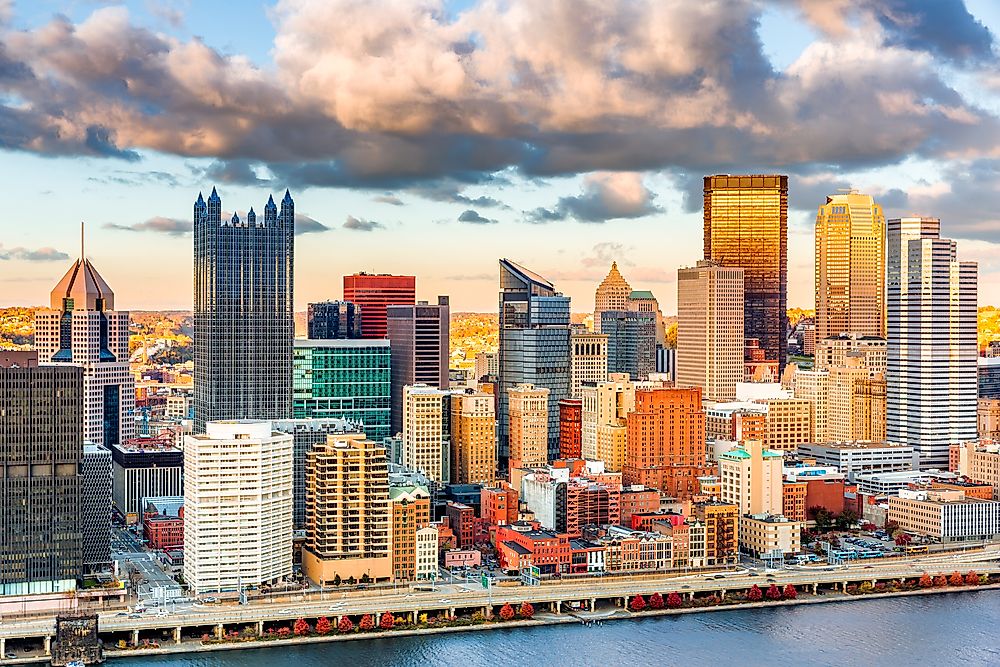
Pittsburgh sits at the confluence of three rivers. The Allegheny and the Monongahela meet at a spot called the Point, in the downtown wedge known as the Golden Triangle, and together they form the Ohio River, one of the longest rivers in Pennsylvania. About 40 of the city's bridges cross these three rivers, and many of the rest span the ravines and valleys that fold through the rest of the city. Pittsburgh covers 58.3 square miles (151 square kilometers), and many of its neighborhoods climb steep hillsides. The most extreme is Canton Avenue, in the Beechview neighborhood, which reaches a 37 percent grade over a short stretch and is the steepest officially recorded public street in the United States. Most of the tallest buildings in Pittsburgh stand in the Golden Triangle, and the city's other districts, the East End, West End, North Side, and South Side, are named for where they sit relative to the rivers.
A History of Pittsburgh's Bridges
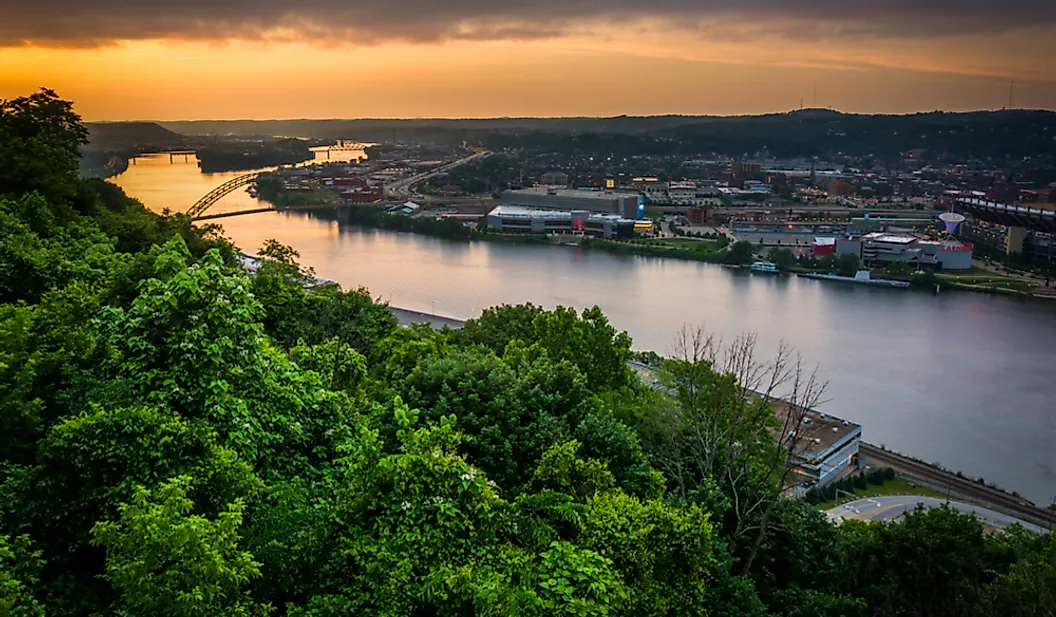
The first bridge in Pittsburgh was a wooden structure opened in 1818 across the Monongahela at Smithfield Street, and it burned in the city's Great Fire of 1845. The oldest bridge still standing is the Smithfield Street Bridge, opened in 1883 and designed by the engineer Gustav Lindenthal as a lenticular truss, its lens-shaped spans unlike anything else in the city. It was named a national historic landmark in 1976. The city built in waves: a major roads-and-bridges campaign between 1924 and 1940 produced many of the older spans still in use, and the arrival of the interstate highways set off another building period later in the century. Over more than a hundred years Pittsburgh accumulated nearly every major bridge type, including cantilever, arch, and suspension designs, most of them built with steel produced in the city's own mills. A large share of the downtown bridges wear a yellow shade close to the city's official gold, paired with black. One exception, the Hot Metal Bridge, sat unused for years before it reopened in 2000 as a pedestrian and bicycle crossing.
The Fort Pitt Bridge

The Fort Pitt Bridge is the double-decked steel bowstring arch that carries Interstate 376 across the Monongahela River between downtown and the Fort Pitt Tunnel, near the Point. When it opened on June 19, 1959, dedicated by Governor David L. Lawrence, it was the world's first computer-designed bowstring arch bridge and the first built as a double-decker. The engineer George S. Richardson designed it, the project cost $6,305,000, and it used 8,066 tons of steel. The bridge is also known for a difficult traffic weave on its lower deck, where drivers headed for the tunnel may have to cross several lanes in only a few hundred feet.
So, Which City Has the Most?
By the numbers Guinness recognizes, Hamburg wins, and it is not close. By fame, density, and the strength of a good nickname, Pittsburgh wins, and it really does have more bridges than Venice and more than any other US city. The disagreement comes down to definition. Count every overpass and ramp and the totals climb into the thousands; count only the significant river and valley crossings and the list shrinks to something much smaller and more arguable. Either way, both cities earned their bridges the same way, by being built on water and hills that left no easier way across.