The 11 Longest Bridges in the United States
The United States has somewhere around 617,000 bridges, and most of them you cross without a second thought. The eleven below are different. These are the ones that swallow the horizon, where solid ground vanishes behind you and the far shore takes ten or fifteen minutes to arrive. Louisiana alone claims most of the top of the list, for the simple reason that there is barely any dry land left between Baton Rouge and the Gulf to build a normal road on. Ranked longest to shortest, here are the eleven longest bridges in the country.
11 Longest Bridges in the US
- Lake Pontchartrain Causeway - 23.83 miles
- Manchac Swamp Bridge - 22.8 miles
- Louisiana Airborne Memorial Bridge - 18.2 miles
- Chesapeake Bay Bridge-Tunnel - 17.6 miles
- Bonnet Carré Spillway Bridge - 11 miles
- Louisiana Highway 1 Bridge - 8.26 miles
- Jubilee Parkway - 7.5 miles
- San Mateo-Hayward Bridge - 7 miles
- Seven Mile Bridge - 6.79 miles
- General W.K. Wilson Jr. Bridge - 6.08 miles
- Norfolk Southern Lake Pontchartrain Bridge - 5.8 miles
1. Lake Pontchartrain Causeway - 23.83 miles

The undisputed champion runs 23.83 miles (38.35 kilometers) straight across Lake Pontchartrain in southeastern Louisiana. For most of that distance, drivers can see no land in any direction, just water and the thin gray ribbon of road ahead. The southbound span opened in 1956 and its parallel twin followed in 1969, linking Metairie and Mandeville across the New Orleans metro. The Causeway held the Guinness record for longest bridge over water until 2011, when China's Jiaozhou Bay Bridge muscled in. The dispute was settled with a bit of bureaucratic compromise: the Causeway keeps its crown as the longest continuous bridge over water, and the commuters white-knuckling the middle stretch can attest it has earned the title.
2. Manchac Swamp Bridge - 22.8 miles

Barely a mile behind sits the Manchac Swamp Bridge, 22.8 miles (36.7 kilometers) of twin concrete trestle gliding over a cypress swamp that locals swear is haunted. Built in 1979, it carries Interstate 55 and U.S. Route 51 and accounts for roughly a third of I-55's entire length, making it one of the longest toll-free bridges anywhere. The ghost stories trace back to a deadly 1915 train wreck nearby, and the legend now has its own small tourism economy, which is not bad for a stretch of highway most people only meant to drive across.
3. Louisiana Airborne Memorial Bridge - 18.2 miles

Louisiana sweeps the entire podium. Officially the Louisiana Airborne Memorial Bridge but better known as the Atchafalaya Basin Bridge, this 18.2-mile (29.29-kilometer) span carries Interstate 10 over the largest river swamp in the United States. Construction began in 1971 and the bridge opened in 1973, connecting Baton Rouge and Lafayette. For much of its run it travels as a pair of parallel structures, merging into a single deck where it crosses the Whiskey Bay Pilot Channel and the Atchafalaya River itself.
4. Chesapeake Bay Bridge-Tunnel - 17.6 miles

The Chesapeake Bay Bridge-Tunnel is the strangest entry on the list, and the hardest to measure, which is why the figure shifts depending on the source. Per the structure's own operators, it covers 17.6 miles (28.32 kilometers) across the mouth of Chesapeake Bay, with the road plunging into two mile-long tunnels partway so that ships can pass overhead. It links the isolated Eastern Shore of Virginia with the Hampton Roads mainland. The first two lanes opened in 1964 and retired the old commuter ferries; a 1999 expansion doubled the above-water spans to four lanes while the tunnels still run two.
5. Bonnet Carré Spillway Bridge - 11 miles

Louisiana reclaims the list to round out the top five. The Bonnet Carré Spillway Bridge carries 11 miles (17.7 kilometers) of Interstate 10 over Lake Pontchartrain, the Bonnet Carré Spillway, and the LaBranche Wetlands, connecting St. Charles Parish with St. John the Baptist and Jefferson Parishes. It opened in 1972 atop a flood-control structure with a serious job: when the Mississippi River runs dangerously high, the spillway below diverts the floodwater into Lake Pontchartrain and spares flood-prone New Orleans. It is a bridge sitting on top of a release valve for the continent's biggest river.
6. Louisiana Highway 1 Bridge - 8.26 miles

The Louisiana Highway 1 Bridge, fittingly nicknamed the Gateway to the Gulf Expressway, vaults 8.26 miles (13.29 kilometers) over Bayou Lafourche and the surrounding marsh in the far southeastern toe of the state. Completed in 2009, this toll road through Lafourche Parish connects Leeville to Port Fourchon, the service hub for much of the Gulf's offshore oil and gas industry. The elevated route exists in part because the marsh road it replaced was sinking and flooding, a recurring theme in a state losing land to the sea.
7. Jubilee Parkway - 7.5 miles

Southern Alabama finally breaks Louisiana's grip. The Jubilee Parkway carries Interstate 10 for 7.5 miles (12.1 kilometers) across the north end of Mobile Bay as a pair of two-lane viaducts, linking Mobile with Spanish Fort and Daphne. Opened in 1978, it takes its name from the "jubilee," a genuine local phenomenon in which low oxygen in the deep water drives crabs, shrimp, and flounder into the shallows, where residents scoop them up by hand. Locals just call the bridge the Bayway, and have spent two decades arguing about widening it to escape the chronic backup at the George Wallace Tunnel on its western end.
8. San Mateo-Hayward Bridge - 7 miles

The first non-Gulf entry, and the longest bridge in California, the San Mateo-Hayward Bridge spans 7 miles (11.27 kilometers) of San Francisco Bay, tying the San Francisco Peninsula at Foster City to Hayward on the East Bay. The original opened in 1929; the current six-lane structure replaced it in 1967 and gained a lane each way in 2002. Most of it is a low concrete trestle riding just 15 feet above the water, but the western end rears up into a 135-foot high-rise span so ships can slip beneath, a sudden climb that gives the long flat crossing its one dramatic beat.
9. Seven Mile Bridge - 6.79 miles

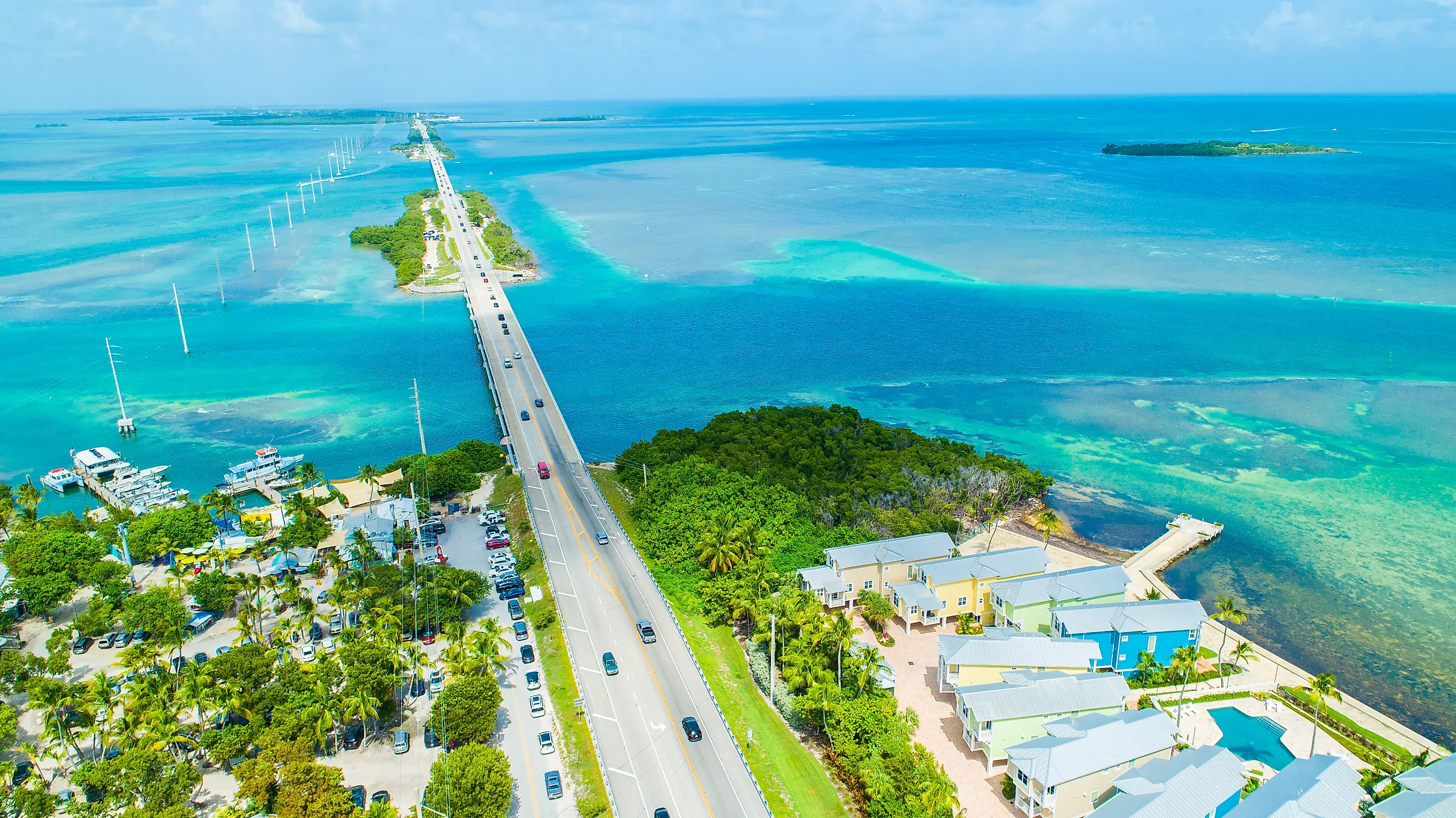
Seven miles? Closer to 6.79 (10.78 kilometers), but nobody was going to name it the Six Point Seven Nine Mile Bridge. Hollywood loves it: chase scenes from True Lies, Licence to Kill, and 2 Fast 2 Furious all tore across it between Marathon and Little Duck Key in the Florida Keys. The modern bridge, built in 1982, carries two lanes of U.S. 1 over the Moser Channel, while its predecessor, an original 1912 railroad bridge, still stands alongside it, now reserved for walkers and cyclists who want the view without the traffic.
10. General W.K. Wilson Jr. Bridge - 6.08 miles

Back to the Alabama counties of Mobile and Baldwin for the General W.K. Wilson Jr. Bridge, 6.08 miles (9.78 kilometers) across the Mobile-Tensaw River Delta. Its twin weathering-steel arches earned it a far better nickname than its formal one: locals call it the Dolly Parton Bridge, and once you have seen the two curves rising side by side, you cannot unsee it. Completed in 1980, it carries four lanes of Interstate 65 and honors the Army Corps of Engineers chief and longtime Mobile resident it is named for.
11. Norfolk Southern Lake Pontchartrain Bridge - 5.8 miles

We end where we began, back on Lake Pontchartrain, but with a twist: this one carries trains, not cars. The Norfolk Southern Lake Pontchartrain Bridge runs 5.8 miles (9.3 kilometers) of railroad, used today by Norfolk Southern freight and Amtrak. It ranks 11th overall, but it has a distinction none of the others can touch. Built in 1884, it is by far the oldest bridge on this list, and it remains the longest railroad bridge in the United States and the longest railroad bridge over water in the world. A century and a half on, it is still hauling.
What The List Reveals
Two things stand out once the bridges are lined up by length. The first is Louisiana, which holds six of the eleven for a reason that is less about ambition than necessity: so much of the state is swamp, marsh, and open water that an elevated trestle is often the only way to lay a road at all. The second is what these spans do to a drive. A normal bridge is a few seconds of crossing. These turn the crossing into the journey, miles of open water on every side and the strange floating calm that comes with it, before depositing you back onto ordinary asphalt on the far shore.