9 Best Natural Wonders To Visit In Portugal This Year
Portugal's best natural wonders are split between the mainland and two Atlantic archipelagos, the Azores and Madeira. In the north, you'll find terraced vineyards lining the schist slopes of the Douro Valley, where Port is produced. On the Algarve coast, guided boat and kayak tours reach Benagil Cave, lit by sunlight falling through a circular opening in its limestone roof known as the "eye." Out on Sao Miguel in the Azores, local cooks use the geothermal heat at Furnas to slow-cook pots of meat and vegetables for hours. And on Madeira, mist settles among the centuries-old til trees of Fanal Forest, some of which predate the archipelago's first settlers. Read on for the nine best natural wonders to explore in Portugal this year.
Douro Valley

Shared by Portugal and Spain, the Douro River offers some of its most remarkable views in the Douro Valley. Combining steep mountains, thousands of acres of terraced vineyards and the winding Douro River, the area is considered one of Portugal's most distinctive landscapes. Centuries of viticulture transformed the terrain schist terrain, with wine and Port production dating back thousands of years. The Alto Douro Wine Region is the oldest demarcated wine region in the world, dating back to 1756 and predating Bordeaux by nearly 100 years. The area is now classified as a UNESCO World Heritage site, connecting the natural geology of the land to human cultivation.
Visitors have several options for exploring the landscape. River cruises follow along the Douro through the valley, and roads and railways give views of the terraces from the surrounding hillsides. Peso da Regua is home to the Douro Museum, which explains the region's winemaking traditions. A closer look at how the agriculture shaped the slopes can be found at the vineyards and quintas. Taking a trip to Douro Valley during September is the best time to witness the harvesting of grapes.
Benagil Cave

Along the Algarve coast, Benagil Cave stands out as one of the most scenic landmarks. Set within Benagil Beach in the municipality of Lagoa, the cave is the result of a carved out limestone chamber with a large, circular opening in its roof. Visitors are familiar with the Benagil Cave for its opening called the "eye," which allows sunlight to illuminate the inner beach and is an excellent spot for photographers. Visitors can view the cave from the water on a guided boat or kayaking tour. Current maritime rules prohibit visitors from swimming or using flotation devices to reach the interior beach.
The beach itself is pristine and features steep cliffs and grottoes, along with formations created by marine erosion. Benagil Cave is just one of the dramatic examples of erosion, but there are other spots that show these geological processes around the Algarve's coastline. The Seven Hanging Valleys Trail follows the cliffs and sea formations across multiple viewpoints and beaches.
Vila Franca Islet

Vila Franca Islet, a nearly circular crater surrounded by the Atlantic Ocean, demonstrates the volcanic origins of the Azores. Located just 1 km off the Vila Franca do Campo coast on Sao Miguel Island, the round landscape is as rare as it is spectacular. The islet consists of a partially submerged crater that formed from an ancient volcano. There is a narrow channel that naturally connects the ocean to the inner circle, which allows turquoise seawater to fill the lagoon. The unusual shape creates a sheltered swimming area that prevents direct impacts of the Atlantic waves. The contrast between the dark volcanic rock and the blue-green water gives the land a vibrancy that flourishes with vegetation and marine life.
After the regional government acquired ownership of the crater in 1989, authorities classified it as a nature reserve and only allows public tourism under seasonal conditions. During the months of June to October, visitors can swim and snorkel inside the crater's lagoon area. The remaining duration of the year the crater is closed for conservation efforts, to allow bird migration and protect the marine habitats.
Furnas Lake

Inside the caldera of the Furnas Volcano sits Furnas Lake, another of the Azores' natural attractions. The area is still shaped by volcanic activity through thermal springs, fumaroles, and geothermal fields. The protected Furnas landscape covers around 3,150 hectares and contains a large, bowl-shaped depression with a diameter of around 8 kilometers. Hot gases and steam are released from beneath the surface using fumaroles. The geothermal field reaches temperatures around 97 C in some areas that demonstrate the continued volcanic activity. Furnas also has pools of boiling water and mineral-rich springs.
One of Sao Miguel's popular culinary traditions is carried out through the unique landscape of Furnas. Local cooks come to the area with pots of meats and vegetables and use the geothermal heat to slowly cook the meal for five or six hours. Visitors can watch the process take place and embrace the unusual relationship between geology and local cuisine. In addition to the volcanic lake, people visiting can hike along the Lagoa das Furnas and witness popular sites like the 19th century gothic chapel called Nossa Senhora das Vitorias and the Mata Jardim Jose do Canto featuring native and exotic plants.
Fanal Forest

Mist and ancient laurel woodland define the Fanal Forest, one of the most important natural remnants of Madeira. Located between the mountains of Seixal and Ribeira da Janela, the green space is part of the ancient Laurisilva forest. Fanal contains til trees that date back centuries and form part of the indigenous laurel forest. Some of the trees have existed for hundreds of years, even prior to people settling the Madeira archipelago. The larger part of the Laurisilva received UNESCO World Heritage status in 1999 because of its representation as the largest surviving ancient forests within Southern Europe.
Fanal's high elevation contributes to its fairytale-like conditions. The forest's thick vegetation is met with mist that frequently sits within the old trees. The steep terrain and ancient trunks create a landscape unlike the drier parts of Madeira. Not only is the forest aesthetically breathtaking, but it holds ecological importance by maintaining water cycles and supporting various species. Fanal is then part of a much larger natural system with exceptional biological value. The forest can be visited year-round, featuring a winter lake formed from an old volcanic crater and several hiking routes, such as the PR13 Vereda do Fanal and PR14 Levada dos Cedros.
Praia da Marinha

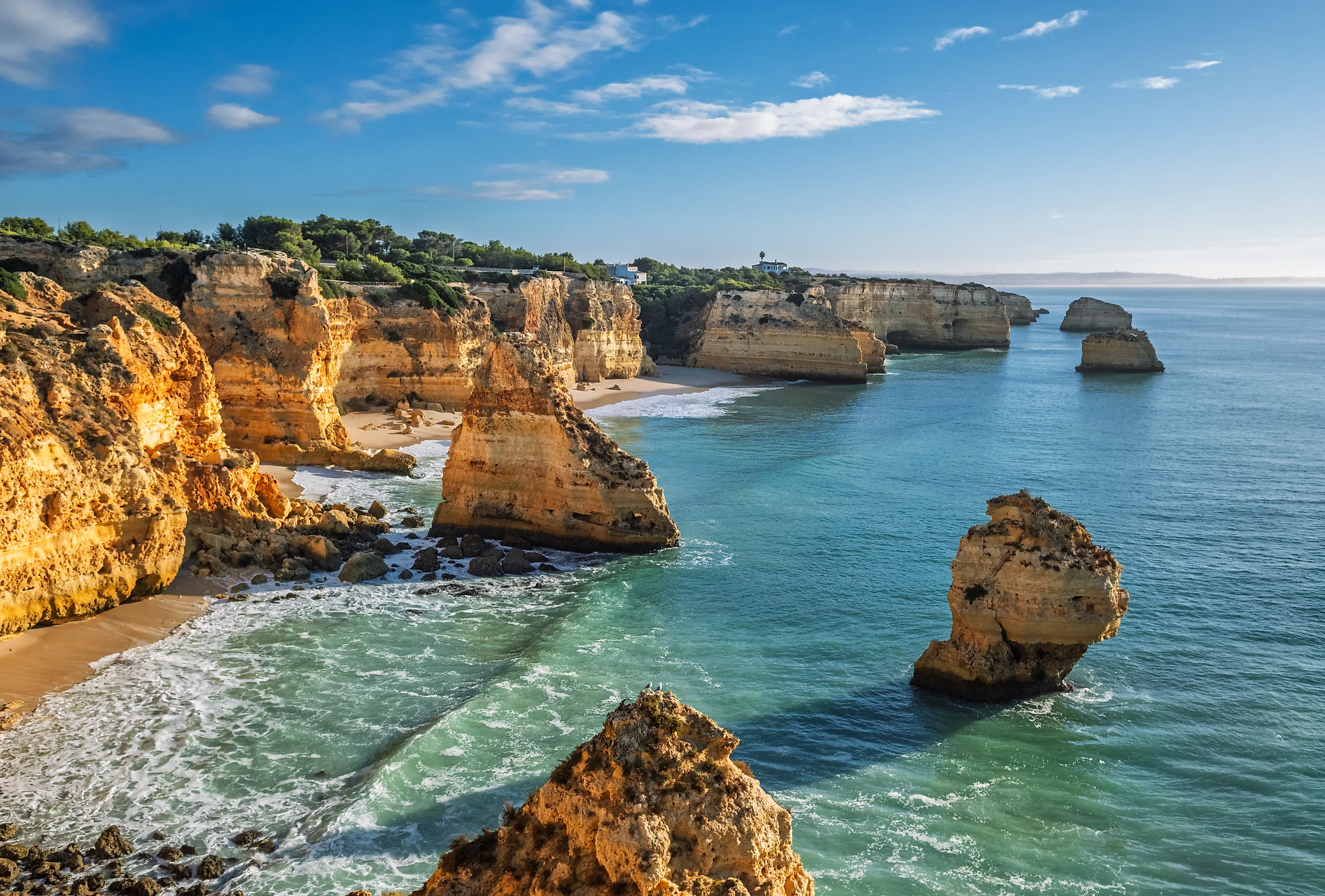
With its eroded cliffs and sea stacks, Praia da Marinha offers another view of the Algarve's coastline. Portugal's official tourism authority recognizes the beach area for its preserved natural setting. Praia da Marinha is a sheltered cove area surrounded by the bright blue ocean. The calmer waters make it a perfect location for swimming, snorkeling, and kayaking. Most fascinating about the area in Caramujeira is its untouched feel, unlike other popular beach towns that often get overrun by hotels and big buildings.
More than just a beach, the irregular cliffs hanging above the shore records the impacts of the Atlantic waves, wind, and rain over the years. While resistant sections of rock remain as pillars and sea stacks, the softer areas gradually erode and contribute to the geological processes that produce rock formations along the popular Portuguese coast.
One of the most famous spots within the natural sculpture garden is the Double Sea Arch on the western edge that is shaped similar to a heart, and is known by locals as O Coracao do Algarve. Another highlight among the rock formations is the "M" rock cathedral that was formed out of rock pillars jutting out from shallow waters. Peak summer months are extremely busy due to the warmer weather and ocean temperature, so visiting between September to October may find the beach less crowded.
Cabo de Sao Vicente

Standing at Cabo de Sao Vicente feels like reaching the edge of the earth. The cape forms a dramatic headland where Southwestern Portugal meets the Atlantic Ocean. Rugged cliffs and exposed rock rise above the sea to create one of the most striking coastal landscapes in the Algarve. It was previously thought as the farthest spot in the world from the Greeks and Romans, given that the only view you can see is miles and miles of ocean.
The cliffs form part of a protected landscape of the Southwest Alentejo and Vicente Coast Natural Park. The region contains a mix of plant communities and habitats that are unique in their thriving capabilities in such a harsh environment. Despite the exposed conditions, the land supports plant diversity and important habitats for bird species. The nearby Vicente Coast offers access to sections of the Rota Vicentina, a network of walking routes that follow the Portuguese coastline.
Ria Formosa Natural Park

Ria Formosa protects one of the Algarve's most important coastal wetland systems. The natural park is a wonder, stretching about 60 kilometers along the water and covers approximately 18,400 hectares through the municipalities of Loule, Faro, Olhao, Tavira, and Vila Real de Santo Antonio. Around 11,000 hectares of the area consists of a lagoon system with channels, marshes, and salt pans. One unique aspect of the natural park is that it is constantly changing with the tides. Some parts remain submerged while others emerge and expose mudflats that help support marine life. Barrier islands and sandy peninsulas shelter the lagoon from the Atlantic, and creates a network of calmer water.
The area is also an important habitat for birds and marine species. The wetlands support migratory birds traveling between Europe and Africa, while the shallow waters provide nursery areas for fish species. The park supports traditional activities such as shellfish farming, fishing, and salt production that remain connected to the lagoon environment. Visitors can explore the nature park by boat, walking trail, or bicycle route. There is beach access on the barrier islands such as Ilha Deserta, Ilha da Culatra, Ilha da Armona, and Ilha de Tavira.
Peneda-Geres National Park

Of all Portugal's protected areas, only Peneda-Geres holds national park status, and it is also the country's largest continuous protected mountain landscape. The space covers about 70,000 hectares across northern Portugal and includes the Peneda, Soajo, Amarela, and Geres mountain ranges. A combination of granite mountains, plateaus, valleys, forests, rivers, and waterfalls make up the traditional rural landscape. The incredible scenery is provided by the foundation of the park's geology. The wider Geres-Xures Transboundary Biosphere Reserve extends across Portugal and into the Galicia region of Spain, with the UNESCO identified Nevosa among the reserve's major peaks at 1,556 meters.
The natural terrain contains historical importance with evidence of human activity dating back thousands of years. Visitors can encounter megalithic monuments, medieval structures, and sections of a Roman road. These features demonstrate how communities adapted to the mountainous environment over time without eliminating its dominant natural character. Peneda-Geres also supports wildlife that has become increasingly difficult to find in other regions of Portugal. The park provides habitat for the Iberian wolf and roe deer, along with free-roaming garrano ponies and wild boar. The forest is home to native oak woodland and rivers that add to the varied ecosystem.
Portugal's Natural Appeal
The natural wonders of Portugal reveal the country's geological and ecological diversity across the Azores, Madeira, and mainland Portugal. The Douro Valley demonstrates how rivers and mountains can shape an internationally recognized cultural landscape. The Benagil Cave and Praia da Marinha show the continuing effects of erosion along the Algarve coast. Ria Formosa protects a complex tidal wetland, and the harsh elements of the Atlantic edge are highlighted at Cabo de Sao Vicente.
The Azores provide a different expression of Portugal's landscape. Vila Franca Islet preserves the crater of an ancient volcano and Furnas Lake sits atop geothermal activity that influences the area's environment and traditions. Madeira is home to Fanal, land that preserves part of the old Laurisilva forest. The north is captivated by the Peneda-Geres National Park that protects the extensive mountain ecosystem.