9 Offbeat Portugal Towns To Visit In 2026
Portugal has no shortage of postcard-perfect towns, but some of its most memorable places are also its strangest. In Monsanto, houses squeeze beneath giant granite boulders; in Piódão, dark schist walls are broken up by bright blue doors; and in Podence, masked Caretos thunder through the streets wearing belts of cowbells during Carnival. Elsewhere, prehistoric art remains carved into open-air rock faces, marble appears underfoot across an entire town, and medieval streets double as a literary hub. All with populations below 50,000, these offbeat Portuguese towns reveal a side of the country shaped by unusual landscapes, traditions and more.
Monsanto

Monsanto looks as though the village was built around the landscape rather than on top of it. Huge granite boulders sit between houses, form parts of walls, and in some cases function almost like roofs. The result is a settlement where architecture and geology are difficult to separate.
The best way to experience Monsanto is simply to walk through its steep lanes and look for homes squeezed beneath or between the rocks. Higher up, Monsanto Castle overlooks the surrounding countryside and adds another dramatic layer to the village. Travelers visiting around early May may also encounter the Festa das Cruzes, a local celebration tied to legends of a medieval siege. The climb toward the castle provides broad views across central Portugal, but the village's strangest attraction remains at street level: houses that seem to disappear directly into the granite.
Piódão

Piódão has one of Portugal's most distinctive color palettes. The mountain village is built largely from dark schist, giving its houses, walls, and streets a nearly uniform gray-brown appearance. Against that background, bright blue doors and window frames stand out everywhere.
Visitors can wander the tightly packed schist lanes, stopping to notice how the buildings seem to stack against the hillside. The blue-painted doors have become part of Piódão's identity, with a local story claiming that the village's isolation once meant the local shop stocked only blue paint. The white Igreja Matriz de Nossa Senhora da Conceição provides a striking contrast to the darker houses, while nearby trails lead into the Serra do Açor. Piódão is small enough to explore slowly, making its unusual architecture the main attraction rather than something seen between larger sights.
Podence

Podence is quiet for much of the year, but during Carnival, it becomes the center of one of Portugal's most unusual folk traditions. The Caretos de Podence wear vivid fringed costumes, metal or leather masks, and belts loaded with cowbells as they run through the streets during the winter festivities.
The tradition is recognized by UNESCO as Intangible Cultural Heritage and remains closely tied to local community participation. Visitors during Carnival can watch the Entrudo Chocalheiro, when Caretos fill the village with noise, movement, and color. Outside festival season, the Casa do Careto explains the masks, costumes, and history behind the tradition. Podence also lies within the Terras de Cavaleiros UNESCO Global Geopark, giving travelers an opportunity to explore the unusual geology surrounding the village. Few Portuguese destinations combine folklore and landscape in quite the same way.
Miranda do Douro

Miranda do Douro feels culturally different from much of Portugal because the region preserves its own language and traditions. Mirandese, which has official recognition in its traditional territory, can still be heard in local speech, seen in signs, heard in music, and seen at cultural events.
One of the best-known regional traditions is the Pauliteiros de Miranda, a form of folk dancing in which performers strike wooden sticks together while accompanied by traditional music. Visitors can also explore the imposing Miranda do Douro Cathedral, whose scale seems surprising in a small border town. Beyond the center, viewpoints overlook the steep cliffs of the Douro International landscape along the Spanish frontier. Between its minority language, stick-dancing tradition, monumental cathedral, and dramatic geography, Miranda do Douro provides an offbeat experience rooted more in living culture than novelty attractions.
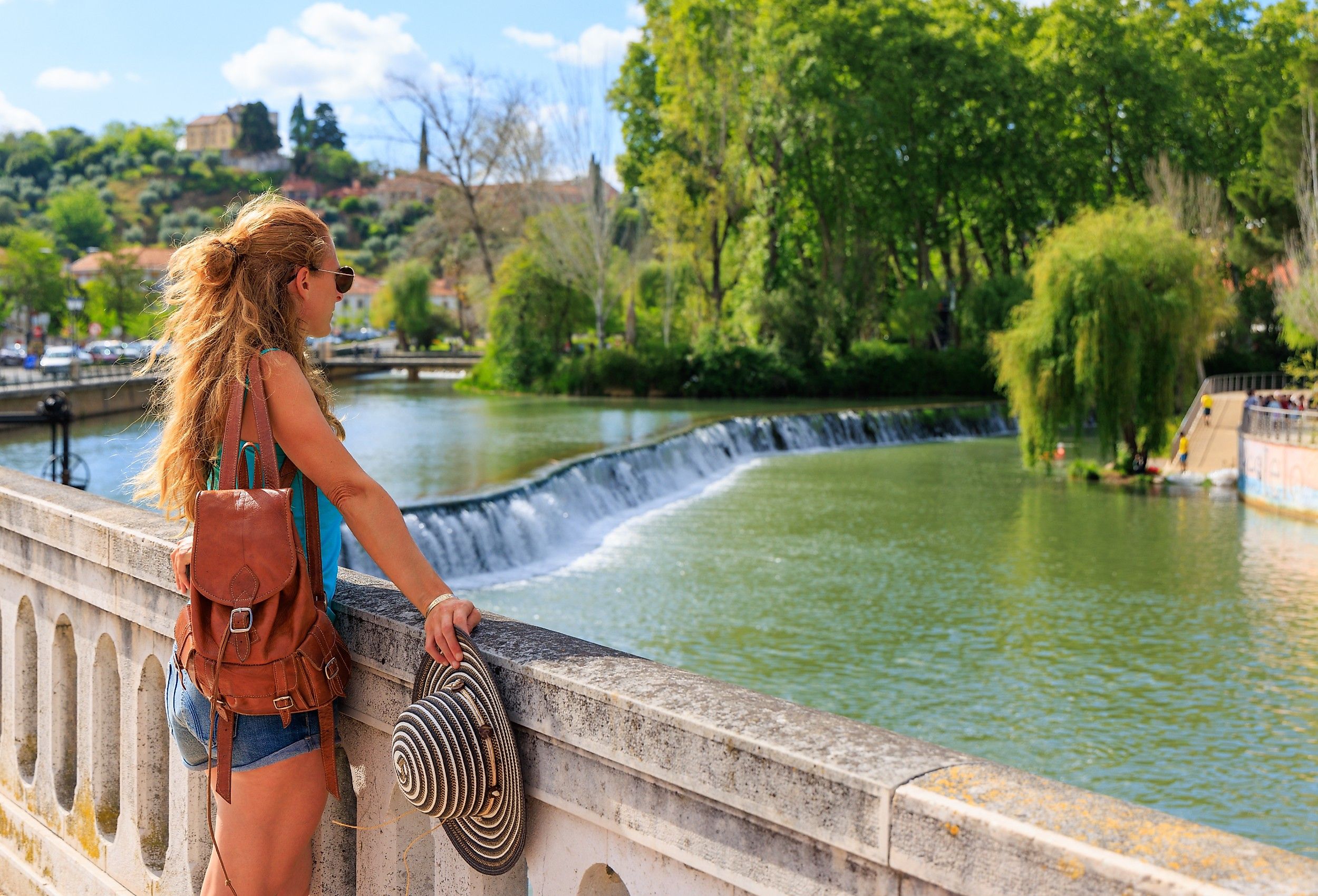
Tomar

Tomar's unusual identity is tied to the Knights Templar, who established a stronghold here in the 12th century. Their legacy survives most clearly at the Convent of Christ, a vast complex that evolved over centuries as the Templars' Portuguese successors became the Order of Christ.
Inside, the circular Charola is one of the most distinctive spaces in Portuguese architecture, reflecting the Templars' connections with sacred architecture in the eastern Mediterranean. Travelers can also explore the adjoining Templar Castle, whose walls still dominate the hill above town. In the historic center, the Synagogue of Tomar preserves another important chapter of local history, while the wooded Mata dos Sete Montes provides a quieter walk below the convent. Tomar is not simply a town with an old castle; its entire historic identity is tied to one of medieval Europe's most famous military-religious orders.
Óbidos

Óbidos may look like a conventional medieval town at first, but books have given it a much stranger modern identity. The walled settlement is recognized as a UNESCO Creative City of Literature, and bookshops occupy spaces that would normally serve very different purposes, including historic buildings and former religious structures.
Walking the medieval walls remains one of the best ways to appreciate the town, but the unusual bookstores are what separate Óbidos from many other Portuguese hill towns. Visitors can also sample ginjinha, a sour-cherry liqueur often served locally in small chocolate cups. The annual FOLIO International Literary Festival brings authors, readers, exhibitions, and performances into the historic center. Óbidos, therefore, manages an unusual combination: medieval walls, literary culture, unconventional bookshops, and a drink that comes with an edible cup.
Estremoz

Estremoz stands out because of the material beneath it. The surrounding region is one of Portugal's major marble-producing areas, and local stone appears throughout the town in buildings, fountains, pavements, doorways, and monuments.
Travelers can start in the upper town at Estremoz Castle, where the tall Torre das Três Coroas dominates the skyline. From there, walking downhill reveals how frequently marble appears in everyday architecture rather than only in major monuments. The broad Rossio Marquês de Pombal forms another important public space, while the Saturday market brings vendors selling produce, antiques, ceramics, and regional goods into the center. Estremoz's eccentricity is subtle, but once visitors start noticing the marble beneath their feet and around nearly every corner, the town's material identity becomes hard to miss.
Vila Nova de Foz Côa

The countryside around Vila Nova de Foz Côa contains one of Europe's most extraordinary archaeological landscapes. Thousands of prehistoric figures were carved into exposed rock surfaces in the Côa Valley, creating an open-air gallery of Paleolithic art.
Unlike famous cave paintings hidden underground, many of the Côa engravings remain in the landscapes where prehistoric people created them. Guided visits take travelers to protected rock-art sites where animals and other figures can still be seen in situ. The Côa Museum provides context for the carvings, archaeology, and environment before or after a site visit. Travelers can also take in viewpoints across the Côa and Douro valleys, where the surrounding terrain helps explain why the location is so unusual. For an offbeat trip, few experiences compare with seeing Ice Age artwork still exposed on rocky hillsides.
Sortelha

Sortelha feels unusually self-contained. Granite houses, narrow lanes, castle walls, and enormous natural rocks all sit within or immediately around the medieval fortifications, making the settlement resemble a stone enclosure preserved almost intact.
Visitors can climb through Sortelha Castle, then walk sections of the fortified walls for views over the surrounding landscape. Inside, the granite houses and lanes preserve the town's medieval character without the need for elaborate attractions. Large boulders and strange rock formations appear around the settlement, reinforcing the sense that the village grew directly out of the terrain. Sortelha is less about checking off museums than moving through an unusually complete stone environment, where houses, defences, streets, and natural rock all seem to belong to the same structure.
Portugal Beyond The Expected
Portugal's most offbeat small towns are unusual for very different reasons. Monsanto and Sortelha merge architecture with massive granite formations, while Piódão is defined by dark schist and flashes of blue. Podence preserves masked Carnival traditions, Miranda do Douro maintains its own language and folk dances, and Tomar carries the legacy of the Knights Templar. Óbidos has turned a medieval town into a literary destination, Estremoz displays marble almost everywhere, and Vila Nova de Foz Côa brings prehistoric art out of caves and into the open landscape. Together, these nine towns show that some of Portugal's most memorable places are also its strangest.