5 Rattlesnake Hotspots In Ontario
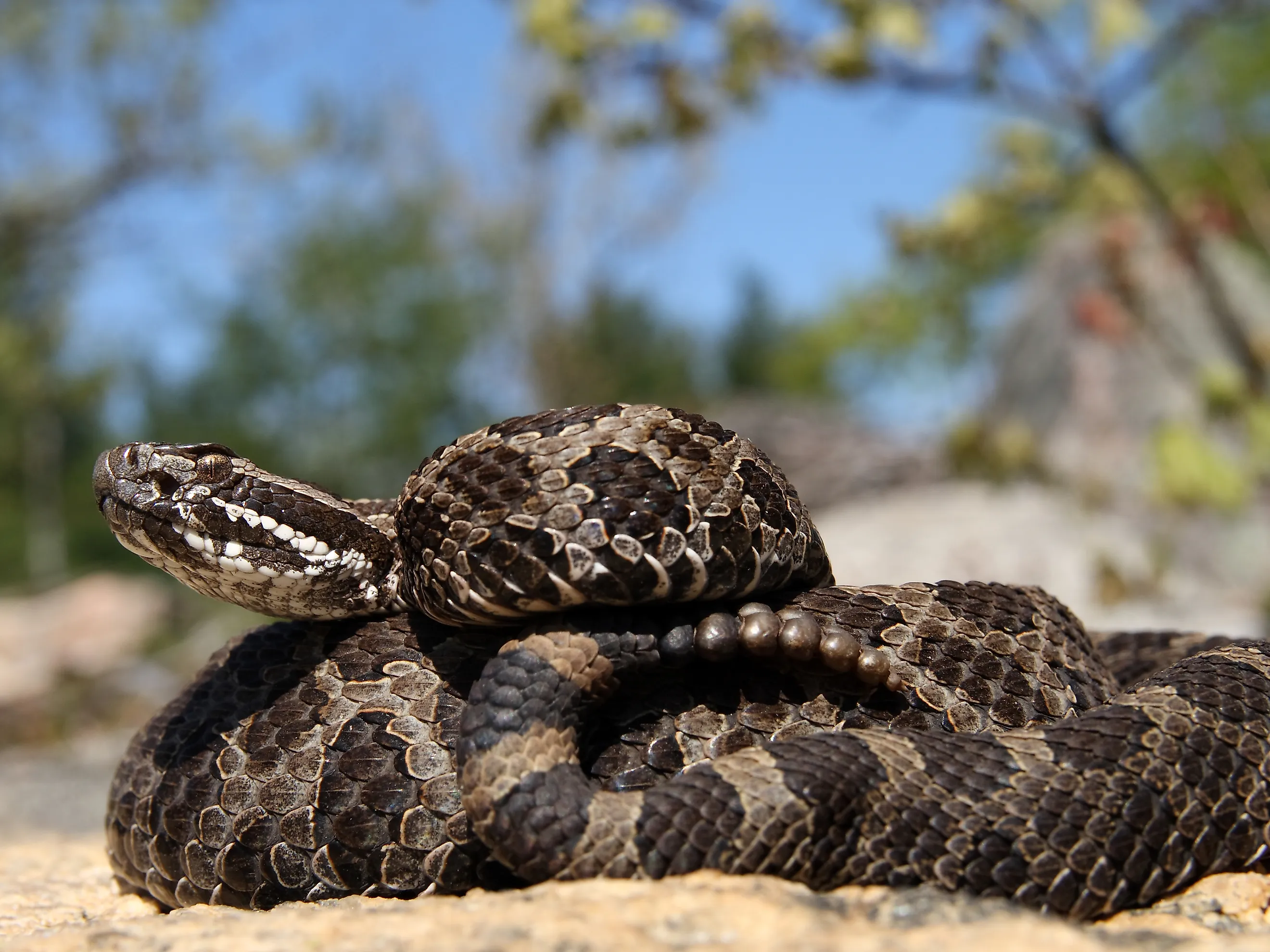
Ontario is home to its only venomous snake, the eastern Massasauga (Sistrurus catenatus), one of three rattlesnake species found in Canada and the only one that lives in Ontario. Rarely exceeding two and a half feet in length with grey-brown blotches running along its back, the Massasauga is easy to miss among its habitat of lichen-covered rocks, bogs, and sedge meadows. Its tail ends in a small rattle that produces a dry buzzing sound when threatened, though this timid snake's first instinct is almost always to stay still and rely on its camouflage. It can deliver a deadly bite. Still, this snake would much prefer to avoid confrontation.
The Canadian population of about 10,000 to 16,000 individuals is split into two groups with the Great Lakes - St. Lawrence group listed as Threatened and the Carolinian population listed as Endangered under Canada's Species at Risk Act. Their historic range has shrunk considerably. These vulnerable snakes still persist in a few strongholds: the eastern Georgian Bay shoreline, the Bruce Peninsula, the North Shore of Lake Huron, and Wainfleet Bog near Port Colborne. The Carolinian population that historically lived within the tall grasslands of the Ojibway Prairie Complex is nearing extinction, with no wild individuals recorded since 2019. Recovery efforts are currently focused on captive breeding programs with the eventual goal of reintroduction.
For the wild populations that remain, five parks and reserves protect a significant portion of their territory and include parts of the Canadian Shield shoreline, Great Lakes alvars, and isolated Canadian bogs. As an ambush predator of small mammals, and prey in turn for hawks, herons, and foxes, the Massasauga occupies a middle rung of the food web wherever the species survives. Increasingly, this is only in these handful of protected areas.
Bruce Peninsula National Park

Bruce Peninsula National Park represents one of the most concentrated rattlesnake territories in Ontario. Parks Canada identifies the park's 60 square miles (156 square kilometers) as one of the last remaining strongholds for this at-risk rattlesnake, which was once widespread across the province.
The snakes are active from early spring through late fall, and visitors are most likely to encounter them sunning themselves on open rock outcrops along trail corridors. A Massasauga needs external heat to digest food and regulate its body temperature, so on cool mornings it presses its entire body flat against sun-warmed limestone and lies motionless for hours. The Cyprus Lake area, including the rocky sections of the Georgian Bay Trail, is particularly ideal habitat for thermoregulation. The trail passes through the exact combination of open limestone barrens, cedar forest, and wetland edges that Massasaugas use to sun themselves, den, and hunt meadow voles.
According to Parks Canada, a study conducted at the park found that Massasaugas only rattled 40 percent of the time when approached by humans. The rest of the time, they relied on camouflage to stay hidden. The park has installed ecopassages on Cyprus Lake Road and Emmett Lake Road specifically to reduce road mortality, which has been identified as the most significant threat to the local population.
Killbear Provincial Park

Of all Ontario's provincial parks, Killbear is the most reliable place to encounter a Massasauga rattlesnake. Signs reading "Please Brake for Snakes" line roads across parts of the park. Staff run daily Snake Talks, and the Discovery Centre houses a live Massasauga ambassador for visitors to observe.
The park's Kilcoursie Swamp Nature Reserve of sedge meadow surrounded by black ash swamp provides critical hibernation habitat for the species. These snakes overwinter communally in rock fissures and crayfish burrows just below the frost line. Sometimes they gather in the dozens in a single hibernaculum, emerging in April when soil temperatures climb above 50 degrees Fahrenheit. Massasaugas at Killbear use the granite and pine landscape in a predictable pattern. They bask on warm rock surfaces in the morning and late afternoon. Then, they retreat to adjacent wetlands to hunt.
The Friends of Killbear organization have funded a dedicated snake researcher position since 2013. Park staff have installed about four miles of exclusion fencing along park roads to reduce road mortality. Research conducted at the park concluded that without those ecopassages, the rattlesnake population could have disappeared within 20 years. For sightings, the park asks visitors to call 705-342-5492 and watch the snake from a safe distance until staff arrive.
The Massasauga Provincial Park

The only Ontario provincial park named directly after the snake, The Massasauga Provincial Park on eastern Georgian Bay protects a significant part of the Massasauga population in Canada. The park's name also carries Ojibwe roots. "Massasauga" means "mouth of the river" in the Ojibwe language, a fitting description for the park's location at the mouth of the Moon River.
Because the park has no roads, access is entirely water. This creates a wilderness character that most Georgian Bay parks cannot match. Paddlers navigating to interior campsites or along the bay coastline are entering prime snake country. The Massasauga hunts those wetland edges at dusk, tracking meadow voles and young muskrats through the sedge using heat-sensing pit organs located between each eye and nostril.
Rocky shorelines, exposed bedrock barrens, and the wetland edges between them are excellent Massasauga habitat. The Nipissing-North Arm Orienteering Trail passes through some of the most remote sections. This is snake habitat on its own terms, undeveloped, waterlogged, and full of the crevices, rodent burrows, and open rock areas the snakes depend on for overwintering and hunting.
Georgian Bay Islands National Park

Georgian Bay Islands National Park is one of the few places in Canada where the Massasauga rattlesnake, named Zhiishiigweg in Anishinaabemowin, still persists. The park's Massasauga Recovery Team works directly with the provincial government and conservation authorities to protect them. The park has played a central role in reducing the indiscriminate killing of Massasaugas that was common until the 1970s. They launched an on-site and community based education program that is now credited with dramatically reducing persecution of the species in the region. Park staff also coordinate with partners to track deaths on Honey Harbour Road and South Bay Road, mapping crossing hotspots to inform future wildlife crossing infrastructure.
Beausoleil Island, the park's main island, is the focal point for snake activity. Rocky shorelines and the transition zones between meadows and exposed granite ridges are where sightings are most likely. Beausoleil Island itself has been recognized as an Important Amphibian and Reptile Area by the Canadian Herpetological Society. The park's hiking trails and canoe routes cross both the Canadian Shield northern section and the more wooded southern end of the island. Both environments host snakes depending on the season. The park is only accessible by water taxi from Honey Harbour, which limits visitor traffic and leaves large sections of the island in the low-disturbance state that the species needs to thrive.
Wainfleet Bog Conservation Area

Wainfleet Bog is the most southerly Massasauga site in Canada and arguably the most ecologically isolated one. The bog formed atop 10,000 years of sphagnum accumulation since the last glaciation, creating an acidic and waterlogged environment that supports carnivorous sundew plants alongside the snakes. This area is home to a small population that is genetically and geographically distinct from the Georgian Bay snakes. The federal government's COSEWIC 2025 status report lists Wainfleet as one of the recognized subpopulations of the Eastern Massasauga in Canada. An estimation of 40 to 70 mature individuals remain at the site.
The bog lies about a mile from the north shore of Lake Erie in the Niagara Regional Municipality, straddling the boundary of Wainfleet Township and the City of Port Colborne. This subpopulation is listed as Endangered, a stricter designation than the Threatened status applied to the Georgian Bay populations. The habitat here is fundamentally different from the granite and pine Georgian Bay landscape. Wainfleet is peat wetland, where sphagnum moss, sedge meadow, and scrub forest provide the structure these snakes use for hunting, thermoregulation, and denning. The area is managed by the Niagara Peninsula Conservation Authority. Visitor access is limited to protect the vulnerable population. Any sightings should be reported to the Natural Heritage Information Centre at Ontario Nature's reptile-amphibian atlas.
The Remaining Habitats of the Massasauga Rattlesnake

These five parks are some of the last functioning Massasauga rattlesnake habitats, which have been contracting for over a century. Protecting these snakes and their territory also helps a wide cast of other at-risk species that share the same wetlands, alvars, and granite basins.
The continued conservation work in these parks is critical to a healthy ecosystem across an increasingly fragmented landscape. Visitors to these parks can assist in this effort through respecting the snake's space, driving slowly and carefully to help reduce road mortality, and reporting sightings to help researchers understand where the population is concentrating.