10 Of The Oldest Castles In Europe You Can Actually Visit
- The Citadel of Aleppo is the oldest castle in the world, with some parts of the structure dating back to 3000 BC.
- Built in 1070 AD, Windsor Castle is the oldest castle that is still actively used today.
- Prague Castle is the largest castle in the world at 70,000 square meters.
Here is a fun thing about castles: a lot of the "oldest" ones you read about are either piles of rubble you admire from behind a fence, or somebody's very private home. This list is different. Every castle here is genuinely old, genuinely a castle, and genuinely open to you, ticket in hand. One honesty note before we start: pinning down a castle's exact birthday is tricky, since most were built in fits and starts over centuries, so treat these dates as "first solid evidence" rather than a firm ribbon-cutting. We are going oldest first, which means we begin more than eleven hundred years ago, in Prague.
Prague Castle

We are starting with a record-holder. Founded around 880 AD, Prague Castle in the Czech Republic is not just old, it is enormous, holding the Guinness World Record for the largest ancient castle on Earth at some 70,000 square meters. That is less a castle than a small walled town, and eleven centuries of owners each left a mark, so one walk takes you past Romanesque stonework, a soaring Gothic cathedral, and Renaissance halls without ever leaving the grounds. It is still the official seat of the Czech president, and yes, you can wander most of it.
The Alhambra

The hilltop the Alhambra sits on in Spain was first fortified all the way back in 889 AD, which is where its "oldest" credentials come from. But here is the twist worth knowing before you go: the showpiece palace you actually tour, all honeycomb ceilings and courtyards full of fountains, is mostly the work of the Nasrid dynasty in the 1200s and 1300s. So it is an ancient site wearing a younger and dazzling outfit. Book well ahead, because it is one of the most visited monuments in the world and tickets sell out fast.
Guimaraes Castle

Swapped into this list for good reason, Guimaraes Castle is where Portugal was, more or less, born. Countess Mumadona Dias had it built around 968 AD to shield a local monastery from Viking and Moorish raids, and a century and a half later it became the stronghold of the counts who would forge an independent kingdom. The first king of Portugal is said to have spent his childhood here, and the castle is stamped right onto the national coat of arms. Locals call it the "cradle of the nation," and the walls still carry a blunt inscription: "Portugal was born here." It is a national monument now, open daily.
Chateau de Foix

Our second newcomer perches on a rocky crag above the town of Foix in southern France, and it has stood there, on paper at least, since 987 AD. For centuries it was the seat of the powerful Counts of Foix, and during the brutal Albigensian Crusade of the 1200s it was besieged three separate times by Simon de Montfort and shrugged off every attempt. The fighting is long gone but the towers remain, and the castle now doubles as the Ariege departmental museum, so you can climb the medieval towers and dig through the history in a single visit.
Reichsburg Cochem

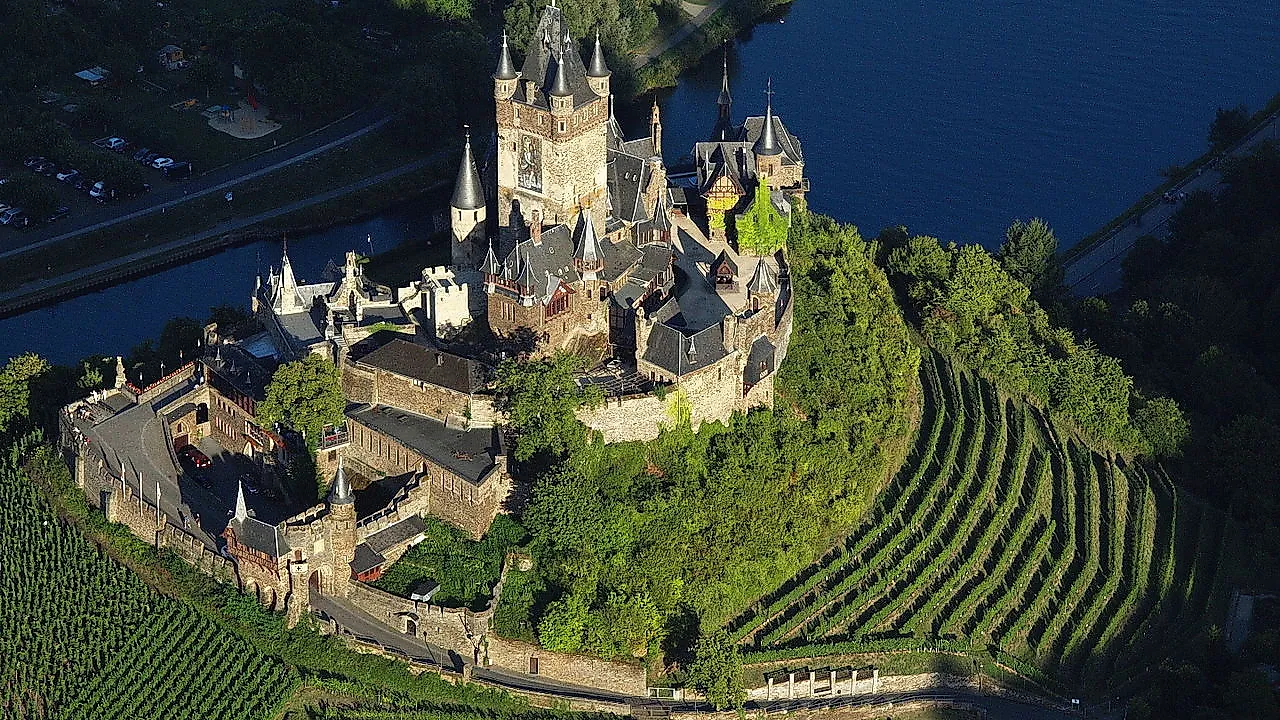
Rising over the Moselle River in Germany, Reichsburg Cochem is thought to date to around 1000 AD, and it has had a rough ride. French troops blew much of it up in 1689, and it sat as a ruin for nearly two centuries until a wealthy Berlin businessman bought the shell in the 1860s and rebuilt it in romantic neo-Gothic style. So what you tour today is part genuine medieval fortress and part nineteenth-century daydream about what a medieval fortress ought to look like. The town of Cochem owns it now and runs tours, and the views over the river vineyards alone are worth the climb.
Warwick Castle

When William the Conqueror swept into England after 1066, he threw up castles fast to hold his new kingdom, and Warwick, begun in 1068, was one of them. It housed the Earls of Warwick for the better part of nine centuries before something very modern happened: in 1978 the Tussauds Group bought it and turned it into a full-blown attraction. That means Warwick leans harder into the "experience" than anything else here, with jousting, birds of prey, and costumed everything, which is either great fun or a bit much depending on your tolerance for a man in chainmail shouting about trebuchets.
Windsor Castle

Also courtesy of William the Conqueror, Windsor Castle went up around 1070 and then simply never stopped being used, which earns it the title of the oldest and largest occupied castle in the world. Nearly a thousand years of monarchs have tinkered with it, expanded it, and moved in, and it is still a working royal residence today. The payoff for visitors is real: when the royals are away, you can tour the State Apartments and St. George's Chapel, and few places let you stand inside a building that has been in continuous royal use since the Normans.
Hohenwerfen Fortress

Perched on a rock above the Salzach valley in Austria, not Germany as it is sometimes miscredited, Hohenwerfen has guarded the approach to Salzburg since about 1077, when a local archbishop had it built. It started as a timber fort and was steadily rebuilt in stone over the centuries. Film buffs may find it oddly familiar, since it has turned up on screen more than once, most famously in the movie "Where Eagles Dare." Today you can ride up, tour the fortress, and, in a very Austrian touch, catch a live falconry show from the old hunting grounds.
Rochester Castle

Down in Kent, Rochester Castle replaced an earlier timber one around 1087, and its towering stone keep, added a few decades later by an archbishop of Canterbury, is one of the best-preserved in the country. Its most dramatic day came in 1215, when rebel barons held it against King John, who besieged them for weeks and finally cracked a corner of the keep by tunneling underneath and setting the props alight, using, as the story goes, the fat of forty pigs. The barons surrendered, the fallen corner was rebuilt round rather than square, and you can still spot the join today.
Alcazar of Segovia

We finish with the youngster of the group, though "young" here still means first documented in 1120 AD. The Alcazar of Segovia began as a fortress and grew into a favorite residence of the Castilian monarchs, who kept piling on towers and turrets until it ended up looking less like a castle and more like the prow of a stone ship sailing out over the plain. If that silhouette feels familiar, it is widely said to have helped inspire the Disney castle, a fitting note to end on: proof that a nine-hundred-year-old fortress still shapes how we picture the word "castle" today. And yes, you can climb the tower for the view.
Old, real, and open to visitors: that is the entire checklist, and these ten clear it with centuries to spare. Whichever one you start with, you will be standing somewhere people have been defending, ruling, and rebuilding for the better part of a thousand years.