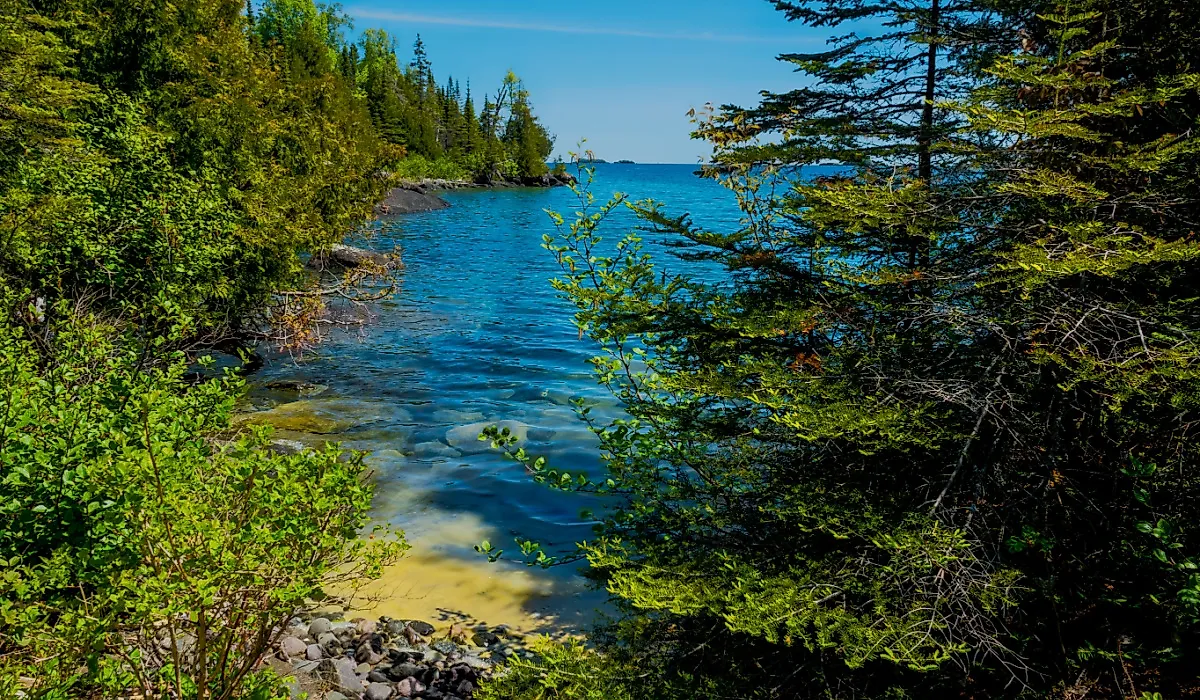
The Least Visited National Park East Of The Mississippi
Great Smoky Mountains National Park recorded 11,527,939 recreation visits in 2025, which works out to more than 31,000 people on an average day. Isle Royale National Park, a roadless island in northwestern Lake Superior, recorded 29,091 for the entire year, the fewest of any national park in the Lower 48. The only ways onto the island are by boat or seaplane, so a trip here starts with a ferry schedule long before it gets to a trail map, and once ashore, everyone gets around on foot or by paddle. That distance from the mainland keeps the crowds small, and it has kept the island's wildlife separated enough that researchers have tracked its wolves and moose since 1958 in the longest continuous predator-prey study in the world. Within the past decade, the island's wolves came close to disappearing altogether.
Most Of Isle Royale National Park Is Underwater

The park boundary around Isle Royale takes in 571,790 acres of northwestern Lake Superior near the Canadian border, and about three-quarters of that area is open water. The land inside it is one main island, about 45 miles long, plus more than 400 smaller islands, and 99 percent of it is designated wilderness or potential wilderness. The forest sits in a transition zone between boreal conifers and northern hardwoods, with long, linear ridges and valleys running across the main island.
The 40-mile Greenstone Ridge Trail follows the longest of those ridges down the center of the island, and hikers on it are walking on the Greenstone Flow, one of the largest lava flows on Earth. It formed during the Midcontinent Rift, which began about 1.1 billion years ago. The same rock holds copper, and people have come to the island for it for thousands of years; the earliest evidence of human use on Isle Royale comes from Archaic-period copper miners.
Isle Royale's Wolves Nearly Disappeared

Only 19 mammal species live on the archipelago, compared with more than 40 on the surrounding mainland, so every large animal here had to cross the lake to arrive. Moose reached the island in the early 1900s, and genetic data linking the herd to northwestern Minnesota has challenged the long-told story that the first ones swam over. Wolves came during the winter of 1948, walking across an ice bridge that formed between the island and the Canadian mainland.
Researchers from Purdue University began tracking both species in 1958, and the project, now run by Michigan Technological University, is the longest continuous study of any predator-prey system in the world. Over those decades the wolf count rose and fell, and between 2016 and 2018 it dropped to just two animals. The National Park Service relocated 19 wolves from the Great Lakes region to the island in 2018 and 2019, and today's population grew from those newcomers. The winter 2026 survey estimated 37 wolves on the island. The moose herd moved in the other direction, falling to about 524 animals, a 75 percent drop from its 2019 peak of roughly 2,000.
165 Miles Of Trail And No Roads

Isle Royale has 165 miles of trail and 36 campgrounds, and with no roads on the island, every mile between them is covered on foot. The Minong Ridge Trail is the hardest of them. The National Park Service describes it as a primitive trail that sees limited to no maintenance and recommends it for experienced backpackers who can navigate with a map and compass. With spur trails to campgrounds, the route runs more than 32 miles and usually takes about five days. The Stoll Memorial Trail is the easy counterpart, a figure-eight of between 1.9 and 4.2 miles that starts at Rock Harbor and ends on the rocky face of Scoville Point.
The interior lakes have calmer water, and canoe and kayak routes connect one lake to the next by portage, with the boat carried overland between them. Overnight paddlers need the same backcountry permit as backpackers, and sea kayakers with open-water experience can also follow the Lake Superior shoreline. A Michigan fishing license is required on Lake Superior but not on the interior lakes, and coaster brook trout are catch-and-release only in all park waters.
Four Lighthouses And Ten Historic Shipwrecks

Rocky reefs around the archipelago lie close to Lake Superior's shipping lanes, and the MV Sandy's Passage Island tour crosses one of those lanes on an 8-mile boat trip before a 2-mile round-trip hike to the Passage Island Lighthouse. That light was completed in 1882 and still guides ships. It is one of four lighthouses around the island, all listed on the National Register of Historic Places. Rock Harbor Lighthouse, the oldest, was completed in 1855 and went dark for good in 1879, and its keeper's house is now a museum and a regular tour stop. The Fresnel lens from the Rock of Ages Light, which began operating in 1908, is on display at the Windigo Visitor Center.
Ten shipwrecks around Isle Royale are listed on the National Register, and they went down over a span of 62 years, beginning with the SS Cumberland in 1871. Several hulls remain largely intact and draw experienced divers. One of them is the America, a package freighter that sank in the North Gap on June 7, 1928, after dropping off passengers at Washington Harbor; the Kamloops is another. The site of the Monarch, a package freighter wrecked in 1906, is visible from above the water on the MV Sandy's Raspberry Island sunset cruise.
Why So Few People Make The Trip

For most visitors, reaching Isle Royale means a long ride across open water. The National Park Service's Ranger III needs about six hours for the crossing between Houghton, Michigan, and Rock Harbor, and the Isle Royale Queen IV takes about three and three-quarter hours to cover the 55 miles from Copper Harbor. Isle Royale Seaplanes, based in Hubbell, Michigan, makes the trip in about 35 minutes, but a one-way flight costs more than twice as much as an adult round trip on the Queen IV. Every crossing depends on Lake Superior's weather, and the boats keep a short calendar. The park is open April 16 through October 31, yet the Ranger III sails only between the last week of May and the second week of September.
Once ashore, the options narrow further. Rock Harbor Lodge is the only full-service lodging, and two camper cabins at Windigo offer an alternative to a tent. There is no Wi-Fi service for visitors anywhere in the park, and the National Park Service warns that cell service is unreliable and should not be counted on for a trip. Rock Harbor and Windigo each have a satellite phone.
Planning A Trip To Isle Royale

The first decision is which end of the island to land on, because it determines the boat. Rock Harbor, on the east end, has the lodge, the Stoll Memorial Trail, and the MV Sandy, whose tours run early June through mid-September and can only be booked once you are on the island. It is served by the Ranger III from Houghton, the Isle Royale Queen IV from Copper Harbor, and the Voyageur II from Grand Portage, Minnesota. Windigo, on the west end, has the camper cabins and the visitor center with the Rock of Ages lens, and the Sea Hunter III and Voyageur II both reach it from Grand Portage. A backpacker hiking the full Greenstone Ridge Trail can land at one harbor and leave from the other, which means booking two different boats.
Every visitor pays an entrance fee of $7 per person per day, with children 15 and younger exempt, and a $60 season pass covers the full season. Anyone camping overnight needs a backcountry permit. Parties of six or fewer use a small-party permit and take campsites on a first-come basis, while groups of seven or more need a group camping permit and an advance reservation. With no Wi-Fi and unreliable cell service, download maps and ferry schedules before leaving the mainland, and check the park's annual newspaper, The Greenstone, for current rules.
Explore This Remote Wilderness Archipelago For Yourself

Isle Royale's 29,091 visitors in 2025 had 571,790 acres almost to themselves, and the wildlife they shared it with is in the middle of a sharp change. The wolves that nearly disappeared a decade ago have grown to an estimated 37 animals from the 19 the National Park Service brought over. A hiker on the Greenstone Ridge Trail today crosses an island with roughly a quarter of the moose that lived there in 2019. Researchers run their winter survey each year while the park is closed to visitors, and the most recent one ran between January 22 and March 3, 2026. The park closed on October 31 and reopens April 16, and the Ranger III typically returns in the last week of May.