The Largest Jellyfish Ever Recorded
The largest jellyfish ever recorded had tentacles stretching the length of three full-size school buses parked end to end. The lion's mane jellyfish (Cyanea capillata), found in Massachusetts Bay, holds the Guinness World Record for its incredible size. These enormous creatures live in cold northern waters, where their long tentacles act as a drifting net, capturing and immobilizing fish and other small marine animals. Some even drift into coastal waters where people swim, and their tentacles can deliver a painful sting.
The Giant Jellyfish Found Off Massachusetts

According to Guinness World Records, the largest jellyfish ever recorded was found in Massachusetts Bay in 1870. Its bell measured 7.5 feet across, and its tentacles extended approximately 120 feet. The bell is the rounded, umbrella-shaped body of the jellyfish. This specimen was unusually large, even without its incredibly long tentacles.
A similar account appeared several years earlier. In his 1865 publication, North American Acalephæ, marine biologist Alexander Agassiz described an enormous lion's mane jellyfish near Nahant, Massachusetts, with a bell measuring 7.5 feet across and tentacles extending more than 120 feet. Although the descriptions are remarkably similar, the discrepancy in the reported dates makes it difficult to determine whether they refer to the same specimen.

In another account published in 1865, Agassiz and his stepmother, Elizabeth Cary Agassiz, an educator and writer who later became the first president of Radcliffe College, described measuring a jellyfish from a rowboat. They laid an eight-foot oar across its body, then slowly backed the boat along its tentacles, using the oar to estimate its length. The jellyfish stayed near the surface of the water, apparently undisturbed. They estimated that its tentacles were approximately 112 feet long.
Present-day scientists have questioned the reliability of the historical 120-foot measurement. A 2015 study published in PeerJ examined records of unusually large marine animals and noted that Agassiz did not explain how he measured the specimen described in North American Acalephæ. Jellyfish tentacles are fragile and can stretch, contract, or break, which makes their original length difficult to confirm. The researchers also noted uncertainty surrounding the specimen's precise species identification, since some North American lion's mane jellyfish appear genetically distinct from their European counterparts. Despite these uncertainties, the Massachusetts specimen remains the Guinness World Record holder for the largest jellyfish ever recorded.
What Does A Lion's Mane Jellyfish Look Like?

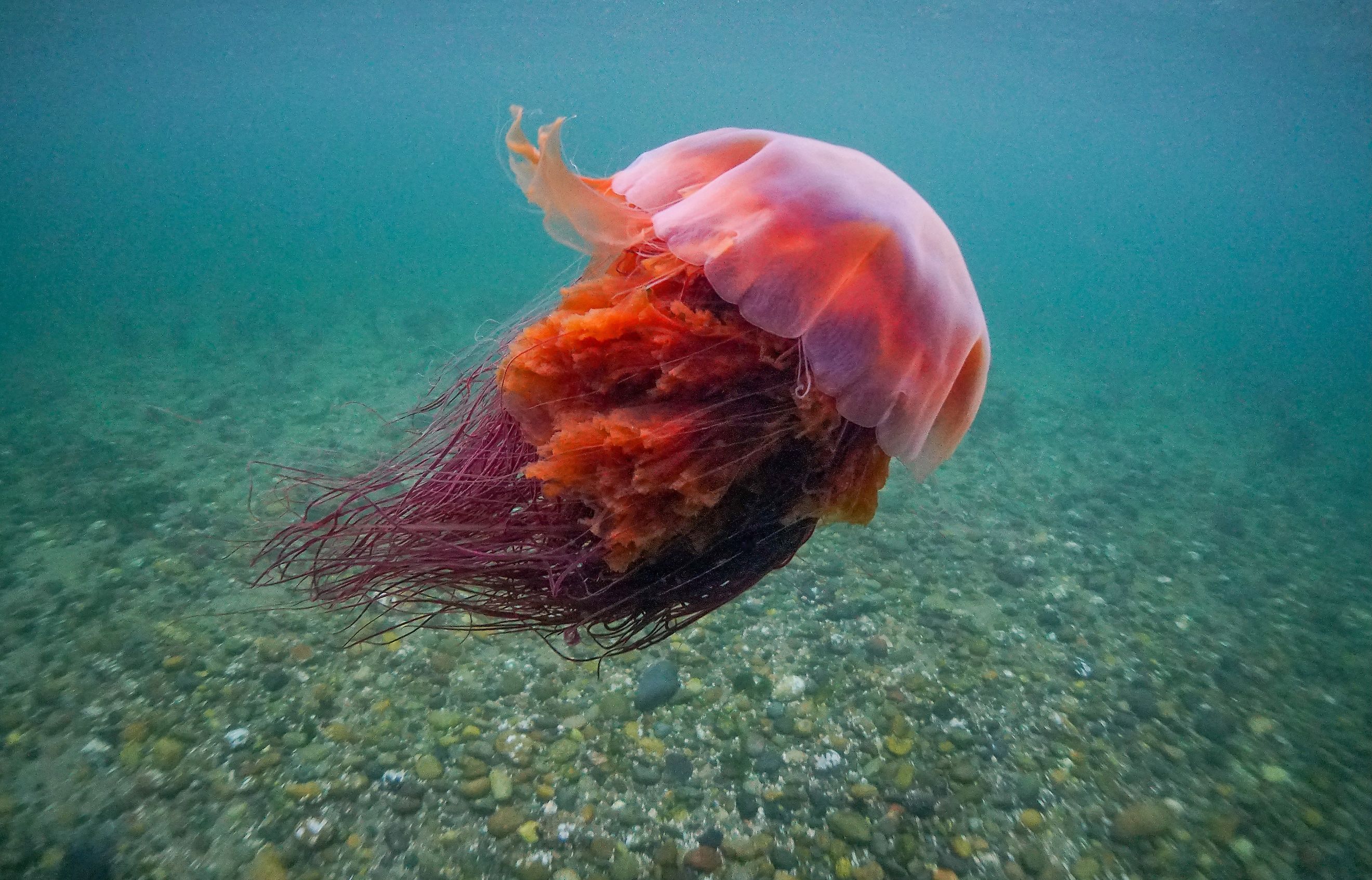
According to the Smithsonian Institution, lion's mane jellyfish commonly have bells around three feet wide, although some grow much larger. Their bells have sixteen lobes arranged in eight pairs, with clusters of long, fine tentacles hanging from them. Some jellyfish have more than 1,000 tentacles. Together, the strands resemble a lion's thick, flowing mane, which inspired the species' name.
Underneath the bell are broad, frilly appendages called oral arms, which the jellyfish uses to move food toward its mouth. Lion's mane jellyfish range in color from pale yellow and orange to deep red, brown, and violet. Younger jellyfish are generally lighter in color. The bell is gelatinous and sometimes translucent, which makes the jellyfish look deceptively delicate.
Where Do The World's Largest Jellyfish Live?

Lion's mane jellyfish inhabit the cold waters of the northern Atlantic and Pacific Oceans, as well as the Arctic Ocean. In the United States, they occur along the coasts of New England and Alaska. The Monterey Bay Aquarium reports that their Pacific range extends from Alaska to Washington, with occasional sightings farther south in California.
The largest individuals are generally found in cold northern waters, especially in Arctic regions. Those found farther south tend to be smaller. In the Chesapeake Bay, for example, they normally have bells measuring only a few inches across. The Virginia Institute of Marine Science reports that they appear in the lower bay in winter and early spring when the water is cooler.
How Does Such A Large Jellyfish Catch Its Food?

Lion's mane jellyfish use their long tentacles to capture small fish, crustaceans, plankton, and other jellyfish, including moon jellies. Their tentacles have cells called cnidocytes, which contain tiny stinging capsules called nematocysts. When triggered by contact with prey, the nematocysts discharge microscopic venomous threads that can immobilize the animal. The jellyfish then moves the catch toward its mouth beneath the bell.
Lion's mane jellyfish have predators of their own. Leatherback sea turtles feed on jellyfish, including lion's mane jellies, despite their stinging tentacles. These enormous turtles have backward-pointing spines called papillae lining their mouths and throats, which help prevent slippery prey from escaping as they swallow.
Can A Lion's Mane Jellyfish Sting Humans?

A lion's mane jellyfish can deliver a painful sting, and its nearly transparent tentacles can extend far beyond its visible body, making them difficult to see. A sting usually causes burning pain, redness, and skin irritation, although prolonged exposure or an allergic reaction can result in more severe symptoms. Even small jellyfish can sting.
A lion's mane jellyfish does not have to be alive to sting someone. The Woods Hole Oceanographic Institution warns that detached tentacles can still sting after separating from the animal. Even fragments washed onto a beach can sting if someone touches them.
Are There Jellyfish Even Bigger Than Lion's Mane?

There are other enormous jellyfish. Nomura's jellyfish (Nemopilema nomurai), found in waters around Japan, Korea, and China, can have a bell approximately six feet across and weigh more than 400 pounds, according to the Scripps Institution of Oceanography.
Other marine animals closely related to jellyfish can reach even greater lengths. Giant siphonophores, such as Praya dubia, can stretch more than 130 feet, longer than a blue whale. Unlike jellyfish, which are individual animals, siphonophores are colonies of genetically identical organisms called zooids. Each zooid has a specialized function. Some capture prey, others digest food or handle reproduction, and others help the colony move through the water. They function as a coordinated colony despite having no central brain.
A Record That Has Survived For More Than 150 Years
Despite questions about its original measurements and identification, the Massachusetts jellyfish has held its place in the record books for more than 150 years. Somewhere in the cold waters of the North Atlantic or Arctic Ocean, another giant may be drifting with tentacles long enough to challenge that record.