The Largest Lakes In The Rockies
The largest natural lake in the Rocky Mountains is in northwest Montana, where Flathead Lake covers 191.5 square miles below the Mission Mountains and the Swan Range. Montana's state parks agency calls it the largest natural body of freshwater by surface area in the western United States, and it is close to 60 square miles bigger than Yellowstone Lake, the Rockies lake most visitors picture first. The rest of the range's biggest lakes lie in Montana, Idaho, and Wyoming and along the Utah and Idaho line. On water this big, size shows up as ice that can take months to clear and as wind with miles of open water to build waves. On one lake in northern Idaho, the U.S. Navy tests submarine designs.
Flathead Lake, Montana

For a lake this size, a full freeze is rare. Flathead Lake last iced over from shore to shore in January 1989, and the ice held for 51 consecutive days. In March 2019, it came closer to freezing over than it had in 30 years, and still stopped short.
Out on the open water, the lake is big enough to hold a state park on an island. Wild Horse Island covers 2,160 acres, the largest island in a freshwater lake west of Minnesota, and it has no bridge, ferry, or public dock. Visitors arrive in their own boats, in kayaks, or on an outfitter's water taxi and come ashore at one of six landing sites. Bighorn sheep, mule deer, bald eagles, falcons, and a handful of wild horses live on the island, and camping, pets, and bikes are banned because they may spook the animals.
Lake Pend Oreille, Idaho

The U.S. Navy tests submarine designs on Lake Pend Oreille, in the Idaho Panhandle. Pend Oreille is 43 miles long, covers about 145 square miles, and drops to about 1,150 feet, and the Navy calls it Idaho's largest, deepest, and quietest body of water. At its research station in Bayview, on the southern end of the lake, engineers run acoustic tests without the problems and costs of working on the open ocean. Their Large Scale Vehicle-2, a large model of a Virginia-class submarine, is used extensively for propulsor research. The Navy has been on this shore before. Farragut State Park, at the lake's southern tip, occupies the grounds of the former Farragut Naval Training Station.
Yellowstone Lake, Wyoming

Yellowstone Lake sits at 7,733 feet, and the National Park Service calls it the largest high-elevation lake in North America. That altitude sets its calendar. The lake freezes completely every winter in late December or early January, and the ice usually does not break up until late May or early June.
When boating season opens, the park's lodge operator rents boats and runs guided trips from Bridge Bay Marina. The water is still in the 40s Fahrenheit in June, and the Park Service advises against swimming because of the cold. The lake's 132 square miles and 141 miles of shoreline also give wind room to build, and sudden gusts can raise dangerous waves.
The lake floor is active ground. Underwater hot springs, hydrothermal vents, steam explosion craters, and siliceous spires dot the bottom, and a canyon east of Stevenson Island drops to about 390 feet. Above them swims the largest population of wild cutthroat trout in North America, now threatened by lake trout that were introduced illegally.
Bear Lake, Utah and Idaho

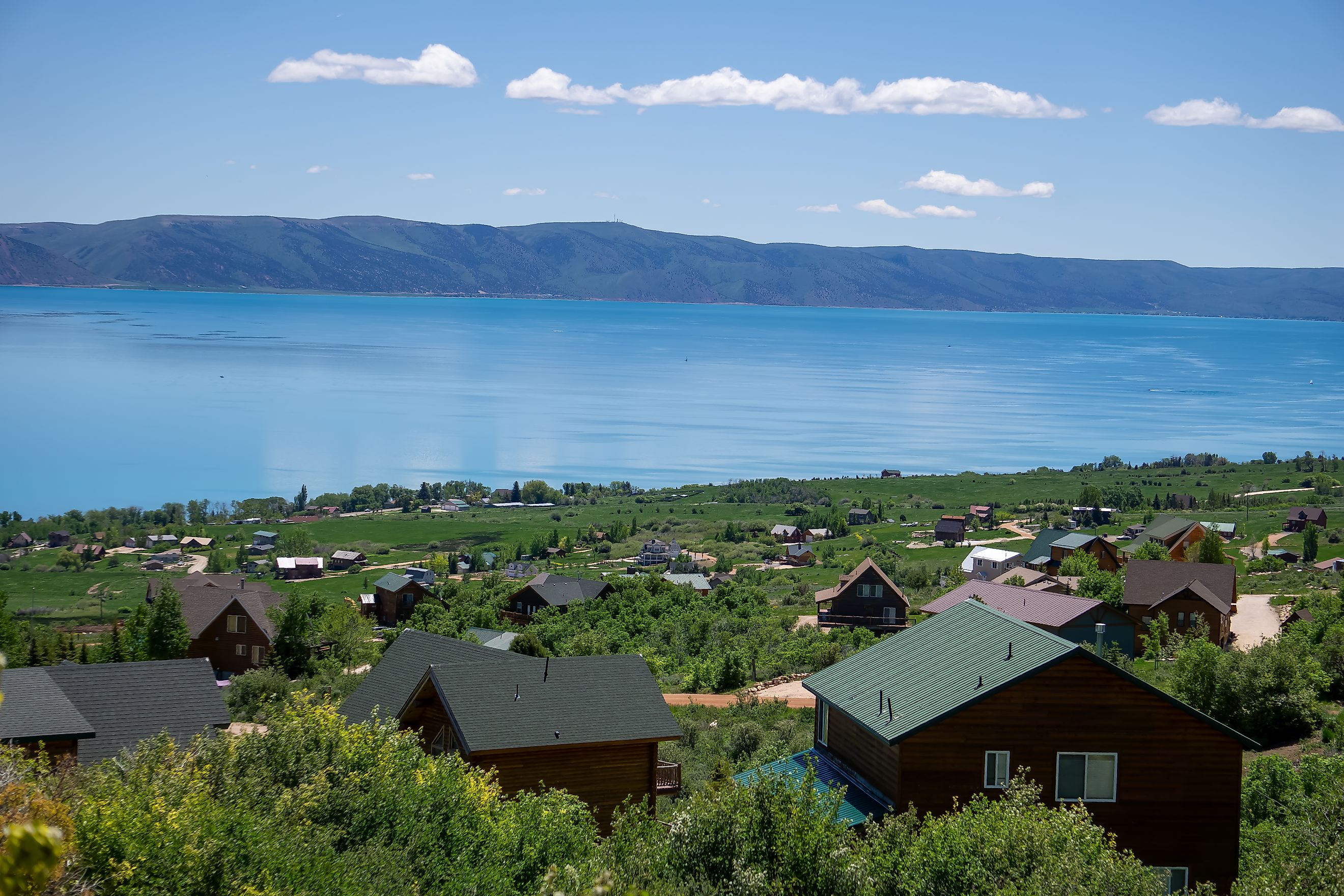
Calcium carbonate in Bear Lake gives its water a green-blue color, the reason for its nickname, the Caribbean of the Rockies. The lake straddles the Utah and Idaho line at 5,923 feet, 20 miles long and eight miles wide over 112 square miles, and the same clear water makes it a scuba diving destination well inland.
Its most unusual fishing comes in January. Bonneville cisco, seven-inch members of the whitefish family, gather in large schools in the rocky shallows to spawn, and anglers wade in with dip nets at Cisco Beach. Many freeze their catch to use later in the year as bait for cutthroat and lake trout. The cisco is one of four fish found only in Bear Lake, along with the Bonneville whitefish, the Bear Lake whitefish, and the Bear Lake sculpin.
Coeur d'Alene Lake, Idaho

On December 20, 2023, observers counted a record 409 bald eagles at Wolf Lodge Bay on Coeur d'Alene Lake, about eight miles east of the city of Coeur d'Alene off Interstate 90 at exit 22. The eagles come from November through February to feed on spawning kokanee salmon, and the Bureau of Land Management counts them weekly through the season. The peak moves. In 2025, the count topped out at 294 on November 26 and fell to 20 by December 19, so the best week to see the birds changes from one winter to the next. The lake they gather on runs 25 miles long and covers about 50 square miles.
Jackson Lake, Wyoming

Jackson Lake lies below the Teton Range in Grand Teton National Park, and part of its size is engineered. The Park Service describes it as a natural lake raised by a 39-foot dam, which the Bureau of Reclamation operates to store up to 847,000 acre-feet of irrigation water. Behind it, the lake reaches about 25,540 acres, close to 40 square miles, and runs up to 15 miles long.
That much water is open to motorboats. Jackson is one of only two lakes in the park that allow them, and the only one without a 10-horsepower limit. Colter Bay Village and Leeks Marina, both on the eastern shore, have boat ramps, and Elk Island is the biggest of the islands out on the lake.
Priest Lake, Idaho

Streams pouring off the high peaks of the Selkirk Mountains feed Priest Lake in northern Idaho, and the water they bring is known for its clarity. The main lake covers about 36 square miles and stretches about 19 miles long and four miles wide.
That length is only the first leg for anyone headed to Upper Priest Lake. A two-mile thoroughfare, a narrow channel at the north end of the main lake, connects the two, and the upper lake can be reached only on foot, by mountain bike, or by boat.
Shoshone Lake, Wyoming

Getting to Shoshone Lake takes a hike or a paddle, because no road reaches any part of its shore. The U.S. Fish and Wildlife Service believes it may be the largest lake in the lower 48 states that cannot be reached by road, at 8,050 acres, or about 12.6 square miles, and 205 feet deep. The DeLacy Creek Trail leads to its northern and eastern shores, and with motorboats banned, canoes and kayaks carry everyone who travels on the water. On the western shore, the Shoshone Geyser Basin holds more than 80 geysers, the largest backcountry geyser basin in Yellowstone National Park.
Lake McDonald, Montana

The Going-to-the-Sun Road in Glacier National Park runs along the southern shore of Lake McDonald, the park's largest lake, which stretches 10 miles long and reaches 472 feet deep. It covers close to 11 square miles at an elevation of 3,153 feet.
Along the shore and in the shallows, the lake is known for its red and green pebbles. The colors come from iron in argillite, a rock found throughout the park. Argillite that was exposed to oxygen turned red as its iron rusted, and argillite that formed underwater without oxygen turned green.
The size of these lakes is easiest to feel on the water. Yellowstone Lake stays cold enough that the Park Service advises against swimming, Jackson Lake is big enough for motorboats in a park that limits them almost everywhere else, and the only way across Shoshone is by paddle. All nine lakes are in the United States, between the Utah and Idaho line and the Canadian border. North of that border, Parks Canada names Maligne Lake in Jasper National Park as the largest natural lake in the Canadian Rockies, and at about 7.6 square miles, it is smaller than Lake McDonald. Many of the biggest lakes in the Canadian Rockies are reservoirs. Williston Lake in British Columbia formed in 1968, when the W. A. C. Bennett Dam blocked the Peace River and the water backed into the Rocky Mountain Trench. The reservoir now covers about 680 square miles, more than three and a half times the size of Flathead Lake.