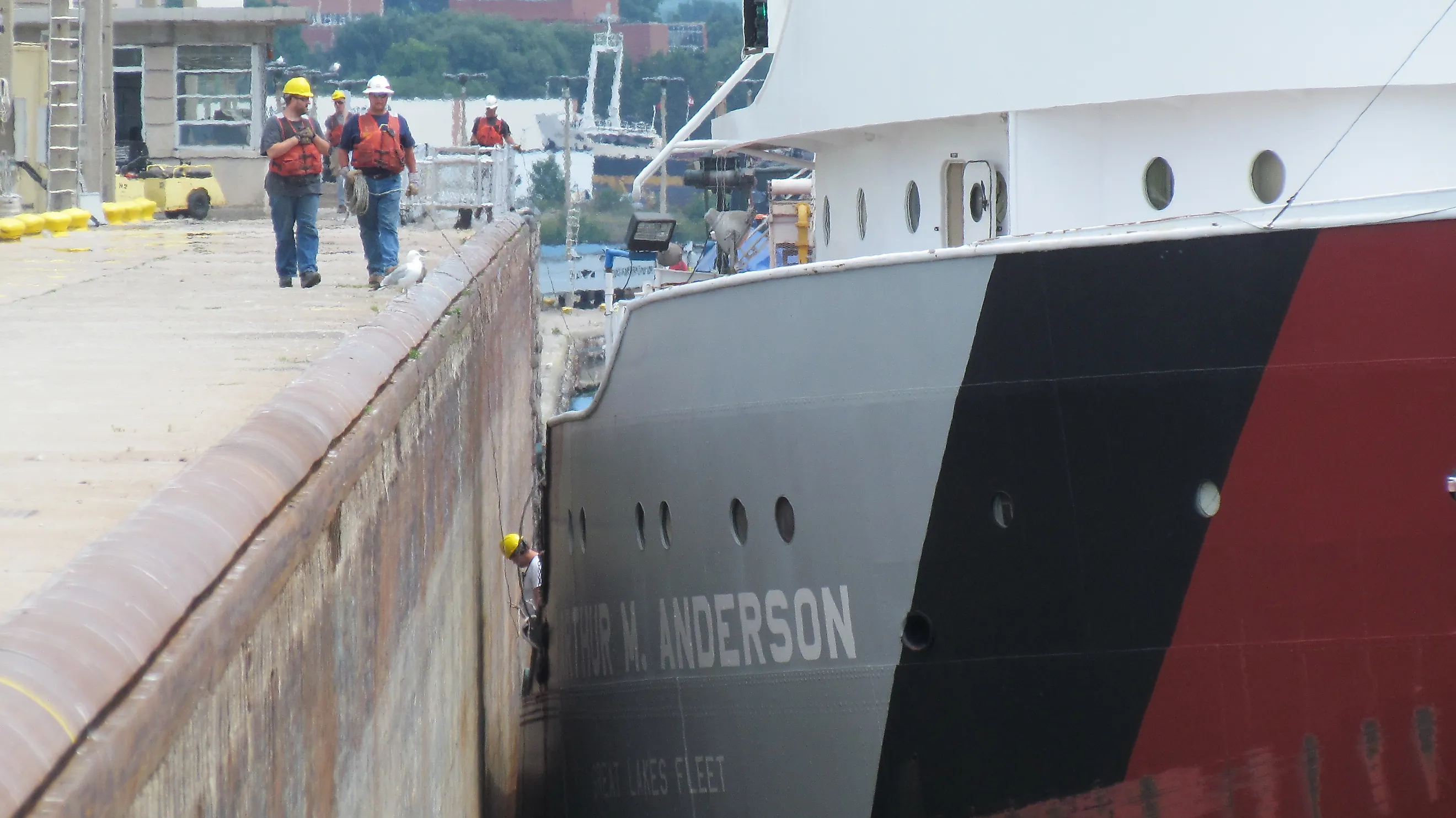
What A Great Lakes Freighter Captain Actually Earns
In 2017, a brand-new officer on a Great Lakes freighter started at $60,000 a year or more. The captain of the same ship could make more than three times that. Do the math, and the person in charge of a freighter crossing Lake Superior could take home more than $180,000 a year. Starting pay has climbed since then.
The catch is how that money gets earned. A captain can live aboard for two months at a stretch, far from family, with more than 20 people relying on the captain's every call. The work only runs part of the year, too. And nobody starts in the captain's chair. The climb begins four ranks down.
The Captain Sits Four Ranks Above a Well-Paid Starting Job

A laker carries four ranks of licensed deck officers. Third mate is the lowest, followed by second mate and chief mate, and the master, the formal title for the captain, sits at the top. The starting rank already pays well, so a captain's multiple of it adds up quickly. In 2019, Jason Toth of Interlake Steamship told News 5 Cleveland that a graduate could get a job on a boat straight out of school making $60,000 a year.
Starting pay has climbed since. Marketplace reported in September 2025 that graduates of the Great Lakes Maritime Academy in Traverse City, Michigan, could earn as much as $100,000 in their first year in the U.S. merchant marine. That first-year figure already tops the national median for the whole occupation, which the Bureau of Labor Statistics put at $92,460 in May 2025 for captains, mates, and pilots of every kind of vessel. At the 2017 ratio, a laker captain's pay sits far above that middle.
The Paycheck Covers a Season of Just Under 10 Months

Most of that pay is earned inside a fixed window. The Soo Locks closed on January 15, 2026, and the Poe Lock reopened on March 25, after roughly 10 weeks with no ships passing between Lake Superior and the lower lakes. American Steamship Company says its fleet operates from late March until mid-January. Great Lakes crews often do not work in the winter, when the lakes freeze, according to the Bureau of Labor Statistics, and the freighter Paul R. Tregurtha typically has just two ship keepers aboard during its winter layup.
Within the season, officers rotate on and off the ship. Many laker crews work 60 days on and 30 days off, so a captain can spend two straight months aboard before a relief officer takes over, and about two of every three days of the season on the ship. Aboard the Mark W. Barker, pretty much everything but shampoo and toothpaste is provided, according to Paul Berger, then the Interlake freighter's captain. The time away lands on the family at home. "It's tough to raise a family, it's easy to provide for them doing this job," Berger told the Mesabi Tribune.
Reaching the Captain's Chair Takes Years of Climbing

The quicker path to the captain's chair starts in a classroom. The Great Lakes Maritime Academy's deck program is a four-year bachelor's degree with three sea projects, internships served aboard working ships, and its cadets prepare for Coast Guard licensing as a Third Mate Great Lakes, along with Oceans Unlimited and First Class Great Lakes Pilot credentials. For the 2026-27 school year, the academy estimates the yearly cost for a Michigan resident from outside Grand Traverse County living on campus at $31,621, about a third of what a graduate could earn in a strong first year at sea.
The other route starts on deck. Sailors call it the hawsepipe, and Lake Superior Magazine reported in 2017 that earning a license that way, with sea time and coursework outside an academy, might take twice as long. Thomas Garvey started as a deckhand in 1974 and has commanded the Joseph L. Block since 2021, nearly five decades later.
Either way, the last steps run through the mates' ranks. Before the Coast Guard issues a master's credential for the Great Lakes, an officer needs a year of service on the lakes as a mate or first-class pilot, with at least six months of it as first mate. "For me, it was as simple as the work schedule and the money," Ryan McDonough told Seaway Review in 2022. He graduated from the academy in 2013, sailed three seasons as a third mate, became a first mate in 2018, and was training for captain with Grand River Navigation nine years after graduation.
Recent Officer Contracts Have Brought Raises Above the National Norm

Pay for mates and engineers on many U.S. lakers is set by union contract. The American Maritime Officers union reported in March 2026 that its one Great Lakes contract from 2025 raised wages by an average of 6 percent in the first year. Over the five-year agreement, the increases total 28.87 percent, before additional wages and benefits negotiated for winter work. Across all industries, first-year raises in 166 labor contracts ratified in the third quarter of 2025 averaged 5.0 percent, according to Bloomberg Law figures the union cited. The same report said that, for the first time, the union had negotiated full contractual recognition for ship masters at a Great Lakes company, Key Lakes, which brings the captains there under a union contract.
Those raises come as U.S.-flag fleets report trouble filling jobs. Marketplace reported in 2025 that the U.S. merchant fleet as a whole already had a hard time filling open positions. On the lakes, the warning came years earlier. In 2017, Captain Mark Blatnik of the Roger Blough said the average age aboard his ship had been right around 50 or 52 the year before, and he expected a huge void to fill within five to 10 years, a window that ends in 2027.
Registered Pilots Are Benchmarked Far Higher

Academy graduates earn a first-class pilot credential for the Great Lakes, but a registered pilot holds a separate job. Foreign ships in U.S. waters of the Great Lakes must take on a U.S. or Canadian registered pilot to guide them through local channels, and the shippers pay rates that the Coast Guard sets each year. Those rates are built on a compensation benchmark per pilot, which for 2026 is $481,642, up 3.73 percent from 2025. The rule covers 57 registered U.S. pilots and seven apprentices, and an apprentice's benchmark is 36 percent of a pilot's, or $173,391.
Laker officers were the yardstick for that figure. A 2018 Coast Guard rule stated that "the compensation of U.S. masters on Great Lakes ships provides a useful proxy for the compensation of U.S. pilots." The union wage data it used covered first mates, and the rule concluded that a pilot should earn, on average, about 1.5 times the salary of a first mate.
Measured against the calendar, the 2017 math gets more concrete. The season that opened when the Poe Lock reopened on March 25, 2026, runs just under 300 days to the mid-January closing, and a captain on a 60-days-on, 30-days-off rotation spends about two of every three of them aboard, roughly 200 days. At the 2017 figure of more than $180,000 a year, that comes to more than $900 for each day on the ship, earned in stretches of up to two months away from home. The same pay also covers the years spent getting there, through an academy degree and time as a mate, or up from deckhand, as Thomas Garvey did after starting in 1974. The officers on the latest Great Lakes contract will see raises totaling 28.87 percent over five years, and the Coast Guard's 2026 benchmark of $481,642 for a registered pilot traces back to the pay of a first mate on a laker.