Why Great Lakes Freighters Break In Half
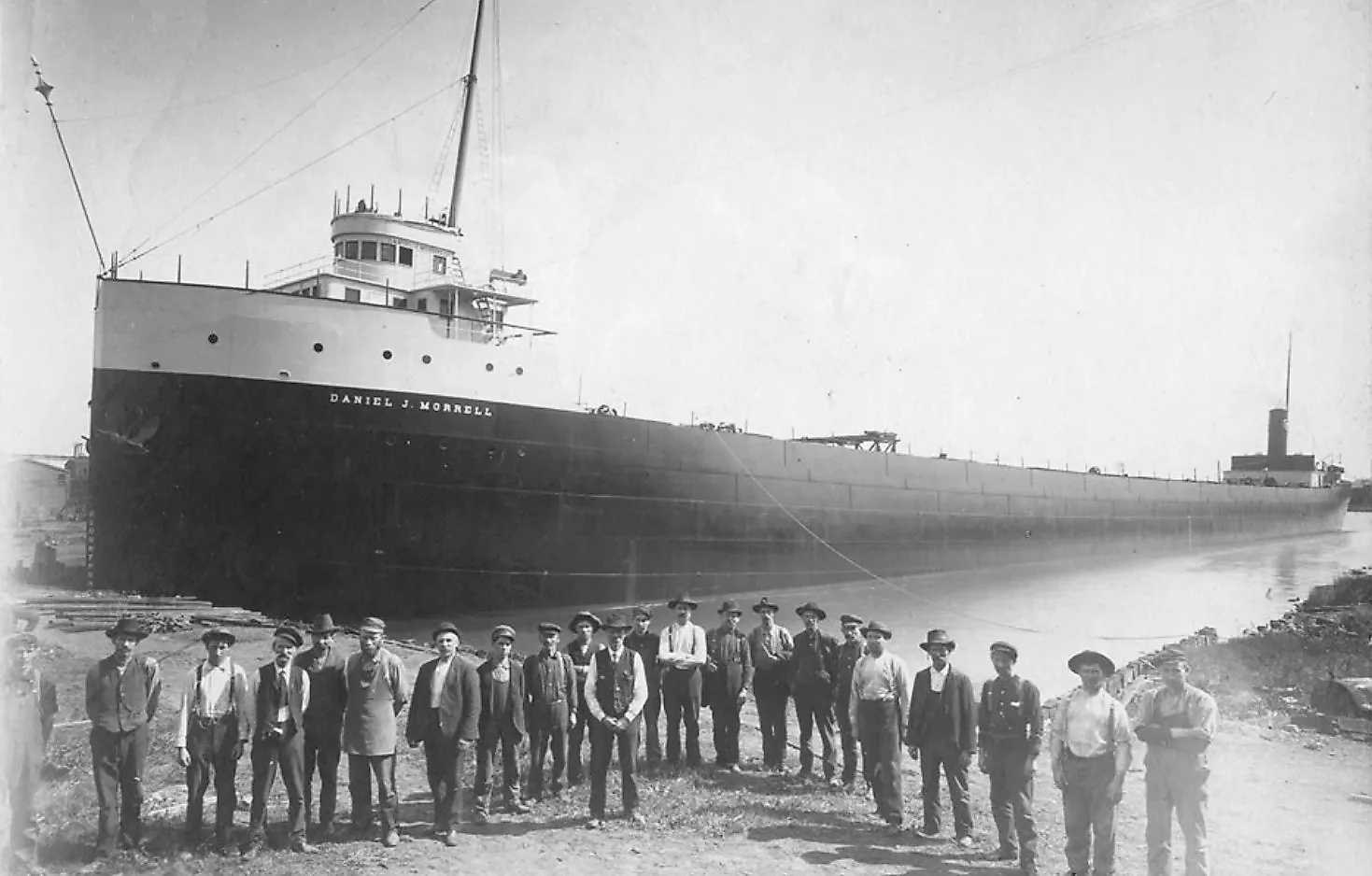
Naval architects treat a ship as a beam, and whether that approach works depends on one ratio. Hull girder methods apply to vessels with a length-to-depth ratio above 12, which is a formal way of saying the hull is long and shallow enough to bend like a plank rather than hold its shape like a box. Great Lakes freighters are built long and shallow because the locks demand it, which puts them at the extreme end of that ratio. The Coast Guard named exactly this as a factor when the Daniel J. Morrell broke in two.
The Lock Determines The Shape

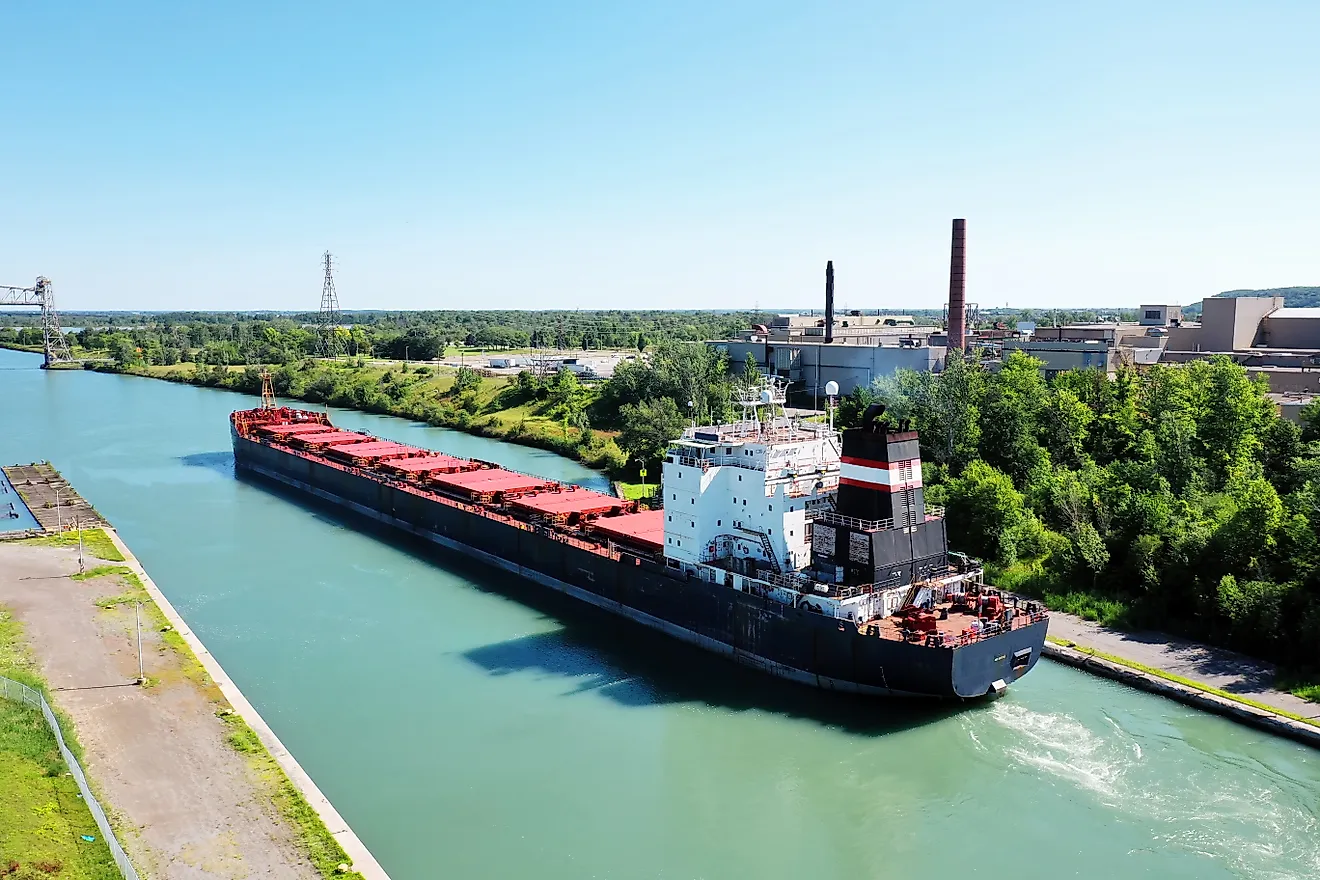
Everything about a laker's proportions follows from a concrete chamber at Sault Ste Marie.
Beam is capped by the lock width and draft is capped by channel depth, which leaves length as the only dimension a designer can grow. The result is a hull close to ten times longer than it is wide.
The Edmund Fitzgerald was 729 feet long and 75 feet wide, tailored to fit the Soo. An ocean vessel carrying similar tonnage would be shorter, wider and deeper, and would behave quite differently in a seaway.
A Long Beam Is A Weak Beam

The mechanics here are not specific to ships. They apply to anything spanning a gap.
Bending moment rises with both the weight and the length of the structure, and total hull deflection scales with the square of the length. Double the span and the deflection goes up fourfold for the same load.
Which means a 729-foot hull is not simply a longer version of a 400-foot one. It is a fundamentally more flexible structure carrying far larger bending moments.
The Worst Case Is Wave Length Matching Ship Length

Ship structural design has a standard worst-case condition, and it is remarkably specific.
Classification rules calculate hull strength by superimposing a wave whose length equals the ship's length, in both hogging and sagging. The textbooks state it plainly: the worst case bending moments occur when the length of the ship is nearly equal to the length of the wave.
A crest amidships lifts the middle and leaves the ends unsupported. A trough amidships does the reverse. Either way the hull is being asked to work as a cantilever rather than a floating object.
Section Modulus Is The Number That Matters

How much bending a hull can take before it fails comes down to a single structural property.
Section modulus describes how much material sits how far from the neutral axis at the midships cross section, and it determines the hull's resistance to longitudinal bending. Classification rules specify a minimum based on length, beam and block coefficient.
The Marine Board investigating the Morrell listed among its contributing factors a limited original design section modulus for a vessel having such a large length-to-depth ratio. The hull was not strong enough as a beam for how long and shallow it was.
Empty Is More Dangerous Than Loaded

This is the detail that surprises people, and the record supports it.
The Carl D. Bradley was crossing northern Lake Michigan in ballast, carrying no cargo, when she broke in two on November 18, 1958. The Coast Guard traced the loss to excessive hogging stresses brought on by the ship's ballasted condition. The Daniel J. Morrell was also running light when she failed eight years later.
A loaded hull has weight distributed along its length, roughly matching the buoyancy supporting it. An empty hull concentrates its weight in the machinery aft and the structure itself, leaving the distribution badly mismatched.
Lake Waves Arrive Far More Often

The loading environment on the lakes differs from the ocean in a way that matters for fatigue rather than for peak stress.
Ocean swells typically arrive 10 to 12 seconds apart. On the Great Lakes, Michigan Tech's Guy Meadows puts the interval at three to five seconds. Fresh water is less dense than salt, producing waves that are shorter, steeper and closer together.
So a laker in a gale is not enduring a handful of enormous bending cycles. It is enduring several times as many, over and over, for as long as the storm lasts.
Which Produces Fatigue, Not Just Overload

The failure mode is often cumulative rather than a single catastrophic wave, which the investigations reflect.
Among the Morrell's contributing factors the Marine Board listed low cycle stress fatigue, meaning repeated bending had weakened the structure before the night it failed. Steel loaded and unloaded enough times fails below the stress that would break it once.
The Fitzgerald's own captain reportedly reduced speed because the ship was flexing and wiggling in ten-foot waves, which one theory holds had already opened cracks.
Then The Steel Decides

Bending alone does not break a hull. It breaks a hull with a flaw in it, and the material determines whether the flaw spreads.
The Morrell investigation cited steel highly notch sensitive at low temperatures and a notch in the structure that formed the nucleus of the initial fracture. Pre-1948 steel was higher in carbon and sulfur and lower in manganese, giving it a high ductile-to-brittle transition temperature.
Below roughly 50 degrees Fahrenheit that steel stops absorbing a crack and starts propagating it. A November lake supplies the temperature.
No Bulkheads To Stop It

The internal arrangement of an ore carrier offers little to arrest a failure once it starts.
The Bradley had two watertight bulkheads, fore and aft of five cargo holds, as did the Morrell. The Fitzgerald investigation cited a lack of transverse weathertight bulkheads in the cargo hold among its contributing factors.
A hull designed as one long open box unloads quickly through a crack, which is why both survivors of the Bradley described the break and the sinking as taking minutes.
The Short Answer

Great Lakes freighters break in half because the locks force a hull shape that is long, narrow and shallow, which makes it a flexible beam carrying large bending moments. Waves arriving every three to five seconds load that beam far more often than ocean swells do, producing fatigue as well as peak stress, and running in ballast makes the weight distribution worse rather than better.
Add a steel that turns brittle below 50 degrees, a notch somewhere in the structure, and no transverse bulkheads to contain the result, and the hull does not tear slowly. It goes in one piece into two.