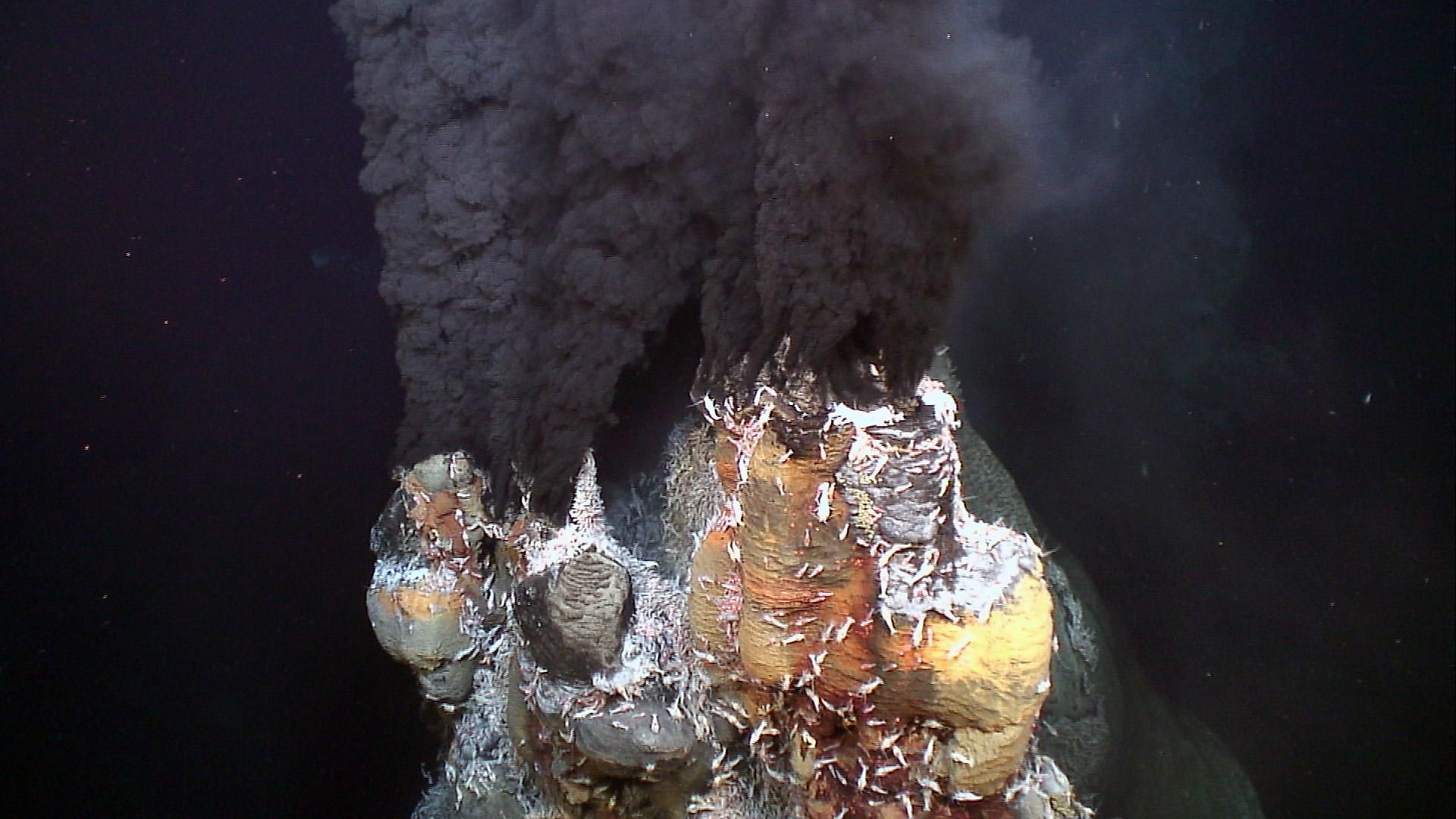
The Creatures That Survive Near Scalding Ocean Vents
Offered a range of temperatures in a pressurized tank, a worm from the seafloor off Washington swam toward the hot end. A flatfish in the Marianas walks out onto a crust of cooling sulfur. Thousands of octopus gather at a California seamount to lay eggs in water barely warm enough to notice. All three live near hydrothermal vents, where fluid can leave the seafloor above 700 degrees Fahrenheit. None of them lives in that fluid. Each survives by working the edge of it rather than enduring it.
Pompeii Worm

Alvinella pompejana held the title of hottest animal known for roughly 30 years, and the title is now contested. French biologists Daniel Desbruyères and Lucien Laubier described the species in 1980. Their specimens came from the submersible Alvin, which collected them in 1979 on the East Pacific Rise at 21 degrees north. The worm builds parchment tubes on the walls of black smoker chimneys and coats them with particles of sulfur.
Temperature probes pushed into that habitat came back reading 140 degrees Fahrenheit and higher. Many biologists never accepted the figure. The proteins that run an animal cell fail somewhere between 113 and 131 degrees.
Settling the argument took a pressure chamber. Alvinellids die on the way up, so a French team raised living worms inside a sealed vessel that held deep-sea pressure. The team then warmed them under laboratory control. Two hours at 122 to 131 degrees killed them outright, with tissue damage and a full heat-stress response. Their published ceiling for the species falls below 131 degrees. The worm still prefers water above 108, which keeps it among the most heat-tolerant animals known. It lost a record but held its place near the top.
Sulfide Worm

Paralvinella sulfincola swims toward heat that would kill almost anything else, and researchers have watched it happen. The species lives on sulfide chimneys along the Juan de Fuca Ridge, some 7,200 feet down off the Washington coast.
Peter Girguis of Harvard and Raymond Lee of Washington State University built a high-pressure aquarium in 2006. Inside it they set up the same steep temperature gradient the worms meet at a vent, with room for the animals to move freely along it. Given the run of that gradient, the worms settled into a band running from 104 degrees at the low end up to 122. No other animal on record picks a hotter address. Past that band the margin vanishes fast, because 131 degrees proved fatal within a couple of hours.
The reason is dinner. Bacterial mats grow thickest in exactly that range, and no competitor tolerates the conditions long enough to graze them. The same worm functions across roughly 41 to 118 degrees, the widest span measured in any animal. Such range lets it follow the mats as a chimney shifts. For this worm, heat is no mere hazard. It is the condition that clears the field of competitors and leaves the food for the one animal that can take the temperature.
Vent Shrimp

Rimicaris exoculata carries its eyes on its back. The species name records that its face has none. Swarms of the shrimp cover sulfide chimneys on the Mid-Atlantic Ridge near 11,800 feet. Densities reach roughly 230 animals to the square foot.
Two fused organs sit beneath the transparent shell, loaded with rhodopsin, the pigment that makes vision possible. The pair accounts for about 0.5% of the shrimp by volume. Roughly 7,000 optical units fill it, with no lens and nothing capable of forming an image. Researchers published the anatomy in 1989. A separate calculation that year showed such an organ could register the faint glow of a chimney at 660 degrees Fahrenheit. Human eyes cannot see that glow at all.
The shrimp farms bacteria inside its gill chambers. Feeding means grazing within inches of fluid that would cook it, though the animal itself keeps to water no warmer than 68 degrees. In the darkest place anyone can reach, the one thing that can kill the shrimp is also the only thing it can see by.
Giant Tubeworm

Riftia pachyptila spans two environments at once, keeping one end of its body in each. The tube cements to rock inside the fluctuating vent flow. The red plume at the top rises into seawater already diluted by the cold deep ocean. Colonies grow along the crest of the East Pacific Rise near 8,200 feet. The worm settles only where flow carries heavy sulfide and stays under 129 degrees.
That plume is red because hemoglobin packs it, and the worm's version performs a trick human blood cannot. The pigment binds oxygen and hydrogen sulfide at once, without the sulfide shutting the oxygen down.
Then there is the speed. Riftia puts on some 33 inches a year, driven by cell division rates comparable to those in a tumor. No other invertebrate in the sea grows faster. The hurry is not ambition. A vent typically runs dry inside 10 years. A larva settling on one has exactly that long to grow several feet and reproduce before the plumbing beneath it shuts off.
Scaly-Foot Snail

Chrysomallon squamiferum builds its armor out of metal. No other creature manages the trick. The snail occupies vent fields in the Indian Ocean between 7,800 and 9,500 feet. Its shell runs in three layers, with aragonite inside, an organic layer in the middle, and a skin of iron sulfides outside.
Hundreds of hard plates called sclerites cover the foot as well. New plates come in white and darken as the iron coating develops over them. Researchers now read the armor as a disposal system as much as a defense, since building it locks up sulfur the snail would otherwise handle another way. Running that chemistry takes oxygen, and the animal carries a heart amounting to 4% of the whole snail.
In 2019 the International Union for Conservation of Nature listed the species as Endangered. Nothing from a hydrothermal vent had ever reached the Red List before. The assessment named proposed seabed mining at its vent fields as the reason.
Champagne Vent Mussels

Champagne reaches 217 degrees Fahrenheit at its hottest chimneys, and a few feet of seafloor away the temperature drops below 39. The field caps the summit of NW Eifuku, a small volcano 5,260 feet beneath the surface inside the Marianas Trench Marine National Monument. President George W. Bush established that monument by proclamation on January 6, 2009.
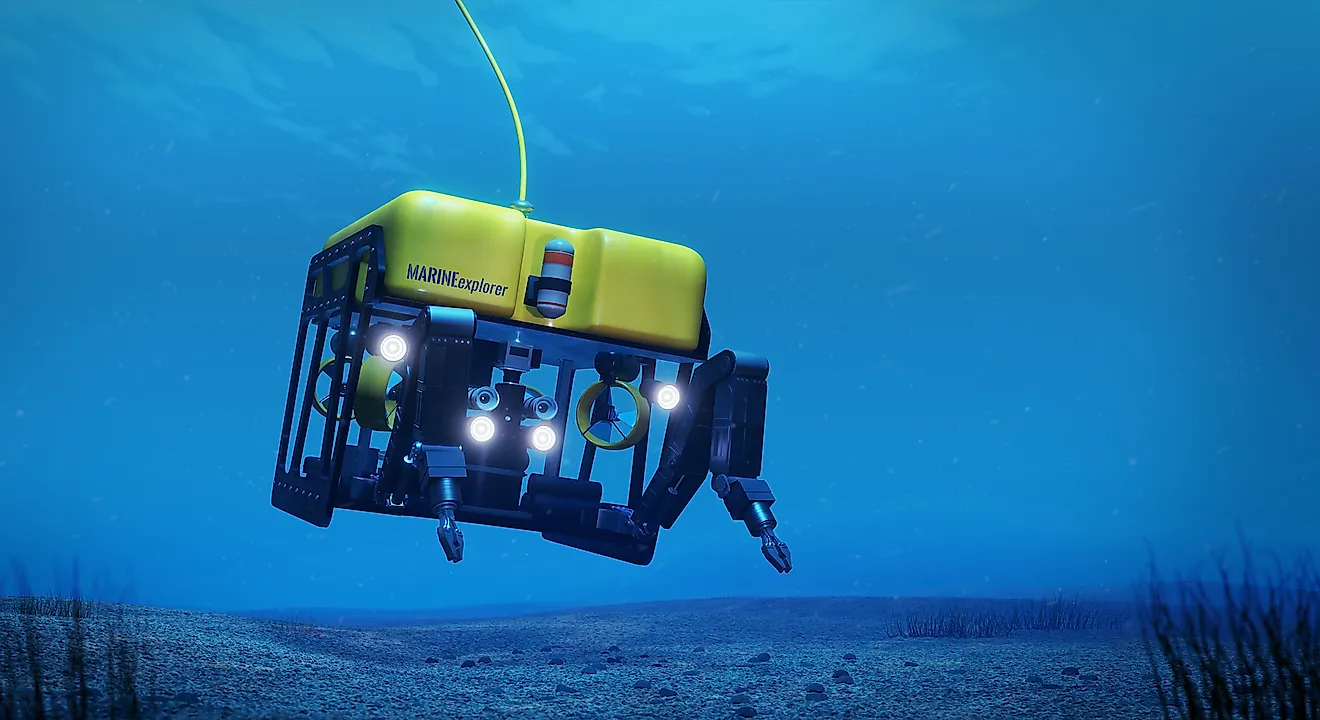
Researchers with the National Oceanic and Atmospheric Administration (NOAA) found the field in 2004 and measured the range across it. The most vigorous chimneys ran at 217 degrees. Other vents nearby discharged anywhere from 52 to 154. Ground where droplets of liquid carbon dioxide percolate upward came in under 39 degrees, cold enough to hold the carbon dioxide as a liquid rather than a gas. Only the Okinawa Trough is known to do the same thing. Those droplets proved corrosive enough to permanently damage the camera faceplates on the robot sent to sample them.
Almost nothing lives at the chimneys themselves. Mussels, shrimp, crabs, and limpets crowd a band a few hundred feet away. That short stretch of summit covers the entire range an animal can occupy.
Sulfur Tonguefish

Daikoku fills a crater on the next volcano over with molten sulfur, and a fish walks on it. That seamount belongs to the same cluster as NW Eifuku and falls within the same monument. NOAA's robot found the pool in 2006 and named it the Sulfur Cauldron. A probe put the melt at 369 degrees, beneath a flexible crust that heaves in slow waves.
Symphurus thermophilus is the only flatfish that lives at vents and nowhere else. Marine biologist Verena Tunnicliffe and colleagues recorded individual fish making repeated trips onto fresh sulfur flows as those surfaces cooled and hardened. The fish is not walking on 369-degree sulfur. The animal rests on the skin above it, which runs far cooler, and the margin keeps it alive.
Crowding at Daikoku averages about eight fish per square foot, with counts above 18 on the sediments. Part of what feeds them arrives from overhead. The volcano's chemical plume stuns midwater fish drifting through it and drops them onto the bottom.
Eelpout

Almost nothing hunts at a vent. Hydrogen sulfide kills animals that never evolved a way around it, so predators common elsewhere on the seafloor simply do not arrive. Worldwide, only two fish species count as true vent specialists, and both keep to the eastern Pacific Ocean.
One of them is Thermarces cerberus, an eelpout growing to about 16 inches. Researchers took 27 of them by submersible at 9 degrees 50 minutes north and opened their stomachs. Snails and limpets accounted for roughly half the diet by frequency. Crustaceans made up most of the rest. The fish showed a clear preference for larger limpets over small ones.
Removing that predator changes the neighborhood. A separate team fenced fish out of vent plots for eight months, and small snails and amphipods multiplied as expected. The other half of the result surprised them. Juvenile tubeworms and mussels declined, because the grazing limpets the eelpout normally thins had taken over the surfaces those larvae needed. The shift was sharpest nearest the vent, where conditions are harshest and life is densest.
Pearl Octopus

Nearly 6,000 octopus gather on one hillside near Davidson Seamount. Surveys suggest the full site may hold more than 20,000 nests. The Octopus Garden lies about 80 miles southwest of Monterey, California, at a depth close to 10,500 feet within Monterey Bay National Marine Sanctuary. No larger assembly of octopus has been found anywhere on the planet.
The heat source is not a black smoker. Water percolating through the flank of an extinct volcano picks up warmth and seeps back out through cracks, and the temperature change is modest. Seawater at that depth sits near 35 degrees. Inside the crevices, it climbs to about 51.
That gap is worth everything to Muusoctopus robustus. A team led by the Monterey Bay Aquarium Research Institute made 14 dives with a remotely operated vehicle over three years. Their 2023 report showed the warmth accelerating egg development sharply. Deep-sea octopus elsewhere brood for years, guarding a clutch without eating until they die, so a shorter watch means fewer eggs lost. The researchers found adults, eggs, and hatchlings but no sign of feeding, which marks the place as a nursery and nothing else.
Life At The Edge Of The Heat
Every animal here solves one problem a different way. The two worms push as close to the ceiling as protein chemistry allows. The shrimp reads the glow to find the line. The tubeworm straddles it, and the tonguefish walks the crust above it. At Champagne the whole gradient shows up in one frame, scalding chimneys and near-freezing ground a few feet apart. At Davidson Seamount that same plumbing runs cool enough to warm an octopus nursery instead.