How Much Of The Ocean Is Still Unexplored
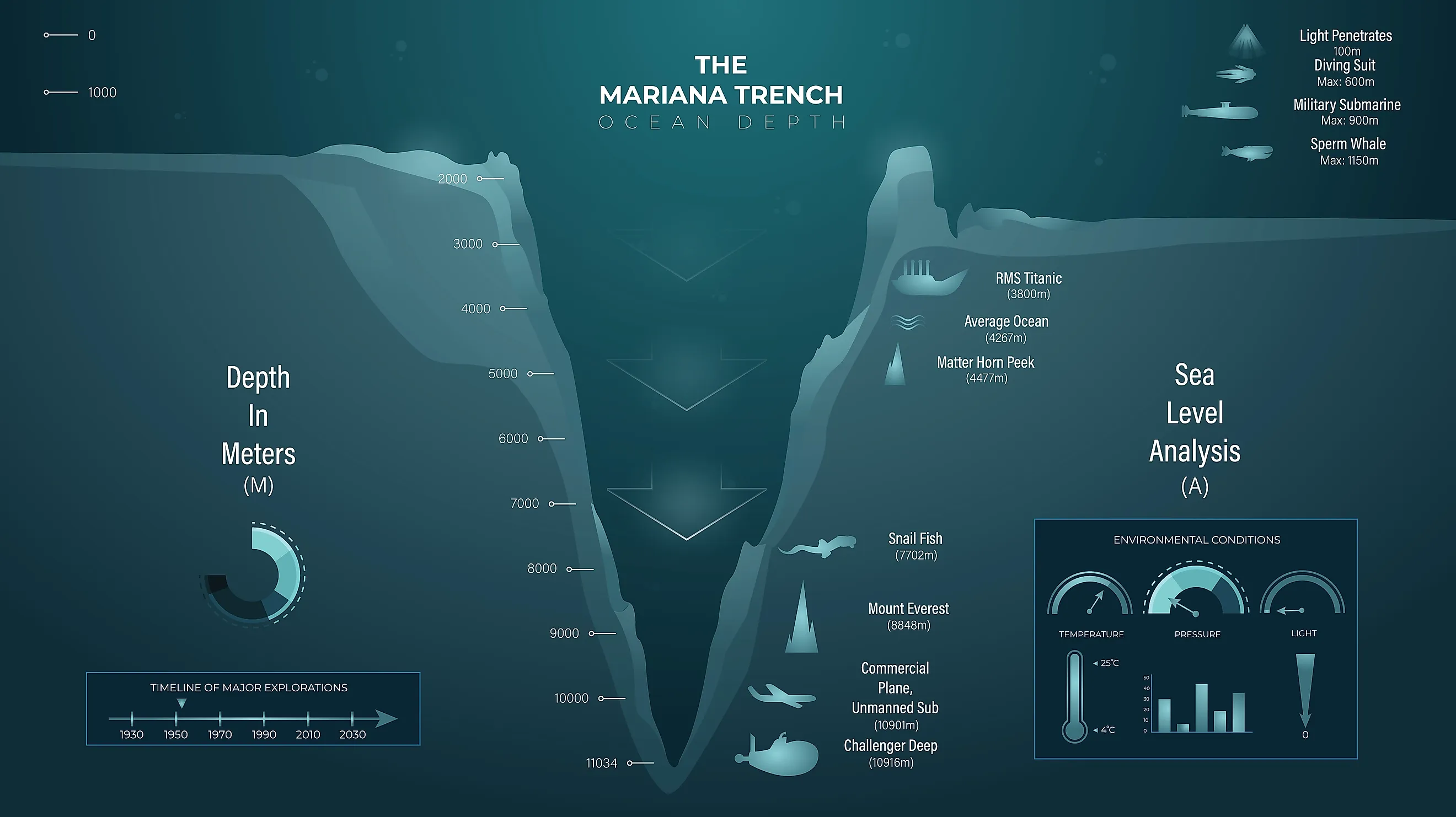
About 250 miles southwest of Guam, the seafloor drops into a scar in the Earth's crust deeper than Mount Everest is tall. This is the Mariana Trench, and at its southern end sits the Challenger Deep, the lowest point in any ocean on the planet. It also happens to be U.S. territory, protected as part of the Mariana Trench Marine National Monument. That makes it a fitting place to start when asking a question that sounds simple but isn't. After more than 150 years of oceanography, how much of the ocean we have actually explored is a surprisingly hard thing to pin down. The honest answer is that it depends on what "explored" means, and the two numbers people usually reach for measure very different things.
Mapped Is Not the Same as Explored

For years, the figure repeated everywhere was that more than 80 percent of the world's oceans remain unexplored and unmapped. NOAA's National Centers for Environmental Information has used that framing, tied to the Nippon Foundation-GEBCO Seabed 2030 project, an international push to produce a complete map of the ocean floor by the end of the decade.
But "unmapped" is a moving target, and NOAA's own numbers have shifted as the effort has progressed. As of April 2026, NOAA Ocean Exploration put the share of the global seafloor mapped with modern high-resolution multibeam sonar at 28.7 percent, up from roughly 23 percent just a few years earlier. That means well over two-thirds of the seafloor still has no high-resolution map, even as the coverage climbs year over year.

Even in U.S. waters, where mapping is a stated federal priority under the National Ocean Mapping, Exploration and Characterization strategy, 44 percent of the ocean, coastal, and Great Lakes area remained unmapped as of January 2026, according to NOAA's Office of Coast Survey. The goal is to close that gap entirely by 2040.
None of this is the same as exploring the ocean. A sonar pass from a ship can tell you the shape of the seafloor, the location of a seamount or a trench, without telling you a single thing about what lives down there or how those ecosystems function. Mapping is the first step. Actual exploration, sending vehicles or people down to observe, sample, and document, lags far behind it. NOAA is blunt about this, as only a small fraction of the ocean has been explored in that fuller sense, even where the maps already exist.
The Deepest Point, By the Numbers

Back to the Challenger Deep. Its depth has been measured differently by nearly every expedition to visit it, with figures ranging from about 10,900 to just over 11,000 meters depending on the era and the instruments used. The most precise modern measurement comes from explorer Victor Vescovo, who first visited the Challenger Deep in 2019 as part of his Five Deeps Expedition, then returned in June 2020 for a dedicated series of dives using a more carefully calibrated pressure sensor. That later analysis pinned the depth at 10,935 meters, or 35,876 feet, give or take about 6 meters. That figure has since been treated as the standard by Guinness World Records, Britannica, and the peer-reviewed literature on the site. For scale, that's deep enough that if Everest were dropped into the trench, its summit would still sit more than a mile underwater.
A Fact That Quietly Stopped Being True

For decades, one line recurred in nearly every ocean trivia list. More people have walked on the Moon than have ever reached the bottom of the ocean. It was true, and it made a genuinely good point about how little of the deep sea humans have actually visited in person.
It isn't true anymore, and the shift happened fast. Twelve people walked on the Moon between 1969 and 1972, and no one has been back since. The Challenger Deep, by contrast, went from a spot only three people had ever reached, in 1960 and 2012, to a regular destination once the submersible Limiting Factor began making repeat dives in 2019. By 2022, 27 individuals had descended to the bottom of the trench across 22 dives, including oceanographer Dawn Wright, the first person of African descent to make the trip, that July. The Moon's tally is now permanently capped. The trench keeps climbing, even if slowly. It's a useful reminder that "unexplored" facts have a shelf life, and a claim that was true in 2010 can flip within a decade.
What's Still Down There
The ocean floor holds its own geography, and most of it is hidden from view. The Mid-Atlantic Ridge, a mountain range that runs the length of the Atlantic basin, is part of the global mid-ocean ridge system, the longest mountain range on Earth, and almost none of that system breaks the surface. Scientists estimate somewhere between 700,000 and a million species live in the ocean, and a large share of them, mostly small invertebrates and organisms in poorly sampled habitats, have never been formally described. That's the real shape of the unexplored ocean. It isn't one dark, empty unknown. It's a specific, measurable gap between how much of the seafloor has a map and how much of it anyone has actually seen, sampled, or catalogued, and by both measures, humans have covered less of their own planet's ocean floor than they have of the Moon or Mars.