How Much Of Earth Is Covered By Ocean?
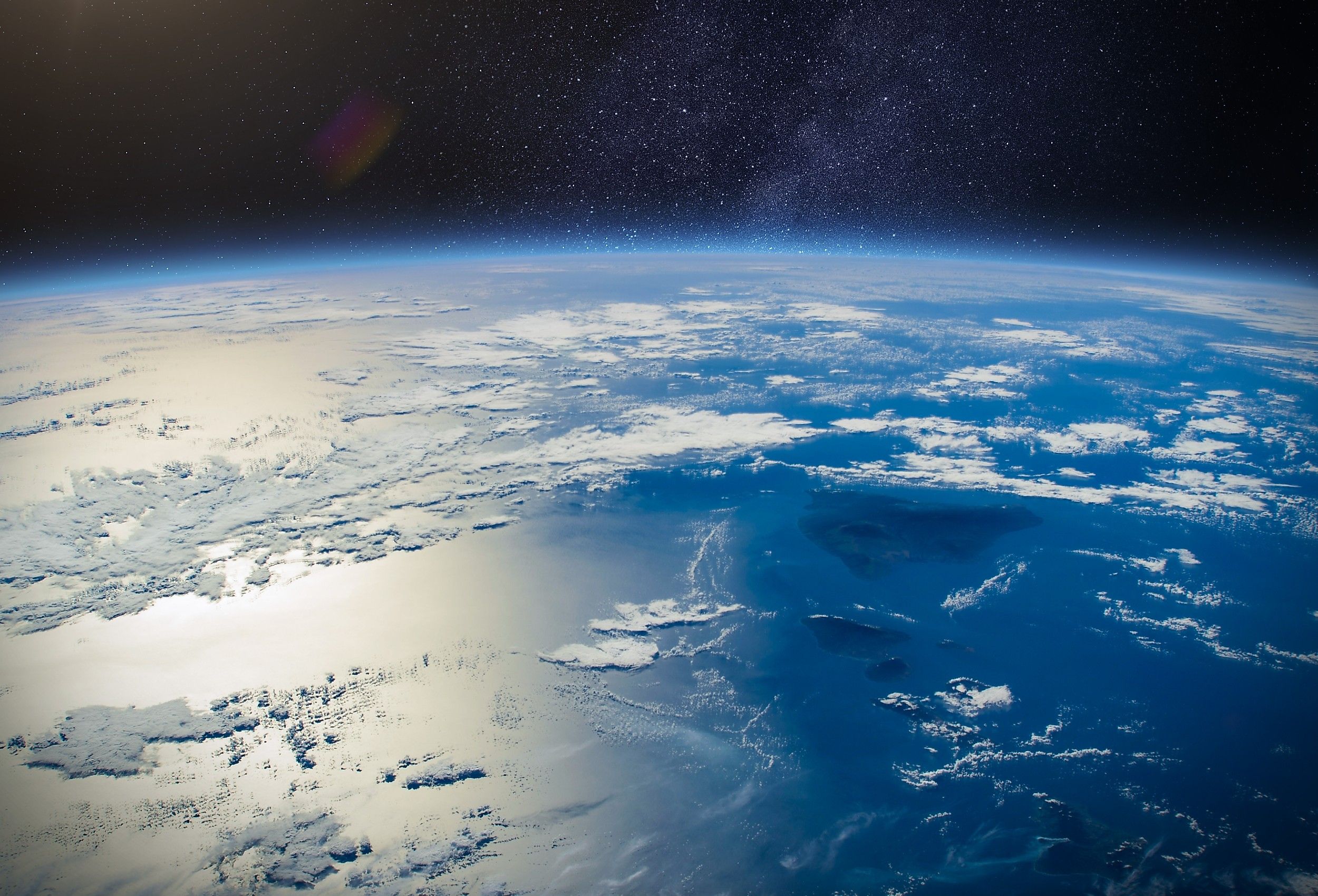
About 71% of Earth's surface is covered by ocean, equal to roughly 139 million square miles. The remaining 29% consists of continents and islands. Although oceans cover 71% of the planet's surface, they contain approximately 96.5% of all water on Earth. As they are all saline, they are unfit for human drinking water, but they do provide crucial environments and ecosystems, and absorb excess carbon dioxide. Discover how much each of the world's five oceans contributes to that 71%, along with lesser-known facts about these bodies of water from smallest to largest.
Arctic Ocean

Using NOAA's boundaries, the Arctic Ocean covers about 6 million square miles, or 4.3% of global ocean area, and contains about 1.4% of ocean-water volume. It is also the shallowest of the oceans, reaching a maximum recorded depth of about 18,200 feet in the Molloy Deep.
The Arctic Ocean is surrounded by North America, Eurasia, and Greenland, and historically has been very difficult to navigate due to ice coverage. For hundreds of years, various explorers attempted to find a Northeast and Northwest Passage through the Arctic Ocean. In 1878-79, Swedish-Finnish explorer Adolf Erik Nordenskiöld led the Vega through the Northeast Passage along Eurasia's Arctic coast, completing the first navigation of the route.
The Northwest Passage was navigated by Norwegian explorer Roald Amundsen using a small boat between 1903 and 1906. He chose a shallow, smaller boat that could handle the icy waters better, taking lessons from the Netsilik Inuit who lived near the Arctic Ocean.
Southern Ocean

With its northern boundary at 60°S, the Southern Ocean covers about 8.5 million square miles, representing roughly 6.1% of global ocean area and 5.4% of ocean volume. It differs from the other four named oceans in two important ways. First, unlike the other named oceans, it encircles a continent. The Antarctic Circumpolar Current also helps distinguish its waters oceanographically. Second, it is the most recent ocean to be recognized as one.
The US Board on Geographic Names approved the name Southern Ocean in 1999, National Geographic added it to its maps in 2021, and the International Hydrographic Organization approved its formal recognition in 2023. The main reason it took so long to recognize it was the questions among scientists and disagreements between nations.
The Southern Ocean circles Antarctica and is the coldest ocean. Surface waters generally sit between about 28 degrees Fahrenheit, near the freezing point of seawater, and roughly 50 degrees Fahrenheit. It is defined by the Antarctic Circumpolar Current, which flows eastward around the continent. The current is the world's largest by volume transport, while persistent winds and an exceptionally long uninterrupted fetch generate immense waves; a buoy measured a 78-foot individual wave in 2018.
Indian Ocean

The Indian Ocean is generally considered the warmest ocean because of its broad tropical extent and its enclosure by Asia to the north, although its southern waters connect with the cold Southern Ocean. The Indian Ocean has a surface area of about 27.2 million square miles, making up roughly 19.5% of all ocean waters.
The Indian Ocean began opening as Gondwana broke apart roughly 140 million years ago; India collided with Asia approximately 50 million years ago, helping form the Himalayas. This geological event created the Himalayan Mountains, including the highest mountain above sea level: Mount Everest. The Indian Ocean's coastlines continued evolving through plate movement, sedimentation, erosion, and changes in sea level.
During the South Asian summer monsoon, intense heating over land draws moist southwesterly air from the Arabian Sea and Indian Ocean; the air produces heavy rain as it rises and cools.
Atlantic Ocean

The Atlantic Ocean is the second-largest ocean on Earth, covering about 32.9 million square miles and accounting for roughly 23.5% of all oceans. It began to form around 200 million years ago, as the supercontinent Pangea began to break apart.
The Atlantic Ocean is often divided into the North Atlantic, which joins up into the Arctic Ocean, and the South Atlantic, which extends all the way to the Southern Ocean. The Mid-Atlantic Ridge is a divergent boundary separating the North American and Eurasian plates in the north and the South American and African plates in the south. In this ridge, there is a significant amount of volcanic activity.
Many Atlantic hurricanes develop from westward-moving tropical disturbances off Africa when they encounter warm water, moist air, thunderstorms, and low wind shear; dry Saharan air often inhibits their development.
Pacific Ocean

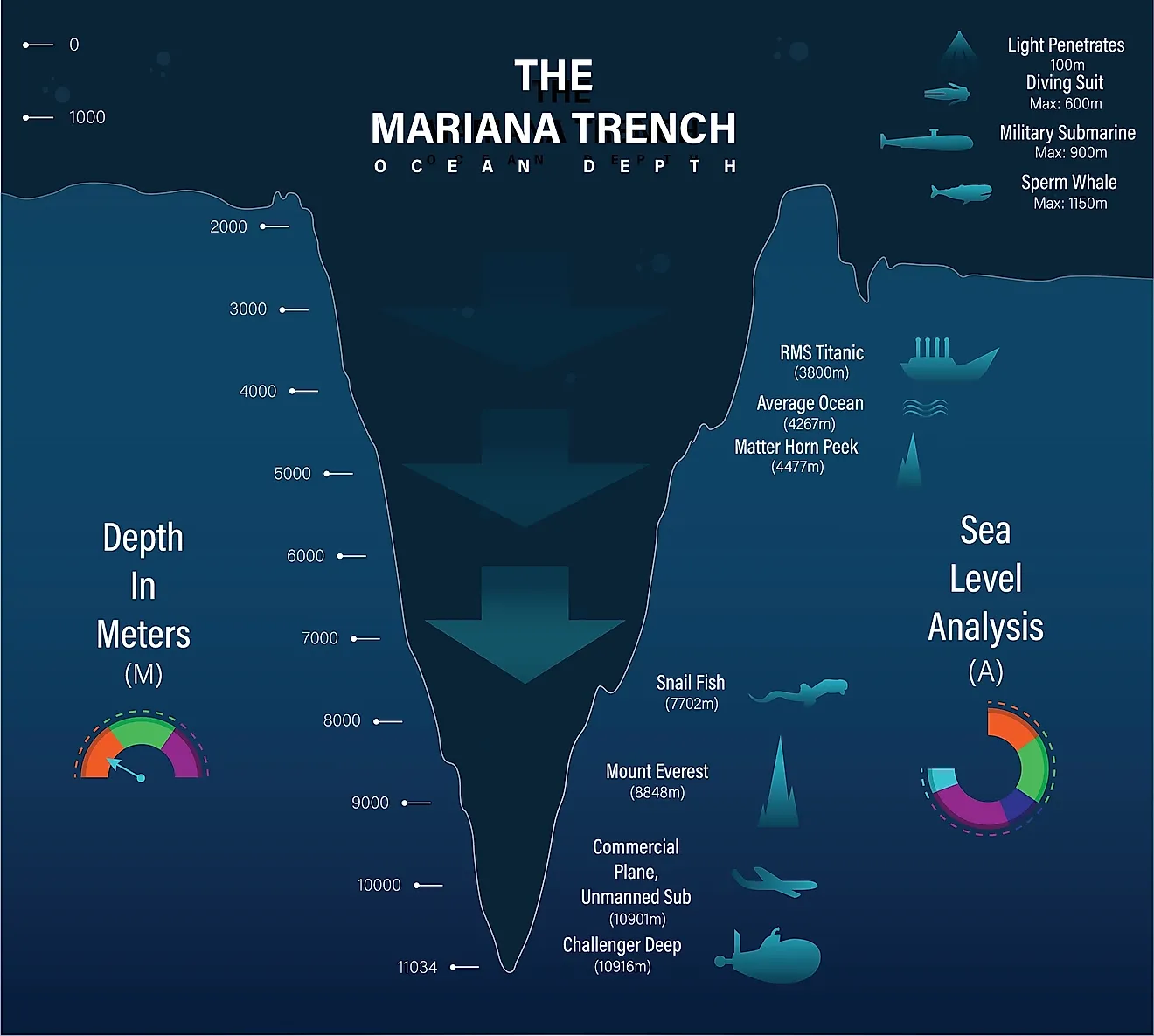
The Pacific Ocean is both the largest and deepest ocean on Earth, covering about 65 million square miles, which makes up 46.6% of all oceans. It has an average depth of 13,000 feet, but its deepest point recorded is in the Mariana Trench, at about 36,070 feet. This is the deepest place on Earth.
The ocean gets its name from Ferdinand Magellan in 1520, who named it after the Portuguese word for peaceful. In reality, the Pacific Ocean is far from peaceful, as it produces powerful tropical cyclones, called typhoons in the western North Pacific. Typhoon Mangkhut struck the northern Philippines in 2018 with sustained winds of approximately 130 miles per hour after reaching greater intensity over the open ocean.
Another destructive feature is the roughly 25,000-mile Ring of Fire, a belt of volcanoes, trenches, and earthquake zones around the Pacific; the Mariana Trench formed where the Pacific Plate subducts beneath the Mariana Plate. In 1960, Jacques Piccard and US Navy Lt. Don Walsh descended to Challenger Deep aboard the Navy-operated bathyscaphe Trieste. Confirmed Mariana Trench animals include hadal snailfish, amphipods, worms, and sea cucumbers.
A Planet Covered by Ocean
Although divided into five named basins, Earth’s oceans form one connected body of salt water covering about 71% of the planet’s surface. That amounts to roughly 139 million square miles compared with just 29% covered by land. The Pacific alone accounts for nearly 45% of the global ocean area, while the Arctic is the smallest of the five. Despite this enormous coverage, only 28.7% of the seafloor has been mapped with modern high-resolution technology, and less than 0.001% of the deep seafloor has been seen directly. Earth is therefore more than a planet with oceans; it is an ocean-covered world whose largest environment remains largely unseen.