Which State Has The Most National Parks?
National parks belong to all Americans, but not every person has equally convenient access to these incredible sites. Twenty states have no national parks at all, while others are practically filled with them. Among the states that are home to national parks, a few in particular stand out for their impressive totals. California sits at the top with nine, followed closely by Alaska's eight. Here's a closer look at what these states have to offer, along with the others with significant numbers of national parks.
California (9)

California is home to nine national parks that are as beautiful and diverse as the state itself.
In Northern California, the National Park System preserves one of the country's most unique natural environments. Along the coast, visitors can explore the towering forests of Redwood National Park on foot, by bike, or through scenic drives, checking out the home of the tallest trees in the world, alongside rivers and unspoiled Pacific Ocean coastline.

Inland, Lassen Volcanic National Park is home to steaming volcanic vents, mountain lakes, meadows, and other environments that are as fun to explore in the winter via skiing and snowboarding as they are by hiking and camping in warmer weather. However, Lassen isn't the only preserved example of California's active geological history. Pinnacles National Park, southeast of Santa Cruz, showcases the otherworldly landscapes created by volcanic activity millions of years ago, which has left behind a landscape of valleys, rock spires perfect for hiking and climbing.
Southern California also offers a mix of national parks spanning from the deserts near the Nevada border to the waters off the coast of Los Angeles. The latter park, Channel Islands National Park, preserves five islands that have developed one-of-a-kind natural environments due to their relative isolation, setting aside areas to hike, snorkel, kayak, and whale-watch that show what much of coastal Southern California may have looked like before human development. In stark contrast, Death Valley National Park is the driest place in North America and the home to the hottest temperature ever recorded. Those who brave the temperatures can hike, take scenic drives, and learn about the history of those who tried to brave this inhospitable environment in the days before air conditioning. Southern California's deserts are likewise home to Joshua Tree National Park, which offers unique plant life, dark skies, and relative accessibility to Southern California's largest cities.

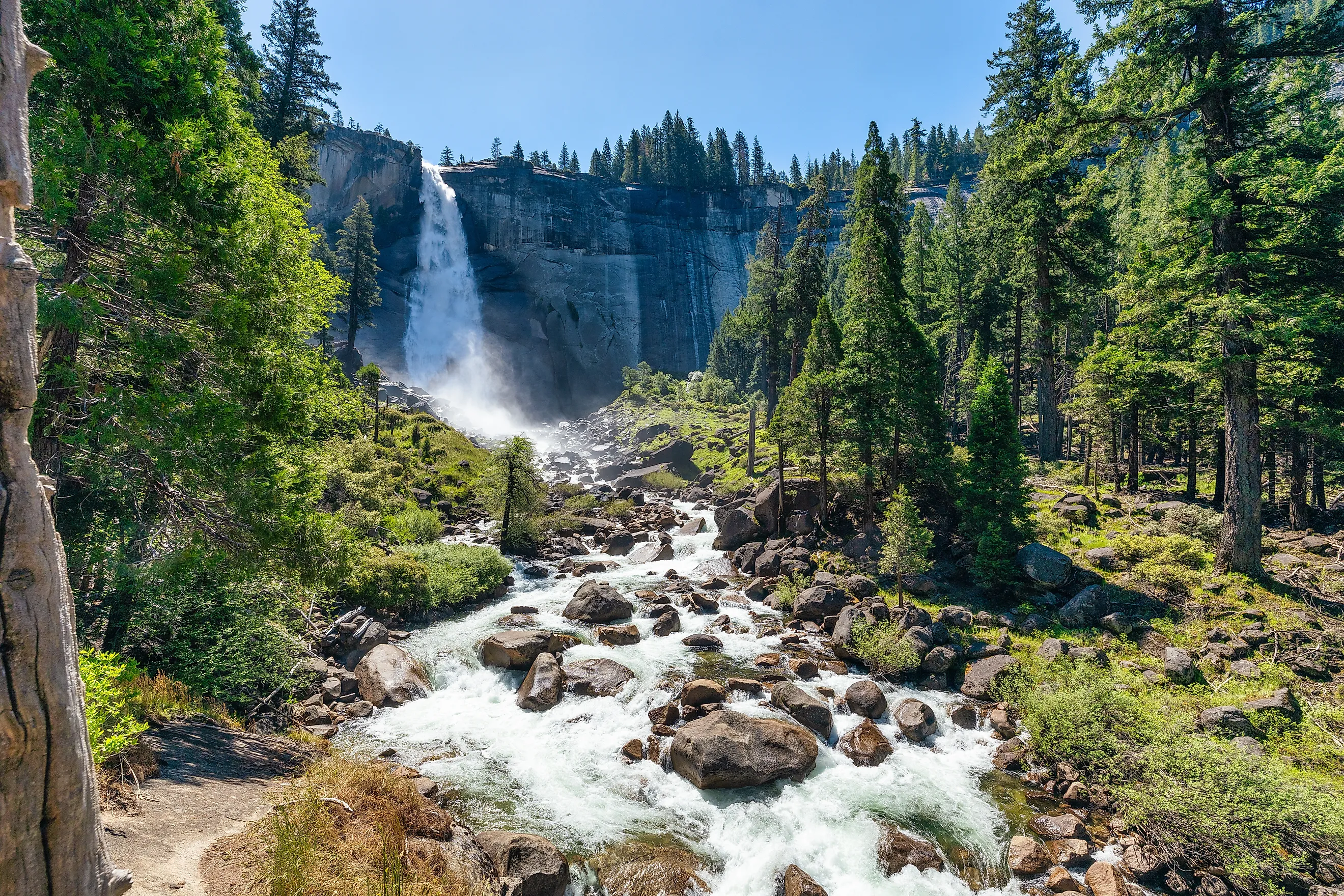
However, many likely consider the national parks in the Sierra Nevada mountains as the true gems of the state's parks. This includes Yosemite National Park, one of the oldest and most beloved in the entire system, home to countless valleys, rock formations, waterfalls, and some of the region's best hiking and climbing. A bit further south are Sequoia National Park and Kings Canyon National Park, the former of which is home to the world's largest trees by volume. The General Sherman tree soars nearly 275 feet, measuring over 102 feet around at ground level, with many others nearby in the Giant Forest nearly as impressive. Kings Canyon, while lesser known, offers diverse landscapes in the mountains and valleys around the Kings River, providing hiking, climbing, scenic drives, and other outdoor recreation with fewer visitors than California's bigger-name parks.
Alaska (8)

Just behind California is Alaska, which fits eight national parks (including several of the system's largest) into its expansive borders.
Along Alaska's southern coast lies a group made up of Glacier Bay National Park and Kenai Fjords National Park. The former, located in southeast Alaska, is best explored via boat, weaving between immense glaciers to check out wildlife like whales, bears, seals, and birds. Meanwhile, Kenai Fjords preserves the Harding Icefield, from which nearly 40 glaciers flow, as well as the icy waters of the surrounding area.

A middle group of somewhat accessible, but also quite wild, national parks includes four other Alaska parks. These are Wrangell-St. Elias, Lake Clark, Katmai, and Denali. Wrangell-St. Elias is the nation's largest national park, spanning an immense 13.2 million acres when its adjacent preserve is included, containing four mountain ranges and several of the country's tallest mountains. Lake Clark National Park offers a bit of everything, including volcanoes, salmon-filled rivers, crystal-clear lakes, and plentiful bears. Meanwhile, Katmai National Park protects the Brooks River (a top spot to view wild bears hunting for salmon), as well as the Valley of Ten Thousand Smokes, a unique volcanically altered landscape. Finally, Denali National Park is home to (and named after) the tallest mountain in North America, sometimes known as Mt. McKinley. Scenic tours and hikes around and through the wilderness surrounding this mountain are the top attraction, as is mountaineering for those particularly skilled at climbing.

The parks that may make Alaska most unique are the two that sit squarely in the Arctic, Kobuk Valley National Park and Gates of the Arctic National Park. There's no wilder and more remote experience in the National Park System or the country at large, particularly at the latter, where visitors will find no visitor center, services, or even trails within the park itself, leaving them to survive on their own as they camp, hike, and float this varied landscape. It's a stark contrast to other Alaska parks at Kobuk Valley, where soaring sand dunes are the defining feature, alongside the Kobuk River. It also offers no in-park amenities or trails.

Of these eight parks, five are inaccessible by car, leaving visitors to arrive by plane, boat, or, rarely, on foot. These are Glacier Bay, Katmai, Lake Clark, Kobuk Valley, and Gates of the Arctic. This is one of the most unique features of Alaska national parks compared to other states.
Utah (5)

Utah represents a step down from Alaska and California in total number of parks, but makes up for it with the impressive combination of scenery and accessibility offered by the five parks there. Sometimes called the "Mighty 5", the group includes Arches, Bryce Canyon, Canyonlands, Capitol Reef, and Zion National Parks.
Two of these parks sit near the southeastern Utah community of Moab. Arches National Park contains the densest concentration of natural stone arches in the world, along with other colorful sandstone formations like pinnacles, fins, and balanced rocks. The best-known is Delicate Arch, an isolated 52-foot-high formation that has become one of Utah's most recognizable natural landmarks. Nearby Canyonlands National Park protects a much larger and wilder landscape carved by the Colorado and Green Rivers. The park is divided into four districts, including the accessible Island in the Sky, the hiking-focused Needles, and the remote Maze.

Farther west, Capitol Reef National Park preserves the Waterpocket Fold, a nearly 100-mile-long "wrinkle" in the Earth's crust surrounded by cliffs, canyons, and natural bridges. Visitors can experience much of this scenery along a paved scenic drive, while the historic orchards around Fruita offer a break from Utah's rugged desert landscapes.
The final two parks may offer the group's most distinctive scenery. Bryce Canyon National Park contains the world's largest concentration of hoodoos, dramatic pillars of colorful rock created by erosion and weathering that stand throughout the landscape. Meanwhile, Zion National Park centers on towering sandstone canyon walls carved by the Virgin River. Its most famous adventures include Angels Landing, where hikers need a permit for the narrow, somewhat perilous final section, and The Narrows, where the route actually enters the Virgin River between canyon walls that rise a thousand feet overhead.
America's Largest Collections of National Parks are Found Out West
To be sure, other states have an impressive collection of national parks, including Colorado's four (Rocky Mountain, Mesa Verde, Great Sand Dunes, and Black Canyon of the Gunnison) and several states with three apiece. However, California's nine stands head and shoulders above most others, with the exception of Alaska's eight. With this in mind, those looking to explore the states most packed with national parks should head west and north, where they'll have plenty to choose from.