8 Most Walkable Town Centers In Alabama
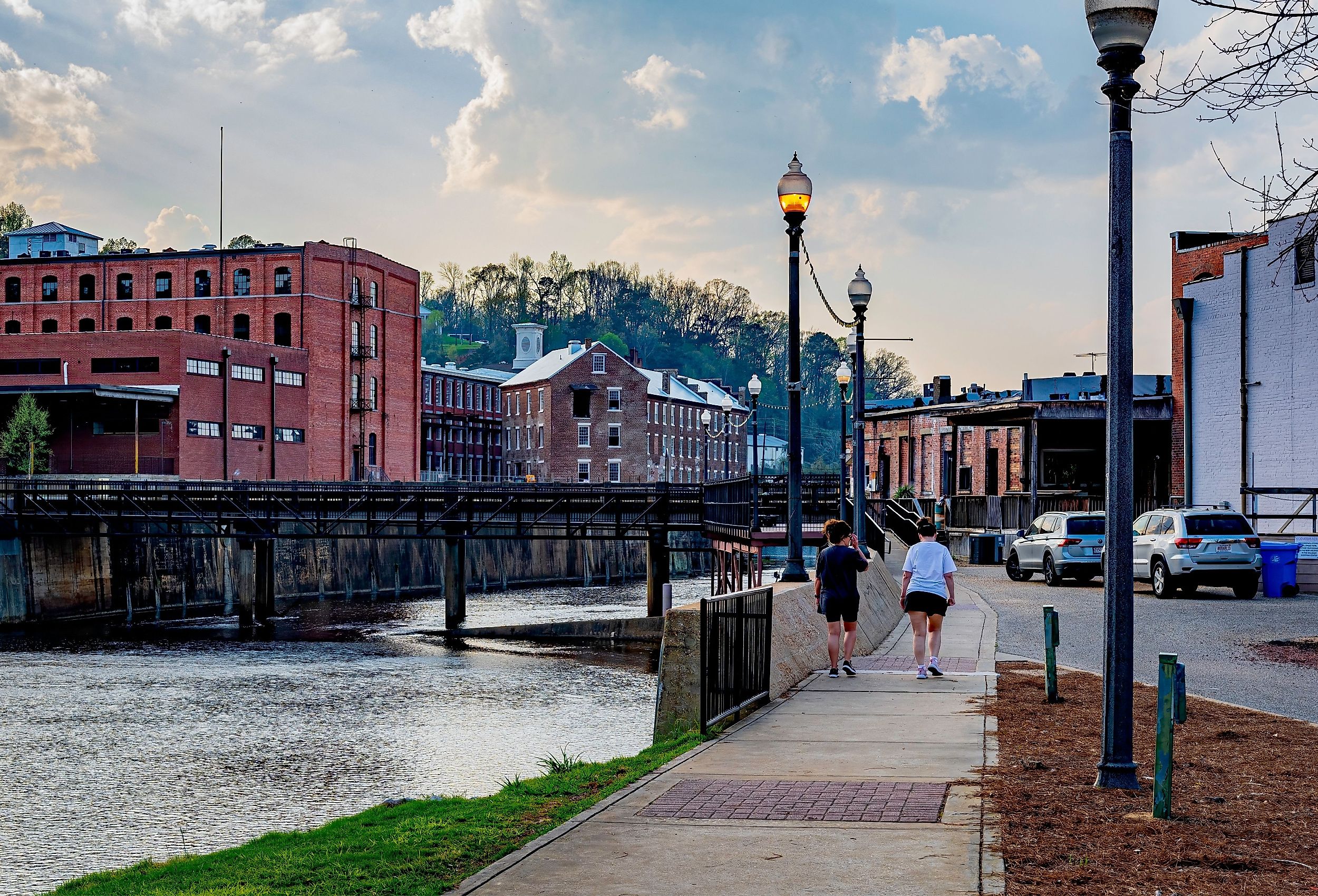
These eight downtowns put their best foot forward across just a few blocks, featuring riverside walks and historic landmarks. Court Street carries you through the middle of downtown Florence, with Wilson Park a block away and the earthen mound a straight walk south. In Tuscumbia, the commercial blocks end at Spring Park, where Cold Water Falls is illuminated by a light show after dark. Wetumpka fits its entire commercial historic district along the few blocks of Company Street between Spring Street and the Coosa River bridge. Fairhope Avenue slopes toward Mobile Bay, with the municipal pier and waterside park providing ample space for an extended stroll. These are the eight most walkable town centers in Alabama.
Florence

Downtown Florence centers on Court Street. A block off it on North Seminary Street, Wilson Park surrounds a fountain given to the city in 1934. Every October, that park fills with the Alabama Renaissance Faire, which will celebrate its 40th year in 2026. Farther south along the same street, the Florence Mound reaches 43 feet, the largest domiciliary mound in the Tennessee River Valley. A museum at its base is devoted to Southeastern Native American history and the Trail of Tears. Built in the 1830s as a two room brick house, Pope's Tavern Museum on Hermitage Drive now shows the Slavery in the Shoals exhibition, with an archaeological dig underway on the grounds. The only Frank Lloyd Wright building in Alabama is the Rosenbaum House, toward the river on Riverview Drive, and it still has its original Wright designed furniture.
Tuscumbia

Tuscumbia's commercial blocks work their way toward Spring Park. At the back of it, Cold Water Falls drops 48 feet, the largest man made natural stone waterfall in the world. After dark, a light show plays across the park's fountain. Helen Keller was born at Ivy Green on North Commons Street, and the pump where Anne Sullivan spelled water into her hand still stands in the yard. A play about Sullivan and Keller, The Miracle Worker, reached its 65th season on that lawn in 2026. Four galleries of Alabama and southeastern art fill the Tennessee Valley Museum of Art on North Water Street. Among the objects are the Martin Petroglyph and a 3,000 pound boulder carved with footprints and snakes, set inside a rebuilt bluff shelter.
Opelika

In Opelika, South Railroad Avenue follows the tracks through the Railroad Avenue Historic District, where Courthouse Square serves as the public plaza. More than 5,000 objects from the 19th and 20th centuries fill the Museum of East Alabama on South 9th Street, which represents five counties and charges no admission. Side Track Coffee, farther along the avenue, pairs its coffee with food pop-ups, art shows, and live music. Three blocks north of the tracks, the Northside Historic District is made up of Victorian, Neoclassical and Mission Revival houses of the 1880s through the 1940s. Every December, more than 50 of them get dolled up with vintage Santas and angels for the Victorian Front Porch Tour.
Wetumpka

Only a few blocks of Company Street separate Spring Street from the Coosa River bridge, and the entire commercial historic district lines that stretch. The Wetumpka Impact Crater Discovery Center, also on Company Street, explains the asteroid that struck about 85 million years ago and left a rim nearly five miles across, part of which downtown sits on. A marble model and rocks from the site are on display. Beside the same street, a pocket park called the Fall Line Overlook looks out over the Coosa at the point where the Piedmont drops away to the Coastal Plain. Alabama artists are shown at the Kelly Fitzpatrick Center for the Arts on Hill Street, which also hosts free morning sketch sessions. Behind city hall on South Main Street, Gold Star Park offers a paved riverbank path and a boat launch, with wild kingfishers flying over the water.
Prattville

Autauga Creek cuts straight through Prattville's Daniel Pratt Historic District, about 15 blocks of buildings from the 1840s to the 1930s around Main and Court Streets. Heritage Park, on South Court Street, overlooks the creek dam, the millpond, and Daniel Pratt's old gin works, and has an artesian well to drink from. Paddlers are drawn to the spring-fed creek, which is a certified National Recreation Trail, with a portage route that takes boats through Heritage Park. On foot, the Creekwalk follows it from behind City Hall through Heritage Park and on to Pratt Park. Inside the 1848 McWilliams-Smith-Rice House on East Main Street, the Prattaugan Museum details county history and stores the genealogy archives.
Fairhope

Fairhope Avenue slopes downhill toward Mobile Bay, crossing Section Street in the middle of a historic district built largely in local clay brick. A rebuild of the waterfront, dedicated in March 2026, added new stairs and a ramp down the bluff to the park, making the walk from downtown to the water straightforward. Out over the bay, the Fairhope Municipal Pier reaches 1,448 feet from a 10-acre park with a rose garden and fountain at the top. The Spanish mission-style building that served as the city hall in 1928 now houses the Fairhope Museum of History on North Section Street, whose rooms trace the town's founding, the single-tax colony, and the Mobile Bay Jubilee. Page and Palette has been selling books in town for 60 years, and the store now also includes a coffee shop and a basement bar with live music.
Cullman

Downtown Cullman was built up from the 1880s onward, and the railroad splits it down the middle along First Avenue. The largest timber-framed building in Alabama stands on First Avenue NE, the Festhalle Marktplatz, which hosts the farmers market on Tuesdays, Thursdays, and Saturdays from April into October. Next door, Depot Park serves as the town's front lawn and fills with Oktoberfest at the beginning of October, complete with a parade and three biergartens celebrating the region's German heritage. Over on Second Avenue NE, the Cullman County Museum occupies a replica of founder John G. Cullmann's house, and its eight rooms focus on the original German colony, the pioneer years, and the Civil War.
Homewood

Most of Homewood's shops and restaurants cluster along a few blocks of 18th Street South. Off that same street lies the Rosedale neighborhood, on the National Register for its architecture and for its Black history from 1875 to 1949. One block over, on 19th Street South, the Homewood Theatre at SoHo Square puts on a six-show season of plays and musicals. Homewood Central Park and the public library share Oxmoor Road. The park has paths, an amphitheater, and a playground, while the Ellenburg Art Gallery shows rotating work inside the library. Paved and flat, the Shades Creek Greenway follows Lakeshore Drive past Samford University, and a 1.4-mile extension opened at its western end in 2025. It forms one leg of the Red Rock Trail System, a network stitched together across Jefferson County.
A Slower Way To See Alabama
If you would rather park once and spend the day on foot, these Alabama town centers are built for it. Highlights include a creek path through the middle of Prattville, a beer garden in Cullman in October, a Victorian porch hung with angels in Opelika in December, and the only Frank Lloyd Wright house in the state. Whether you are drawn to a museum, a riverbank or a long lunch downtown, these are Alabama's most walkable town centers.